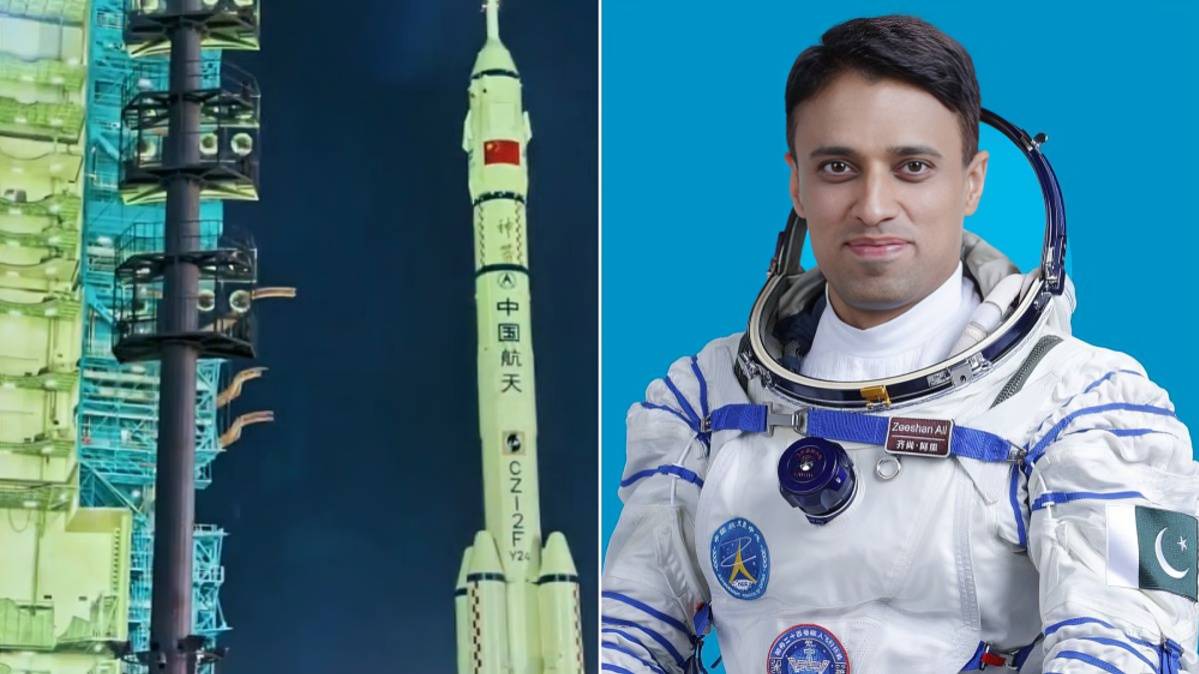
China has reportedly launched its Shenzhou 24 spacecraft carrying a three member crew that includes Pakistani astronaut Muhammad Zeeshan Ali and two Chinese astronauts.
According to the supplied report, the spacecraft lifted off from the Jiuquan Satellite Launch Center in northwestern China on Wednesday.
Muhammad Zeeshan Ali reportedly became the first foreign astronaut to participate in a Chinese crewed mission travelling to the country's space station.
The other crew members are Chinese astronauts Tang Hongbo, aged 51, and Wu Yi, aged 39.
The mission represents a reported milestone in China's crewed space programme and highlights the growing cooperation between China and Pakistan in space science and technology.
Shenzhou 24 Successfully Enters Designated Orbit
Following its launch from the Jiuquan Satellite Launch Center, the Shenzhou 24 spacecraft reportedly separated successfully from its carrier rocket and entered its designated orbit.
The successful orbital insertion represents an important stage in the crewed mission.
Spacecraft travelling to orbital space stations must complete several carefully coordinated procedures before reaching their destination.
These procedures generally include orbital adjustments, communication checks and preparations for docking with the space station.
The supplied report confirms the spacecraft's reported entry into orbit but does not provide details regarding the completion of docking operations.
Further official announcements would establish the crew's arrival at the Chinese space station.
Muhammad Zeeshan Ali Marks Reported Milestone for Pakistan
Muhammad Zeeshan Ali's participation in the Shenzhou 24 mission represents a reported achievement for Pakistan's space exploration efforts.
His inclusion in the crew highlights opportunities for countries to participate in international human spaceflight programmes through scientific and technological partnerships.
Astronauts selected for crewed missions generally undergo extensive physical assessments, technical training and preparations for operating in challenging space environments.
International crew members may also receive training in spacecraft operations, scientific research procedures and emergency preparedness.
However, specific details regarding Ali's professional background, astronaut selection process and responsibilities during the mission were not included in the supplied report.
His reported participation could encourage greater interest in space science and technology among students and researchers in Pakistan.
Chinese Astronauts Tang Hongbo and Wu Yi Join Mission
The Shenzhou 24 crew reportedly includes Chinese astronauts Tang Hongbo and Wu Yi alongside Muhammad Zeeshan Ali.
Tang Hongbo has previously participated in China's crewed space programme and contributed to missions involving the country's space station.
Crewed space missions require astronauts to work together while performing scientific activities, maintaining spacecraft systems and supporting daily operations in orbit.
International missions also require effective communication and coordination among crew members from different professional and cultural backgrounds.
The specific responsibilities assigned to the three astronauts during the Shenzhou 24 mission have not been disclosed in the available information.
China's Tiangong Space Station Supports Scientific Research
China's Tiangong space station serves as an orbital laboratory supporting scientific research, technological development and long duration human spaceflight.
The facility includes the Tianhe core module and the Wentian and Mengtian laboratory modules.
Astronauts aboard the station can conduct research in areas such as space medicine, material science, biology and microgravity.
Scientific experiments conducted in orbit can help researchers understand how different materials, biological organisms and human bodies respond to conditions in space.
The station also supports research into technologies that could contribute to future space exploration programmes.
The reported inclusion of a Pakistani astronaut represents a potential expansion of international participation in China's orbital research activities.
However, the specific scientific experiments planned for the Shenzhou 24 mission remain unconfirmed.
China and Pakistan Expand Space Cooperation
China and Pakistan have maintained cooperation in several scientific and technological sectors, including satellite development, communications and space research.
Pakistan's Space and Upper Atmosphere Research Commission has participated in various space related initiatives involving international partnerships.
Cooperation with countries possessing established space capabilities can provide opportunities for scientific research, technical training and knowledge exchange.
The reported participation of Muhammad Zeeshan Ali in China's crewed space mission represents a further development in bilateral space cooperation.
Such partnerships may support future research programmes and provide additional opportunities for scientists, engineers and astronauts.
Nevertheless, details concerning future joint crewed missions have not been established in the available report.
Importance of Jiuquan Satellite Launch Center
The Jiuquan Satellite Launch Center is one of China's major facilities supporting satellite launches and crewed space missions.
Located in northwestern China, the facility has played an important role in the development of the country's human spaceflight programme.
China has conducted numerous Shenzhou missions from the launch centre as part of its efforts to establish and maintain a permanent presence in low Earth orbit.
The reported Shenzhou 24 launch continues the country's broader programme of crewed space exploration and orbital scientific research.
China's Crewed Space Programme Continues to Develop
China achieved its first independent crewed spaceflight in 2003 when astronaut Yang Liwei travelled into space aboard Shenzhou 5.
Since then, the country has expanded its human spaceflight capabilities through successive missions, orbital laboratories and the development of the Tiangong space station.
These programmes have supported advancements in spacecraft engineering, astronaut training, scientific research and orbital operations.
International participation could introduce additional opportunities for scientific collaboration and knowledge sharing.
According to the supplied report, Shenzhou 24 marks the first joint spaceflight involving Chinese astronauts and a foreign crew member within China's crewed space programme.
Growing International Cooperation in Space Exploration
International cooperation has become an important component of modern space exploration.
Countries frequently collaborate on satellite missions, scientific experiments, astronaut training and the development of space technologies.
Joint crewed missions can provide participating nations with access to specialised research facilities and opportunities to develop technical expertise.
They can also encourage educational initiatives and promote greater public interest in science, technology, engineering and mathematics.
The reported Shenzhou 24 mission highlights the potential for expanding international participation in China's human spaceflight programme.
For Pakistan, the mission could represent an important step towards greater involvement in crewed space research and exploration.
Attention Turns to Shenzhou 24 Mission Progress
The reported launch of Shenzhou 24 carrying Muhammad Zeeshan Ali, Tang Hongbo and Wu Yi has brought attention to China's expanding space programme and its cooperation with Pakistan.
The spacecraft reportedly entered its designated orbit successfully following its launch from the Jiuquan Satellite Launch Center.
Attention now turns to the spacecraft's docking with the Tiangong space station and the scientific activities planned for the crew.
Further official announcements are expected to provide information regarding mission duration, astronaut responsibilities and research objectives.
If officially confirmed, the mission would represent a significant milestone in China Pakistan space cooperation and international participation in China's crewed space programme.