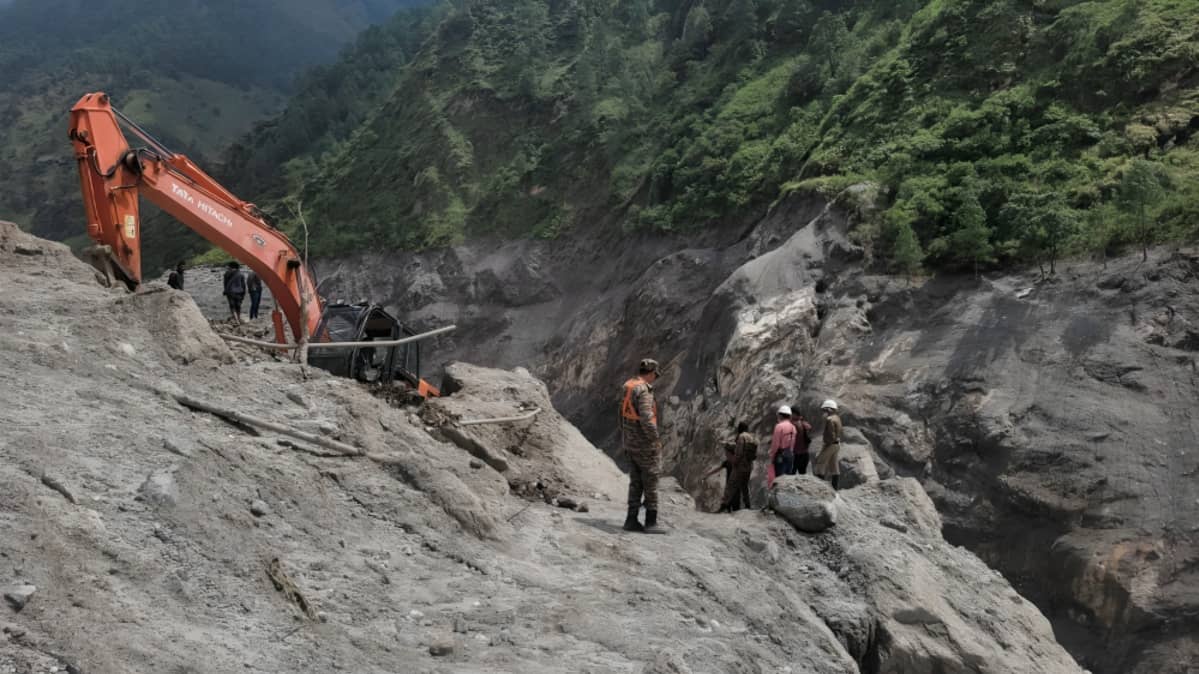
Nepal has ended its non essential search and rescue operation following the devastating floods that struck the country on August 26, 2026. Forty days after the disaster, authorities have confirmed 1,455 deaths, while 5,285 people remain missing. The latest figures also show that 189 Indian nationals are among those still unaccounted for.
The decision marks a major change in Nepal's response to one of the country's most devastating recent natural disasters. Authorities are now shifting their main focus from large scale search operations to reconstruction, rehabilitation and long term recovery in the affected areas.
The floods were associated with the Bhotekoshi Trishuli river system and affected several areas of Nepal after the August 26 disaster. The flooding caused extensive destruction to homes, roads, bridges, farms, settlements and hydropower infrastructure. According to Nepalese authorities, 13,795 people were rescued during the emergency response.
The National Council for Disaster Risk Reduction and Management decided to wind up the 40 day search and rescue operation, except for essential activities. The meeting was chaired by Nepal Prime Minister Balendra Shah and followed recommendations from district security and disaster management authorities, the National Disaster Risk Reduction and Management Authority and field inspection teams.
Officials have stressed that ending the active search does not mean all emergency assistance will stop. Dharam Raj Uprety, chief of the National Disaster Risk Reduction and Management Authority, said authorities would no longer conduct active searches specifically for bodies but would recover remains, property and valuables if they are discovered during rehabilitation and reconstruction work. Emergency rescue operations will also continue if new situations require immediate intervention.
The large number of people still missing remains one of the most difficult aspects of the disaster. With 5,285 people still unaccounted for, families face continued uncertainty over the fate of their relatives.
Nepalese authorities are also considering the legal procedures required to declare missing people deceased. Such procedures could allow families to complete important insurance, banking and other legal formalities. Officials have indicated that the necessary administrative process will be followed before such declarations are formally made.
The number of missing foreign nationals has also drawn attention. According to the latest reported figures, 606 foreign tourists from 36 countries were among those missing. Indian nationals represented the largest group of missing foreign tourists, with 189 people reported unaccounted for. American, Malaysian, Ukrainian, Chinese, Australian, Latvian, British and Canadian nationals were also among those reported missing.
The figures from India have particularly concerned families in several states. Separately compiled information cited by the Times of India indicated that people from Tamil Nadu, West Bengal, Gujarat, Telangana, Uttar Pradesh, Karnataka, Andhra Pradesh, Bihar, Maharashtra and Odisha were among those reported missing.
Tamil Nadu accounted for the largest number in that statewise compilation, with 85 people reported missing. West Bengal was next with 37, followed by Gujarat with 30, Telangana with 25 and Uttar Pradesh with 22. Karnataka and Andhra Pradesh each had 13 reported missing, while Bihar had 12. These figures are part of separately compiled state information and may continue to change as authorities verify identities and records.
The disaster has also created a major financial challenge for Nepal. Authorities have said that the country will require substantial funding for early recovery, reconstruction and rehabilitation. The National Council recommended approval of NPR 559.17 billion for 504 reconstruction and rehabilitation plans submitted by various ministries and government agencies.
The proposed reconstruction programmes are expected to cover damaged infrastructure and support communities affected by the floods. Roads, bridges, farms, settlements and hydropower projects were among the facilities damaged or destroyed during the disaster.
The government is also expected to strengthen disaster preparedness and early warning systems. The scale of the August floods has highlighted the vulnerability of communities living near rivers and mountainous areas, particularly in regions where sudden flooding can cause widespread destruction within a short period.
Nepal's disaster response had involved large numbers of security personnel, rescue teams and helicopters during the early stages. In the first days after the disaster, the government mobilised security forces and worked with international partners to locate missing people and rescue those trapped in affected areas. Earlier official updates had stressed that casualty and missing person figures could change as search and verification operations continued.
The latest decision represents a transition from an emergency response to a long term recovery programme. While active searches have been reduced, authorities have not completely closed the possibility of recovering remains or personal belongings. Any discoveries made during reconstruction work are expected to be handled by the relevant authorities.
The disaster has also raised concerns about future flood risks in Nepal. In a separate development, the country has announced plans to reduce the risk posed by several high altitude glacial lakes. The proposed project involves four lakes considered potentially dangerous and is intended to reduce the possibility of future flooding. The initiative includes plans for controlled drainage, monitoring sensors and flood forecasting systems.
The August disaster has therefore created challenges extending well beyond the immediate loss of life. Thousands of families are still waiting for information about missing relatives, while communities affected by the floods face the difficult task of rebuilding homes, infrastructure and livelihoods.
For Indian families whose relatives remain missing, the latest decision by Nepal's authorities is likely to bring both concern and a need for further official information. The identification process and administrative procedures may take time, particularly where records are incomplete or victims were travelling in remote areas.
Nepal's authorities now face the task of coordinating reconstruction across federal, provincial and local governments while managing the needs of displaced communities. Officials have said available resources and manpower will be mobilised to accelerate disaster management and recovery work.
The end of the active search operation does not reduce the scale of the tragedy. With 1,455 confirmed deaths and 5,285 people still missing, the disaster remains a major humanitarian challenge for Nepal. The focus has now moved towards rehabilitation, reconstruction, assistance to affected families and measures aimed at reducing the impact of similar disasters in the future.