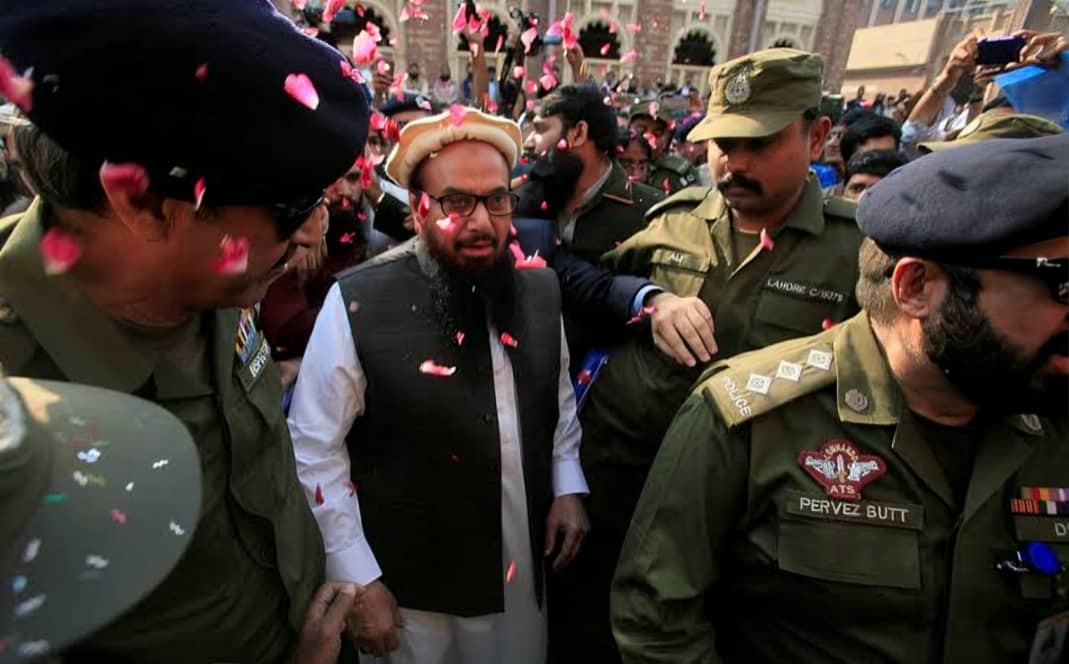
A fresh controversy has emerged in Pakistan following a reported speech by a Pakistani cleric in which allegations were made about Lashkar e Taiba founder Hafiz Saeed and militant activities linked to Kashmir.
According to reports circulating online, the cleric claimed that Hafiz Saeed had sent around 10,000 militants to Kashmir. The allegation has attracted attention because of the longstanding international scrutiny surrounding Saeed and Lashkar e Taiba, an organisation designated as a terrorist group by several governments.
The reported claim has also renewed discussion about the relationship between Pakistan based militant organisations and the broader Kashmir conflict. For decades, militant groups operating from or associated with Pakistan have been a major issue in India Pakistan relations and have been the subject of international security investigations.
However, the specific claim that Hafiz Saeed personally sent 10,000 militants to Kashmir has not been independently verified through reliable primary documentation available in the sources reviewed for this report. The number should therefore be presented as an allegation made by the cleric rather than as an established fact.
The reported remarks have gained attention partly because of their potential implications for understanding the scale of militant mobilisation connected to Kashmir. Claims regarding the recruitment, training and movement of militants have historically been politically sensitive and are often disputed by the parties involved.
Hafiz Saeed is a prominent figure associated with Lashkar e Taiba. He was designated by the United Nations Security Council under its sanctions regime in connection with terrorism related activities. He has also faced legal proceedings in Pakistan.
Lashkar e Taiba has been accused of involvement in numerous attacks, including the 2008 Mumbai terror attacks. The organisation and its leadership have been the subject of extensive international counterterrorism measures.
The latest allegation therefore comes against an established background of international concern regarding Pakistan based militant networks. It has also prompted renewed discussion about whether militant organisations have historically received support, protection or logistical assistance from elements within Pakistan.
However, claims concerning links between militant groups and state institutions require independent evidence. Political statements, speeches and social media posts alone cannot establish the accuracy of such allegations.
The reported remarks have also generated renewed attention to the wider Kashmir issue. India has consistently raised concerns about cross border terrorism and militant infiltration from Pakistan, while Pakistan has rejected India's accusations and maintains its own position on the Kashmir dispute.
The Kashmir conflict has remained one of the most sensitive issues between the two nuclear armed neighbours. Militant violence has added another layer of complexity to the political and security situation in the region.
In recent years, international agencies and governments have continued to monitor organisations and individuals associated with terrorism financing and militant activity in South Asia. Financial sanctions, travel restrictions and asset freezes have been imposed against several individuals linked to designated terrorist organisations.
The latest reported statement is therefore being viewed in the context of this broader security environment. If independently verified, detailed evidence about the recruitment or movement of militants could have implications for assessments of militant networks and their historical operations.
At present, however, the reported claim should be treated with caution. The exact identity and organisational position of the speaker, the context of the remarks and the evidence supporting the figure of 10,000 militants require further verification.
It is also important to distinguish between a political or religious speech and independently established evidence. Statements made by individuals connected to militant or political movements can reflect their own perspectives and may not necessarily represent verified historical records.
The controversy nevertheless highlights the continuing sensitivity surrounding militant organisations and the Kashmir conflict. Any credible evidence concerning the recruitment, training or deployment of militants would be relevant to international counterterrorism assessments.
For readers, the most important point is that the reported figure of 10,000 should not be presented as a confirmed number without independent corroboration. The allegation has generated attention, but further credible evidence is required to establish its accuracy.
The development is likely to remain under scrutiny as more information emerges about the reported speech and the identity of the individual who made the claim