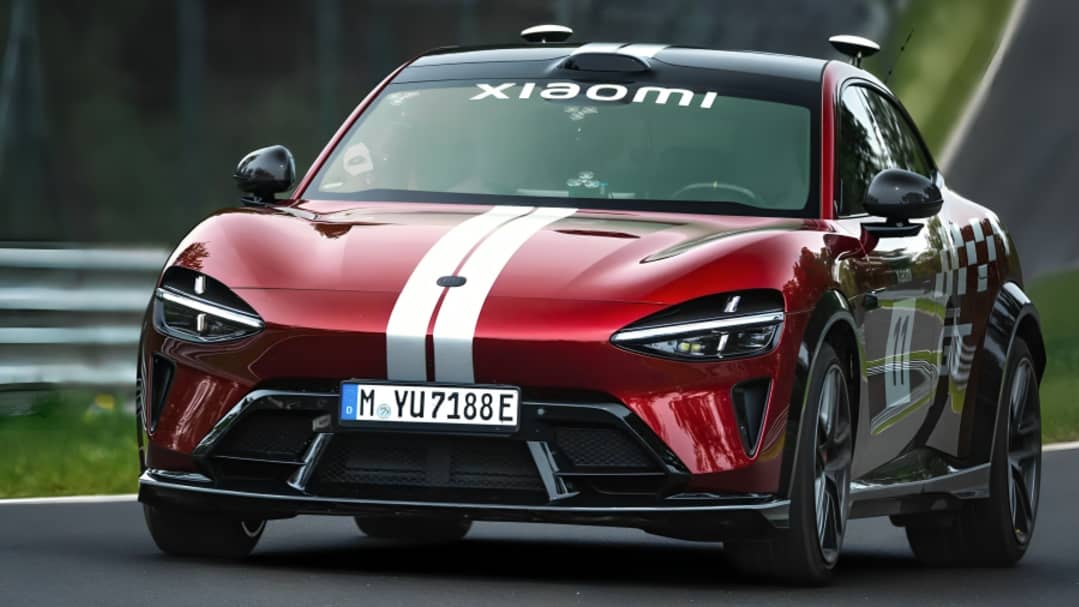

Xiaomi has achieved a significant milestone in the field of autonomous driving technology with its YU7 GT performance electric SUV reportedly completing a full lap of the Nürburgring Nordschleife circuit without a human driver behind the wheel. The accomplishment marks an important step forward in the development of intelligent vehicle systems and showcases the increasing sophistication of artificial intelligence in the automotive sector.
According to reports, the Xiaomi YU7 GT equipped with the Track Package successfully navigated the entire 20.8-kilometre Nürburgring Nordschleife circuit autonomously, recording a lap time of 10 minutes and 29.483 seconds. The achievement is being viewed as a notable demonstration of how advanced driver assistance and autonomous technologies continue to evolve beyond traditional road-driving applications.
The Nürburgring Nordschleife, often referred to as one of the most challenging racing circuits in the world, is located in Germany and is widely regarded as a benchmark for vehicle performance testing. The circuit features numerous corners, elevation changes, varying road surfaces, and demanding driving conditions that require high levels of precision and control. Successfully completing a lap without human intervention represents a major technological accomplishment.
Autonomous driving systems rely on a combination of sensors, cameras, radar, artificial intelligence software, and high-performance computing systems. These technologies enable vehicles to interpret their surroundings, make real-time decisions, and adjust driving behaviour according to road conditions and environmental factors.
Industry experts note that autonomous driving on a race circuit presents unique challenges compared to everyday road use. High speeds, rapid cornering, changing track conditions, and the need for precise vehicle control require sophisticated algorithms capable of processing large amounts of data in real time.
The achievement highlights the growing role of artificial intelligence in modern transportation. AI-powered systems are increasingly being used to improve safety, enhance efficiency, and support advanced vehicle functions. Autonomous technology developers continue to invest heavily in research aimed at creating systems that can operate reliably in a wide range of driving environments.
Xiaomi's expansion into the automotive sector has attracted considerable attention in recent years. Known globally for its consumer electronics and smart devices, the company has made significant investments in electric vehicle development as part of its broader technology ecosystem strategy. The YU7 GT forms part of Xiaomi's efforts to establish itself as a competitive player in the rapidly growing electric vehicle market.
The global automotive industry is undergoing a period of significant transformation driven by electrification, connectivity, automation, and artificial intelligence. Manufacturers around the world are competing to develop vehicles that offer advanced technological capabilities while meeting evolving consumer expectations and regulatory requirements.
Autonomous driving remains one of the most ambitious goals within the industry. While many vehicles currently offer advanced driver assistance features, fully autonomous operation under all conditions remains a complex challenge. Testing autonomous systems in demanding environments such as the Nürburgring helps engineers evaluate performance, reliability, and safety under extreme conditions.
Researchers believe that breakthroughs achieved through performance testing can contribute to improvements in everyday vehicle technology. Lessons learned from autonomous track driving may eventually support safer navigation systems, enhanced collision avoidance features, and more advanced driver assistance capabilities for consumer vehicles.
The successful driverless lap also reflects broader progress in artificial intelligence, machine learning, and sensor technology. These innovations are enabling vehicles to process information faster and respond more effectively to dynamic situations.
As autonomous vehicle development continues worldwide, milestones such as the Xiaomi YU7 GT's Nürburgring achievement demonstrate the rapid pace of innovation within the automotive sector. While widespread adoption of fully autonomous vehicles will require further testing, regulatory approval, and technological refinement, achievements of this nature highlight the potential future of intelligent mobility.
The accomplishment is expected to generate further interest in the capabilities of autonomous electric vehicles and contribute to ongoing discussions about the future of transportation technology.