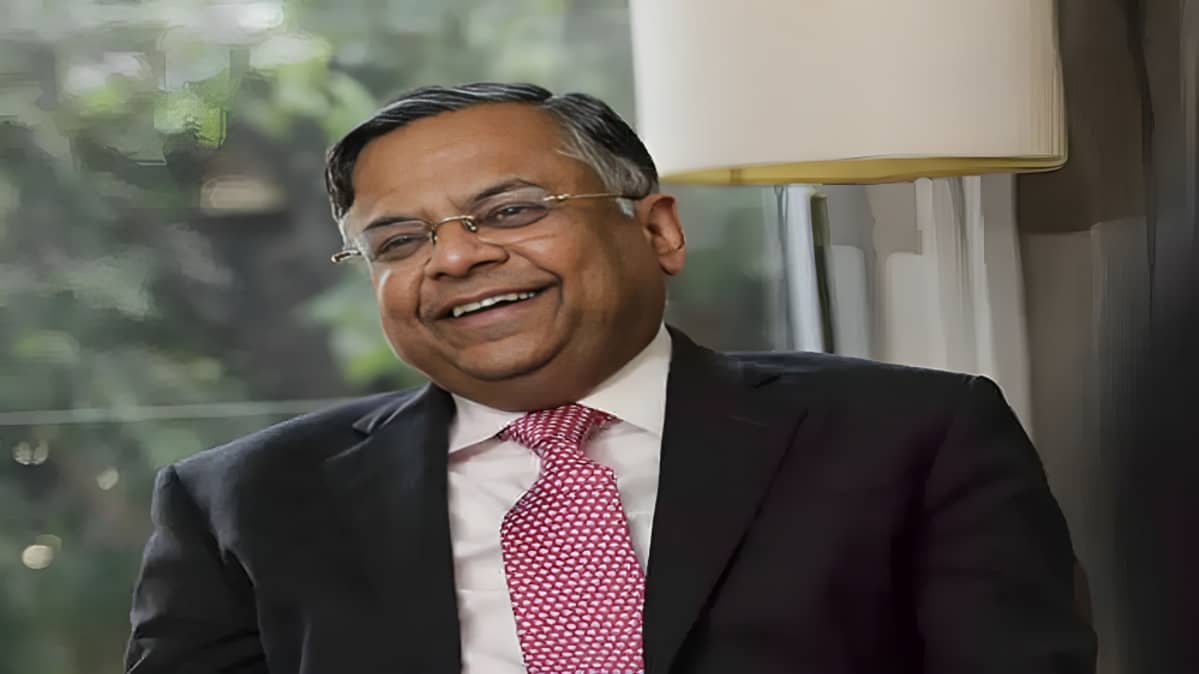
Tata Sons Chairman N Chandrasekaran has said that India’s economy remains robust and in a stable position despite continued uncertainty in the global economic environment.
Speaking at the Indian Foundation for Quality Management Symposium 2026, Chandrasekaran said several economic indicators point to resilience and argued that India has continued to perform strongly despite difficult international conditions. His assessment comes at a time when economies around the world are dealing with geopolitical tensions, changing trade conditions, financial market volatility and energy price risks.
According to Chandrasekaran, three major factors are supporting India's economic performance. These include strong domestic demand, services exports and an enabling policy environment.
He pointed to demand growth across sectors such as automobiles, credit, power and cement as evidence that economic activity remains strong. These indicators, he said, show that domestic consumption and investment continue to provide support to the wider economy.
Chandrasekaran also highlighted India's external economic position. He said the country's current account deficit has remained consistently below one percent of GDP, while services exports account for about 11 percent of GDP. He also cited strong foreign exchange reserves and healthy bank non performing asset levels as indicators supporting his view that the economy is in a stable and strong position.
His comments come against a backdrop of significant uncertainty in the global economy. Recent government assessments have warned that geopolitical tensions, elevated crude oil prices and tighter global financial conditions could create risks for India's inflation, currency and capital flows. At the same time, the Finance Ministry has noted that domestic economic activity, exports, capital inflows and foreign exchange reserves remain important sources of resilience.
Chandrasekaran therefore stressed that maintaining India's growth momentum will require continued attention to structural priorities rather than relying only on current economic strength.
He identified energy security as one of the most important requirements for long term growth. India remains a major energy importer, making international energy prices and global supply disruptions important factors for the domestic economy. Strengthening energy security can help reduce vulnerability to external shocks and provide greater stability for businesses and consumers.
The Tata Sons chairman also highlighted the need to create more advanced and precision manufacturing jobs. He argued that India needs to move beyond assembly-based manufacturing and develop deeper capabilities across the manufacturing value chain.
According to Chandrasekaran, the country needs stronger capabilities in areas including engineering, research and development, precision manufacturing, standards and supplier ecosystems. Developing these capabilities would help Indian companies become more competitive internationally while also creating higher-productivity employment opportunities.
He referred to countries such as Germany as examples of economies that built competitive advantages through engineering, quality, precision and strong supplier networks. He also cited Toyota as an example of a company that used quality not simply as an end result but as a driver of innovation, productivity and competitiveness.
Chandrasekaran said India needs a similar transformation in its manufacturing sector. He called for quality, innovation, productivity and competitiveness to become central elements of India's manufacturing ambitions.
Another major priority identified by him was investment in human capital. As India expands its manufacturing and services capabilities, the availability of skilled workers will become increasingly important.
Investment in education, training and skill development can help prepare workers for higher-value industries and advanced manufacturing roles. Chandrasekaran linked human capital development to India's broader ambition of achieving sustained economic growth.
He also connected these priorities with the Viksit Bharat 2047 vision. According to Chandrasekaran, achieving that long term objective will require inclusive and sustainable development supported by world-class infrastructure, strong institutions and intellectual property.
The emphasis on intellectual property is particularly relevant as India seeks to strengthen its position in technology-intensive industries. Building domestic capabilities in research, innovation and product development could allow Indian companies to compete more effectively in global markets.
Chandrasekaran also called for sustainable manufacturing to become part of India's broader industrial strategy. He said sustainability should be integrated into manufacturing processes alongside quality and productivity.
His comments suggest that India's next phase of economic growth will need to focus not only on increasing output but also on improving the quality and competitiveness of production.
The services sector remains another important part of India's economic strength. Chandrasekaran pointed to services exports as a significant contributor to the country's external position. India's established position in information technology, business services and other professional services has helped generate foreign exchange and support economic activity.
At the same time, expanding manufacturing could provide another important source of growth and employment. Developing a stronger manufacturing ecosystem could create opportunities for large companies as well as micro, small and medium enterprises.
Chandrasekaran said India's manufacturing transformation should not be limited to large corporations. A stronger middle-tier and supplier ecosystem would also be required to build competitive supply chains and develop specialised expertise.
The economic outlook nevertheless remains subject to external risks. Higher energy prices, geopolitical tensions and changes in global financial conditions can affect inflation, investment flows and the value of the Indian rupee. The Finance Ministry's recent economic review has highlighted these risks while also noting India's underlying resilience.
This makes Chandrasekaran's emphasis on energy security particularly significant. Reducing vulnerability to external energy shocks could help protect economic stability when international markets become volatile.
For businesses, a stable domestic market combined with strong infrastructure and supportive policies could provide opportunities for further investment. However, sustained growth will also depend on productivity improvements, innovation and the ability of Indian companies to compete globally.
Chandrasekaran's comments also underline the importance of balancing immediate economic performance with long term structural reforms. Strong domestic demand can support growth in the short term, while investments in manufacturing, skills, infrastructure and innovation can help strengthen the economy over a longer period.
India's economic performance has remained resilient in recent years, but global conditions continue to present challenges. Trade disruptions, geopolitical developments, commodity prices and changes in international interest rates can all influence India's economic trajectory.
Against this backdrop, Chandrasekaran said India's current position remains strong while identifying areas that require continued attention. Energy security, advanced manufacturing employment and human capital, according to him, will be critical for sustaining growth over the long term.
The remarks come as India continues to position itself as one of the world's major growth economies. The combination of a large domestic market, expanding services exports, increasing manufacturing ambitions and infrastructure development provides a broad base for future expansion.
However, achieving sustained growth will require continued investment and improvements in productivity and competitiveness. Chandrasekaran's comments therefore focus not only on India's present economic resilience but also on the structural changes needed to maintain that resilience.
For now, his assessment is that India's economy remains robust and stable despite a difficult global environment. Strong domestic demand, services exports and supportive policy conditions continue to provide important support, while foreign exchange reserves, external stability and banking-sector health offer additional buffers.
The challenge ahead will be to convert this resilience into sustained and inclusive growth. Chandrasekaran believes that stronger energy security, advanced manufacturing, skilled employment, innovation, quality and human capital development will be central to that effort.