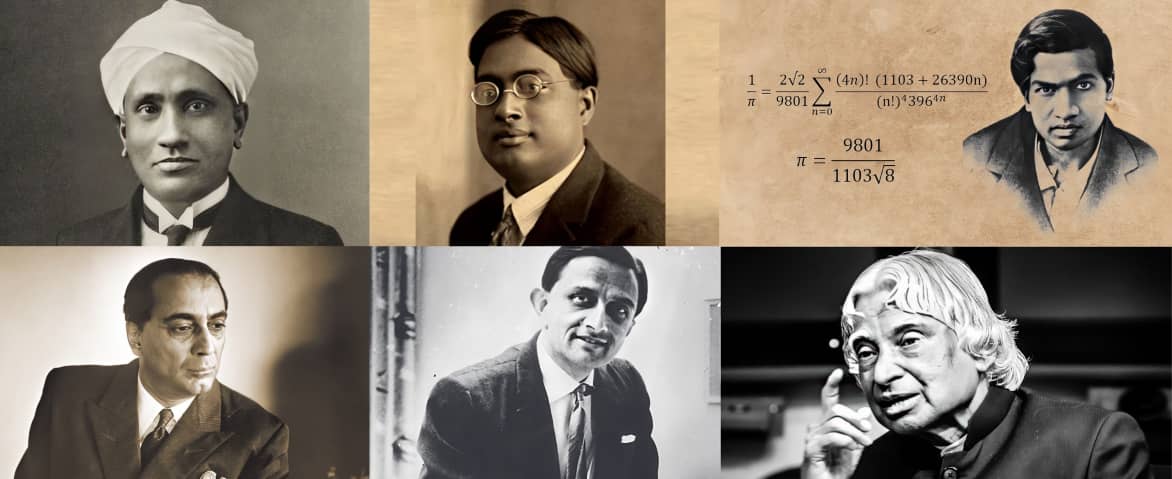
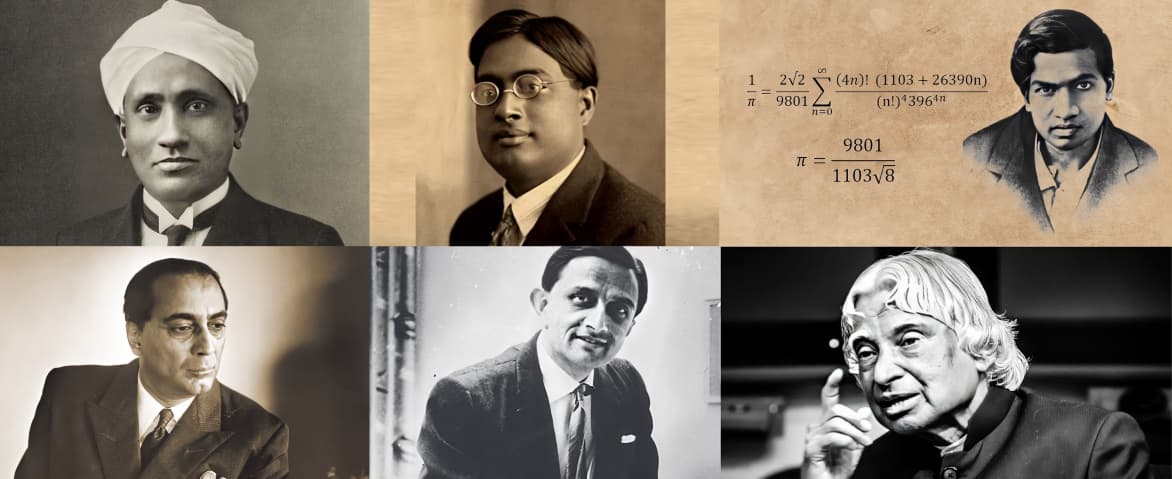
India has a rich history of scientific innovation, producing pioneers whose work has had a lasting impact globally. Five Indian scientists in particular stand out for transforming science and technology, inspiring generations, and shaping research across multiple disciplines.
C. V. Raman
Sir Chandrasekhara Venkata Raman, widely known as C. V. Raman, became the first Asian to win a Nobel Prize in Physics in 1930. He is celebrated for the discovery of the Raman Effect, which describes how light changes wavelength when passing through transparent materials. This groundbreaking discovery in light scattering provided new insights into molecular structures and optical physics. Raman’s work not only established India on the global scientific map but also continues to influence optics, photonics, and material science research worldwide. National Science Day on February 28 commemorates his discovery.
Homi J. Bhabha
Known as the father of India’s nuclear programme, Homi Jehangir Bhabha was instrumental in establishing atomic research and nuclear energy initiatives in India. He founded the Tata Institute of Fundamental Research (TIFR) and led efforts to advance India’s scientific capabilities in nuclear physics. Bhabha’s vision positioned India as a contributor to global nuclear research and enabled participation in international scientific forums. His work laid the groundwork for peaceful nuclear energy applications while also strengthening India’s defence research framework.
Venkataraman Radhakrishnan
Venkataraman Radhakrishnan was a pioneering astrophysicist and space scientist who made notable contributions to understanding galaxies, cosmic radiation, and celestial structures. As a member of the Royal Swedish Academy of Sciences, Radhakrishnan designed ultralight aircraft for observational research, enhancing techniques in radio astronomy and space exploration. His theoretical insights and practical contributions expanded knowledge about the universe and inspired advancements in global astrophysics and aerospace research.
Satyendra Nath Bose
Satyendra Nath Bose’s work in quantum mechanics reshaped modern physics. He introduced novel statistical methods for understanding photons, now known as Bose-Einstein statistics. In 1924, he sent his research to Albert Einstein, who recognized its significance and helped publish it in Europe. Bose’s contributions laid the foundation for quantum theory, particle physics, and Bose-Einstein condensates, influencing countless research areas and establishing him as a cornerstone of modern scientific understanding.
A. P. J. Abdul Kalam
Dr. Avul Pakir Jainulabdeen Abdul Kalam, former president and aerospace engineer, played a crucial role in India’s missile development programme. Working with DRDO and ISRO, Kalam led projects that developed key missiles like Agni and Prithvi, strengthening India’s defence capabilities. His leadership in space and missile research also spurred innovations in satellite technology and aerospace engineering globally. Beyond his scientific contributions, Kalam inspired millions with his vision of education, innovation, and the transformative power of knowledge.
Together, these scientists exemplify India’s contributions to global scientific progress. From light physics and nuclear research to space exploration, quantum mechanics, and missile technology, their discoveries continue to influence modern science, defence, energy, and technology, inspiring both national pride and international admiration.