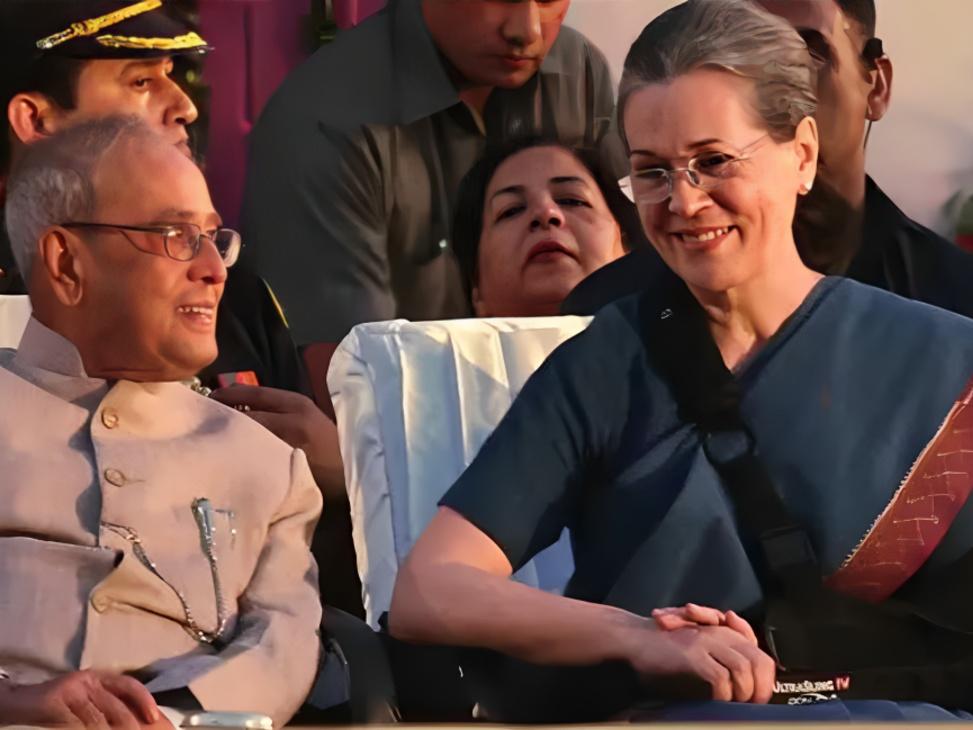
A political discussion has emerged following Congress leader Sonia Gandhi's account of a conversation with former President Pranab Mukherjee in her newly released memoir. Mukherjee's daughter, Sharmistha Mukherjee, has defended her father's ambition to become India's Prime Minister, questioning why his political aspirations should have surprised Sonia Gandhi.
In a post on social media platform X on November 10, Sharmistha responded to the remarks in Sonia Gandhi's memoir, Belonging: A Journey of Love. She argued that her father's ambition was supported by decades of experience in politics and governance, along with hard work and intellectual ability.
Questioning Sonia Gandhi's reaction, Sharmistha asked whether it was a crime for a politician to be ambitious. She also highlighted that her father had risen from a humble background through his own efforts and achievements, without receiving political positions through family connections.
Sharmistha Mukherjee Questions Sonia Gandhi's Reaction
In her response, Sharmistha questioned why Sonia Gandhi was surprised by the possibility that Pranab Mukherjee wanted to become Prime Minister.
She said that her father's political ambition was backed by his long experience in public life, his understanding of governance and his contribution to the country. According to her, there was nothing unusual about a senior political leader aspiring to occupy the country's highest executive office.
Sharmistha also recalled a personal conversation with her father in which she directly asked him whether he wanted to become Prime Minister. She said that Pranab Mukherjee had responded candidly that any politician worth his salt would have such an ambition.
Through this recollection, she sought to explain that her father's aspiration was not something unusual or inappropriate. Instead, she presented it as a natural ambition for someone who had spent decades in public service and held several important responsibilities in the Union government.
She Highlights Her Father's Rise Through Hard Work
A major part of Sharmistha's response focused on her father's political journey and humble beginnings.
She stated that Pranab Mukherjee had achieved his position through merit, dedication and years of hard work. According to her, he was not handed important political positions because of family connections or dynastic privilege.
She questioned whether Sonia Gandhi's surprise was connected to the possibility that someone outside the Gandhi-Nehru family could aspire to become Prime Minister and express that ambition directly.
Her remarks brought the issue of political opportunity and leadership aspirations into the discussion. However, her response was primarily a defence of her father's right to have political ambitions, rather than an announcement about any political disagreement or renewed dispute between the families.
Sharmistha also addressed Sonia Gandhi's observation that Pranab Mukherjee had never made her feel that he resented her response to their conversation. Referring to her father's personal diaries and her own conversations with him, she said he did not hold the matter against Sonia Gandhi or anyone else.
She described her father as a pragmatic person who understood the reasons behind other people's decisions. Her statement suggested that he had accepted the situation without allowing the episode to affect his relationship with Sonia Gandhi.
What Sonia Gandhi Revealed in Her Memoir
The discussion began after Sonia Gandhi described an interaction with Pranab Mukherjee in 2010 in her memoir, Belonging: A Journey of Love, released on November 10, 2026.
In the book, she recalled that Mukherjee had developed serious differences with the then Finance Minister, P. Chidambaram. During one conversation, after expressing his frustration, Mukherjee reportedly suggested that it might be time for a change at the top.
Sonia Gandhi interpreted the remark as an indirect indication of Mukherjee's long-standing desire to become Prime Minister. She wrote that the suggestion surprised her and that she understood it as a hint about his political ambition.
According to her account, she chose to change the subject rather than continue the discussion. She also recalled that although Mukherjee might have been disappointed, he never made her feel that he held her response against her.
The memoir provides Sonia Gandhi's personal recollection of the conversation. Sharmistha's response offers her own understanding of her father's ambitions and his attitude towards the episode.
Pranab Mukherjee's Role in the UPA Government
At the time of the reported 2010 conversation, Manmohan Singh was serving as Prime Minister, and the Congress-led United Progressive Alliance government was in its second term.
Pranab Mukherjee was among the most senior leaders in the Congress and had held several important positions in the Union government. His responsibilities included the portfolios of Defence, External Affairs and Finance.
His long political career and administrative experience made him one of the influential figures in the Congress leadership. He was also closely involved in discussions and coordination between the government and the party.
The Prime Ministerial position was one of the highest offices in Indian politics, and Mukherjee's experience in government made his political aspirations a subject of interest. However, Sonia Gandhi's account does not establish that any formal proposal was made to replace Manmohan Singh or that a leadership change was officially considered.
In 2012, the Congress-led UPA nominated Pranab Mukherjee as its candidate for the presidential election. He won the election and became the 13th President of India, serving from 2012 to 2017. He remained in public life as a respected political figure until his death in August 2020.
Sonia Gandhi's Memoir Reopens Discussion About Congress Leadership
Sonia Gandhi's memoir has drawn attention to several aspects of her political life and her interactions with senior Congress leaders. Her recollection of the conversation with Pranab Mukherjee has become one of the prominent talking points following the book's release.
The account has also renewed discussion about the internal dynamics of the Congress during the UPA years, particularly the relationship between senior leaders and the party's central leadership.
Sharmistha Mukherjee's response has added another perspective to the discussion. While Sonia Gandhi described how she interpreted her former colleague's remarks, his daughter has emphasised that his ambition was understandable given his experience and achievements.
The exchange has attracted attention because Pranab Mukherjee was a senior Congress leader who later became President of India. It also highlights the different personal recollections and interpretations that can emerge when political events from the past are discussed in memoirs.
For now, Sharmistha's response remains a defence of her father's political ambition and a clarification of his attitude towards Sonia Gandhi. The discussion is based on the memoir's account of a private conversation and the response subsequently shared by his daughter.