Ladakh Leader Tashi Gyalsan Urges India to Rename Aksai Chin as Aksai Hind
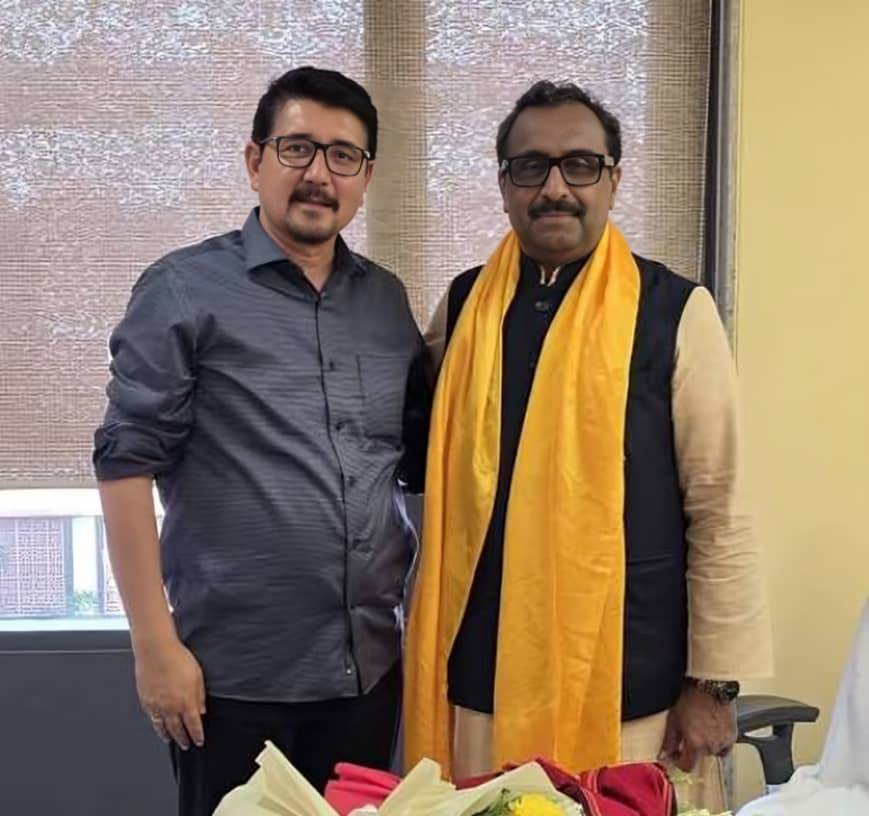
Former Chief Executive Councillor of the Ladakh Autonomous Hill Development Council in Leh, Tashi Gyalsan, has urged the Indian government to rename Aksai Chin as “Aksai Hind”. His demand comes amid renewed diplomatic tensions between India and China over Ladakh’s status as a Union Territory and competing territorial claims along the Himalayan border.
Gyalsan criticised Beijing’s objections to Ladakh’s administrative status and maintained that the region is an integral part of India. He also called on China to respect India’s position on the disputed border areas.
Gyalsan calls for a change in the name
Reacting to China’s latest statements on Ladakh, Gyalsan said the Indian government should stop referring to the territory under Chinese control as Aksai Chin and instead call it Aksai Hind.
He argued that the name should reflect India’s territorial claim over the area. Describing the region as disputed territory under Chinese control, Gyalsan said India should use a name that, in his view, better represents its position.
His proposal is a demand made by a political leader and does not mean that an official renaming has taken place. Any formal change to official geographical names would require action by the relevant authorities.
Gyalsan also criticised China for questioning Ladakh’s status as a Union Territory of India. He maintained that Ladakh could not be separated from India and described Beijing’s statements as unacceptable.
Background to the India-China disagreement
The latest exchange follows China’s objection to India’s decision to standardise the names of 28 geographical locations and features in Ladakh.
On October 2, 2026, the Union Home Ministry announced that the names had been identified in consultation with the Ladakh administration and local stakeholders. The names were incorporated into official Survey of India maps to improve the identification of geographical features and public awareness.
The locations include mountains, peaks, passes, valleys, glaciers, rivers and other geographical features. Some are in strategically sensitive areas near the Line of Actual Control, the boundary separating areas administered by India and China.
China subsequently criticised India’s move. Chinese Foreign Ministry spokesperson Mao Ning said Beijing did not recognise the Union Territory of Ladakh and opposed India’s decision to standardise the place names.
China maintained that India’s actions could not alter its territorial claims in the western sector of the China-India boundary. India rejected those objections and reiterated its position that Ladakh is an integral and inalienable part of the country.
India reiterates its position
India’s Ministry of External Affairs responded to China’s objections by reaffirming that Ladakh is an integral part of India. Ministry spokesperson Randhir Jaiswal said that China’s denial would not change India’s established position.
The ministry also explained that the standardisation exercise was intended to ensure accurate identification of locations and improve public awareness. It said the names had been finalised in consultation with the Union Territory administration and local stakeholders.
The disagreement over geographical names is part of a broader pattern of competing claims along the India-China border. Both countries have previously announced standardised names for locations in areas they claim, leading to diplomatic exchanges.
India has rejected China’s attempts to rename places in areas claimed by New Delhi, while Beijing has similarly opposed India’s naming initiatives in disputed regions.
Why Aksai Chin remains significant
Aksai Chin is a high-altitude region in the western sector of the India-China border dispute. It is administered by China but claimed by India as part of its territory associated with the former princely state of Jammu and Kashmir.
The region is strategically important because of its location and the road infrastructure connecting parts of China's Xinjiang region with Tibet. Its geography and position have made it a significant factor in the two countries’ border relations.
The broader border dispute has remained unresolved despite diplomatic engagement, military talks and efforts to reduce tensions. The two countries continue to maintain different positions over sections of the boundary.
Gyalsan’s proposal to use the name Aksai Hind adds a political dimension to the continuing disagreement. However, it remains a proposal rather than an official change in the name of the region.
Wider implications for bilateral relations
The latest statements underline the sensitivity surrounding territorial claims, administrative boundaries and the naming of geographical features. For India, the standardisation of place names is presented as an administrative and identification measure. China has objected to the exercise on the grounds of its own territorial claims.
Such exchanges can influence the diplomatic atmosphere even when they do not immediately change conditions on the ground. Both countries have an interest in managing border tensions through diplomatic channels and established mechanisms.
Gyalsan’s remarks reflect his strong opposition to China’s position and his call for India to use the name Aksai Hind. The Indian government has separately reiterated its position on Ladakh’s status, while China continues to reject India’s claims over areas it considers its own.
The dispute over Aksai Chin and the naming of locations in Ladakh therefore remains part of the larger unresolved India-China boundary issue. Any official decision regarding a proposed name change would need to be confirmed through an announcement by the Indian government.