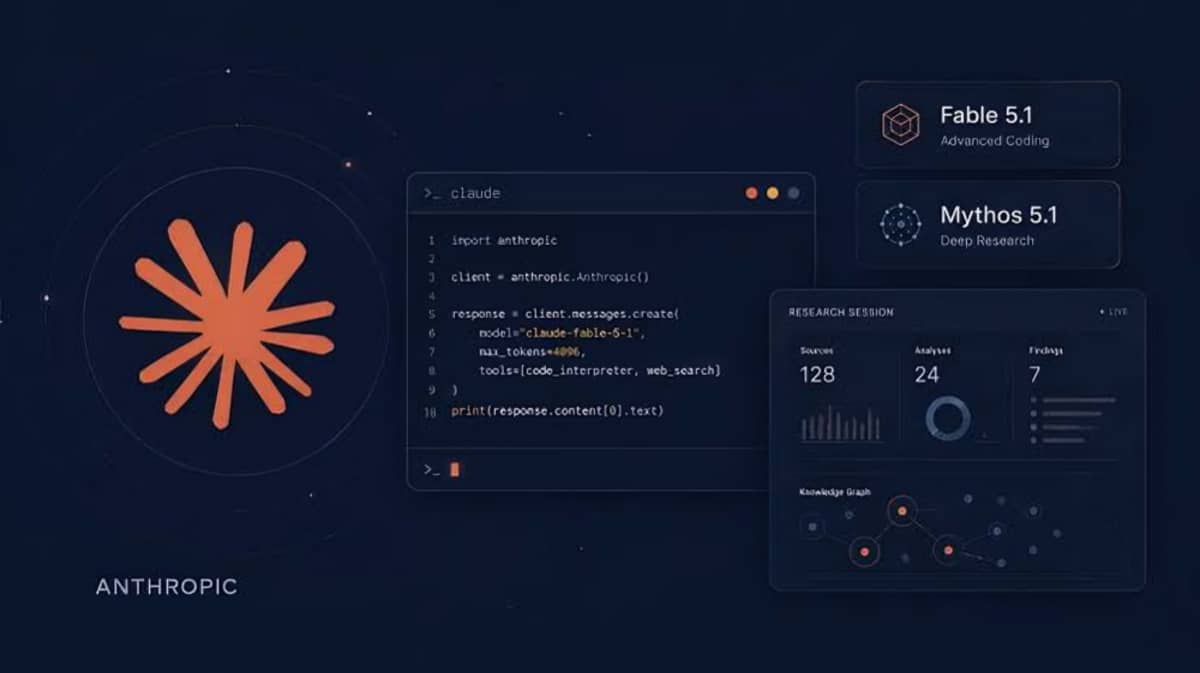
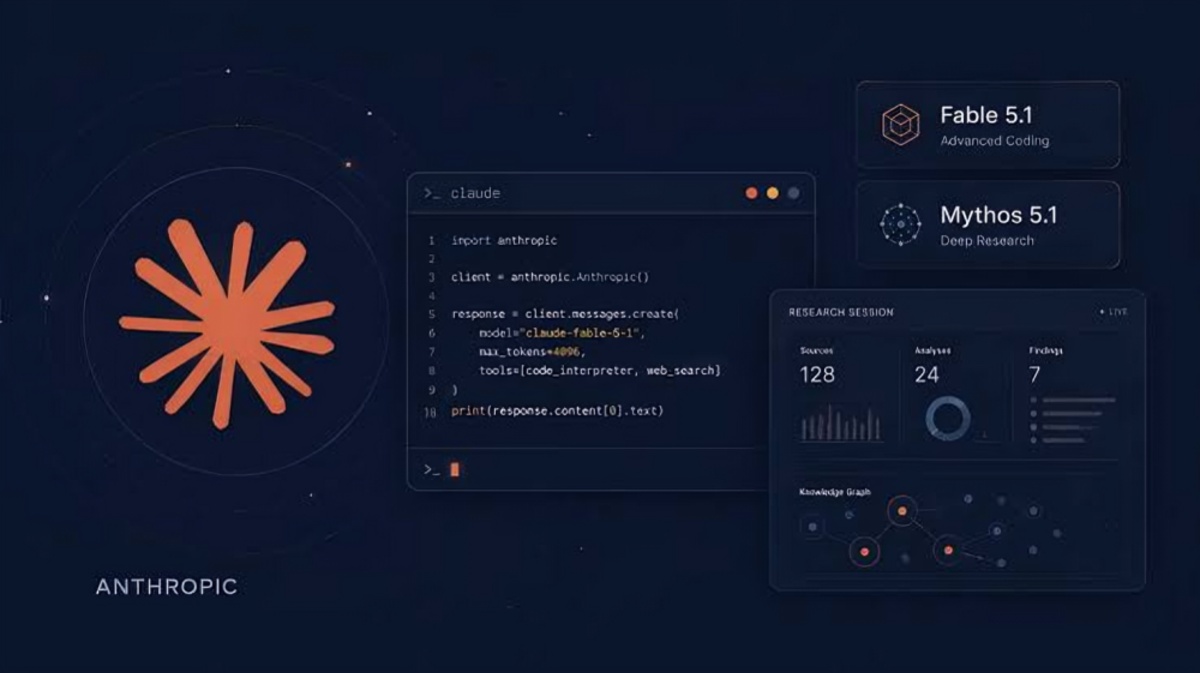
Anthropic has introduced Claude Fable 5.1 and Claude Mythos 5.1, the latest updates to its advanced artificial intelligence model family. The company says the new models are designed to improve performance in coding, research, reasoning and long running agentic tasks. The announcement comes at an important time for the artificial intelligence industry, with OpenAI also preparing its next frontier model, Astra.
Anthropic describes Claude Fable 5.1 as its most advanced generally available model for demanding reasoning and long horizon agentic work. The company has focused the model on tasks where an AI system may need to work through multiple steps, use tools and maintain progress over an extended period. This type of capability is increasingly important for software development, research and business workflows.
One of the major areas of improvement is software development. Anthropic says Fable 5.1 provides stronger coding performance compared with the previous generation. The model is intended to handle complex programming tasks and longer workflows in which an AI agent may need to inspect code, make changes, test those changes and continue working through a problem.
The company has also highlighted improvements in knowledge work and research. These capabilities can be useful for analysing information, preparing reports, solving technical problems and completing tasks that require multiple stages of reasoning. Anthropic's broader positioning of Fable 5.1 is focused on giving users an AI system that can take on more complex assignments rather than simply answering individual questions.
Another significant part of the announcement concerns cost. Anthropic has optimised the model's use of cached information, reducing the cost of cache reads. According to reports, the changes can lower costs by up to 45 percent for highly agentic workloads, while typical workloads can also see meaningful reductions. Lower operating costs could make advanced AI agents more practical for companies that use models repeatedly over long workflows.
Anthropic has also updated its safety controls. The company says Fable 5.1 uses more precise safeguards designed to reduce unnecessary restrictions while continuing to address potentially harmful uses. This is particularly relevant because increasingly capable AI models can be used for a wide range of legitimate and potentially risky tasks.
Claude Mythos 5.1 has a different availability model. Rather than being released broadly, Anthropic is providing access through trusted access programmes. The model is intended for more advanced work, including areas such as cybersecurity and life sciences. Anthropic has previously positioned the Mythos line as a higher capability system requiring additional safeguards and controlled access.
The distinction between Fable and Mythos is therefore important. Fable 5.1 is available to customers through Anthropic's broader Claude offerings, while Mythos 5.1 remains restricted to selected organisations and participants in approved programmes. This approach allows Anthropic to evaluate more advanced capabilities in controlled environments.
The release also comes shortly after OpenAI announced new information about Astra. OpenAI says Astra has reached a critical cybersecurity capability threshold under its Preparedness Framework. The company says the model is capable of identifying sophisticated vulnerabilities and performing advanced cybersecurity tasks, leading it to strengthen safety testing and controls before wider deployment.
The timing has increased industry interest in the competition between Anthropic and OpenAI. However, it is important to distinguish confirmed product information from competitive speculation. Anthropic has announced Fable 5.1 and Mythos 5.1, while OpenAI has publicly discussed Astra and its safety preparations. Direct comparisons between the models should be made only when comparable independent evaluations become available.
Anthropic's latest release reflects a broader shift in the AI industry toward systems that can perform longer sequences of work with less human intervention. Earlier AI assistants were generally focused on answering questions or generating individual pieces of content. Newer agentic models are increasingly designed to plan tasks, use external tools, inspect results and continue working toward a larger objective.
For software developers, this shift could change how AI coding assistants are used. Instead of asking a model to generate a small function, developers can increasingly delegate larger portions of software engineering workflows. The model may be able to inspect an existing codebase, identify problems, implement changes and run tests.
The same principle applies to research and knowledge work. An AI agent capable of maintaining context across longer tasks could assist with information gathering, analysis and drafting. However, human review remains important, particularly for professional, scientific, financial and other high consequence work.
Anthropic's decision to combine capability improvements with lower pricing and updated safeguards also highlights the changing priorities of the AI market. Model performance is no longer the only factor companies consider. Businesses also look at operating costs, reliability, data handling, safety controls and the ability to integrate AI into existing workflows.
The company's model documentation lists Fable 5.1 for demanding reasoning and long horizon agentic work, while other Claude models target different combinations of speed, intelligence and enterprise requirements. This gives users multiple options depending on the complexity and cost of their workloads.
Safety remains a central issue as these systems become more capable. Anthropic's Mythos 5.1 is an example of a model whose access is restricted because of its capabilities in sensitive areas. OpenAI's Astra announcement similarly demonstrates that advanced cybersecurity capabilities can trigger additional safeguards before a model is deployed more widely.
The developments from both companies indicate that the next stage of AI competition will involve more than benchmark scores. Coding ability, research performance, cost efficiency, agentic capabilities, security and responsible deployment are becoming increasingly important measures.
For users in India and other markets, the practical impact will depend on availability, pricing, language support and access through consumer and developer platforms. Businesses may also evaluate whether these models can reliably perform specific tasks while meeting their internal security and compliance requirements.
Anthropic's launch of Claude Fable 5.1 and Mythos 5.1 therefore represents another step in the development of advanced AI systems. Fable 5.1 is aimed at broader use for complex reasoning and agentic work, while Mythos 5.1 remains under controlled access. At the same time, OpenAI's Astra preparations show that safety requirements are becoming increasingly important as frontier AI models gain more powerful capabilities.
The two developments illustrate the rapidly changing AI landscape in 2026, where improvements in performance are increasingly being accompanied by changes in pricing, access policies and safety measures.