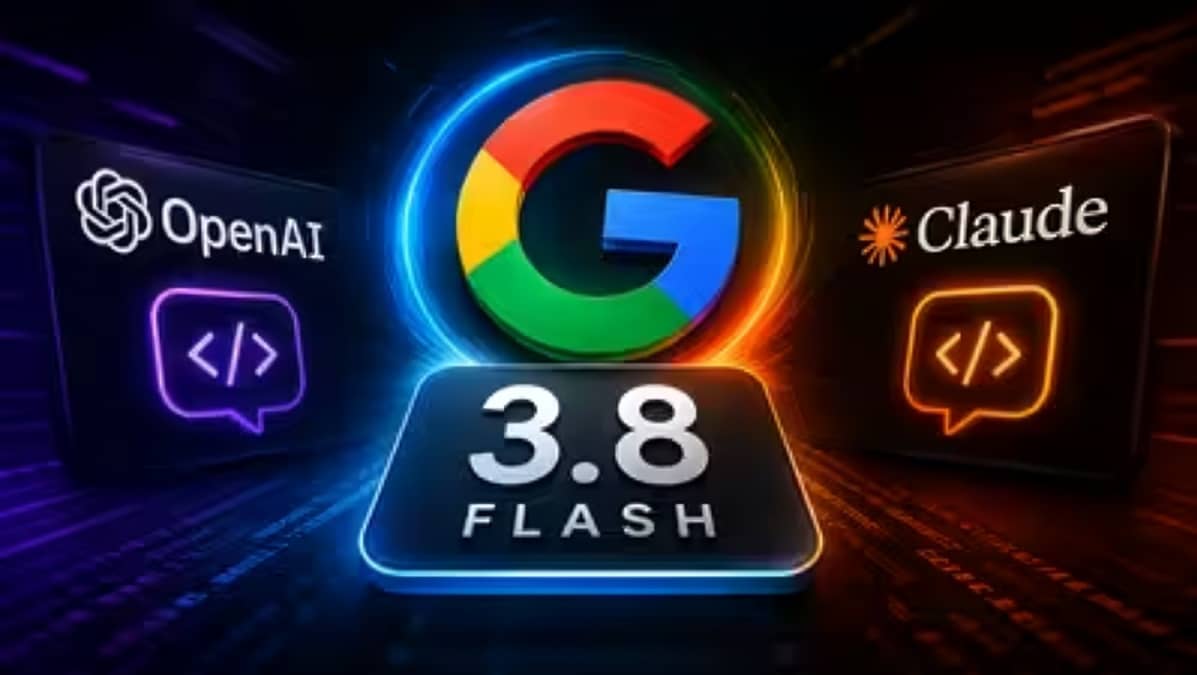
Google DeepMind is reportedly preparing a new Gemini model that could place greater emphasis on software coding and AI assisted development. The upcoming model is being referred to as Gemini 3.8 Flash in reports and is reportedly known internally by the codename Skimaki. According to recent reporting, Google could release the model as early as this week, although the company has not publicly confirmed a launch date for Gemini 3.8 Flash.
The reported development comes at an important stage in the competition among major artificial intelligence companies. Coding has become one of the most commercially important applications for generative AI, with developers increasingly using AI systems to write software, identify errors, modify existing code and assist with larger engineering projects. Companies including Google, OpenAI and Anthropic are therefore competing to improve the ability of their models to work with complex programming tasks.
Google has already positioned its Flash series as a faster and more efficient group of AI models designed for practical workloads. The company recently introduced Gemini 3.7 Flash and described it as a workhorse model for coding and AI agents. Google DeepMind says Gemini 3.7 Flash delivered improvements in accuracy and speed compared with its predecessor, particularly on challenging analytical tasks.
The reported Gemini 3.8 Flash development appears to continue that strategy, with coding reportedly becoming an even stronger priority. The Wall Street Journal reported that Google is preparing the model with significantly upgraded coding capabilities and that it could help the company narrow the performance gap with competitors such as Anthropic and OpenAI. Internal testing reportedly included Google’s Jetski developer platform, where engineers evaluated the model for coding related work.
Reports also suggest that some Google engineers preferred the upcoming model over Anthropic’s Claude Opus during internal coding evaluations. However, these results should be treated as internal testing rather than an independent benchmark. Performance can vary depending on the programming language, task complexity, testing methodology and model configuration. A broader comparison will only be possible once the model is publicly available and independently evaluated.
The reported focus on coding is significant because AI assisted software development is moving beyond simple code generation. Modern coding models are increasingly expected to understand large codebases, identify bugs, make changes across multiple files, work with development tools and complete multi step programming tasks. These capabilities are particularly relevant to agentic coding, where AI systems can perform a sequence of actions instead of simply responding to an individual programming question.
Google’s existing Gemini models have already been developed for coding and agent based workflows. Google’s official information on Gemini 3.7 Flash describes it as a model designed for coding and agents, while its model card notes that the system can complete individual coding tasks but still has limitations when independently chaining tasks into a complete research workflow.
Gemini 3.8 Flash could therefore represent an incremental improvement aimed at addressing some of these limitations. However, details about its architecture, context window, pricing, availability, supported platforms and final benchmark performance have not been officially confirmed by Google at the time of reporting. Information circulating before a formal launch should therefore be considered preliminary.
The timing is also notable because Google is facing strong competition from both OpenAI and Anthropic. Anthropic recently introduced Claude Fable 5.1 and Mythos 5.1, with Fable positioned for advanced coding, reasoning and agentic tasks. Fable 5.1 is generally available, while Mythos 5.1 has more restricted access. Reports indicate that Anthropic has also focused on improving coding performance, speed and cost efficiency.
OpenAI is also preparing its next generation of AI capabilities. The company recently discussed Astra, an upcoming model that has demonstrated advanced cybersecurity capabilities during evaluations. OpenAI said additional safeguards were required because of the model’s ability to identify and potentially exploit software vulnerabilities. The development highlights how increasingly capable AI systems are being evaluated not only for productivity but also for potential security risks.
For Google, improving Gemini’s coding performance could strengthen its position among professional developers and businesses. Software engineering is one of the areas where companies are actively experimenting with AI agents because development work involves many repetitive and time consuming tasks. An AI model that can reliably understand requirements, generate code, test changes and assist with debugging could potentially reduce development time while allowing engineers to focus on higher level decisions.
At the same time, stronger coding capabilities can introduce challenges. AI generated code may contain security vulnerabilities, incorrect logic or compatibility problems. Developers therefore still need to review generated code, run appropriate tests and verify changes before deploying them in production environments. Better coding performance does not remove the need for human oversight.
Another important factor will be cost and speed. The Flash series has generally been positioned around efficient performance, making latency and operating costs important considerations for developers. If Gemini 3.8 Flash can deliver stronger coding results while maintaining the speed and efficiency associated with the Flash family, it could become a significant option for developers building AI coding assistants and software development agents.
Google has not yet publicly confirmed all of the reported details surrounding Gemini 3.8 Flash. The expected launch timing, final capabilities and public benchmark results could change before release. Developers and businesses should therefore wait for official specifications and independent evaluations before drawing conclusions about how the model compares with competing systems.
If Google launches Gemini 3.8 Flash as reported, the release would add another major development to the rapidly evolving AI coding market. The competition between Google, OpenAI and Anthropic is increasingly moving from general chatbot capabilities toward specialised performance in areas such as coding, reasoning, autonomous agents and enterprise software development. The upcoming Gemini model could become an important test of whether Google can narrow the gap with its strongest competitors in AI assisted programming