
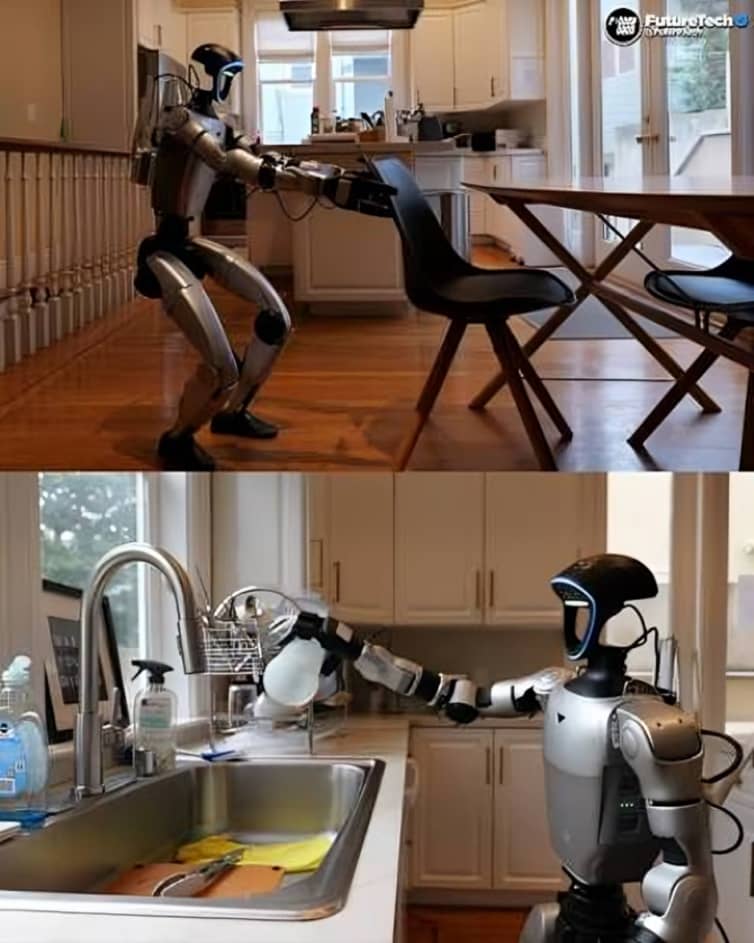

Artificial intelligence is steadily transforming everyday life, and the latest development comes from Tau Robotics, a United States-based startup that has launched a household cleaning service powered by AI-driven humanoid robots. The company offers customers the option to hire intelligent robots for domestic cleaning tasks, with services reportedly starting at Rs 3,000.
The initiative represents a growing trend in the robotics industry, where companies are developing machines capable of performing routine household activities with minimal human supervision. By combining artificial intelligence, computer vision, and advanced robotics, Tau Robotics aims to make home cleaning more efficient and accessible.
According to the company, the humanoid robots are designed to perform a variety of cleaning tasks commonly carried out in homes. These may include vacuuming floors, mopping surfaces, dusting furniture, organizing household items, and handling other routine cleaning responsibilities. The robots use AI-powered navigation systems to move around indoor spaces while identifying obstacles and adapting to different room layouts.
Unlike traditional robotic vacuum cleaners that are limited to floor cleaning, humanoid robots are built with articulated arms and enhanced mobility, allowing them to interact with a wider range of household objects. Their artificial intelligence systems enable them to recognize items, understand assigned tasks, and improve performance through continuous software updates.
Tau Robotics says the service is intended to help households save time by automating repetitive chores. As labor shortages and demand for home assistance continue to grow in several countries, AI-powered service robots are emerging as a potential solution for routine domestic work.
The launch also highlights the rapid advancement of generative AI and robotics technologies. Recent improvements in machine learning, computer vision, and natural language processing have enabled robots to perform increasingly complex tasks while responding to voice commands and adapting to changing environments.
Despite the technological progress, experts note that humanoid robots remain at an early stage of commercial adoption. Their effectiveness depends on factors such as operating environments, hardware capabilities, software reliability, and user requirements. Most current systems are designed to assist with repetitive household tasks rather than completely replace human involvement.
Privacy and security also remain important considerations for AI-powered home robots. Since many systems rely on cameras, sensors, and internet connectivity to function efficiently, companies are expected to implement strong data protection measures and provide users with clear controls over how information is collected, stored, and processed.
Industry analysts believe the global market for domestic service robots is likely to expand over the coming years as hardware costs decrease and artificial intelligence becomes more capable. Companies across the United States, Europe, and Asia are investing heavily in robotics solutions for residential, healthcare, hospitality, and commercial applications.
Tau Robotics' cleaning service demonstrates how artificial intelligence is gradually moving beyond software into practical real-world applications. While widespread adoption of humanoid household robots may still take time, services such as these indicate that AI-powered domestic assistance is becoming an increasingly realistic option for consumers seeking convenience and automation.


