A major astronomical event is set to take place in the final week of August, when a deep partial lunar eclipse crosses the night sky on August 27 and 28, 2026.
The eclipse is expected to attract considerable attention because it will be an unusually deep partial eclipse, with almost the entire visible lunar disk entering Earth's darkest shadow.
According to NASA, at the moment of greatest eclipse, approximately 96.3 percent of the Moon's disk will be inside Earth's umbra. Despite the extremely high coverage, the event will remain a partial lunar eclipse because a small portion of the Moon will remain outside the umbral shadow.
When Will the Lunar Eclipse Occur
The eclipse will take place overnight on August 27 and into August 28, depending on the observer's time zone.
NASA places the greatest eclipse at approximately 4:13 a.m. Universal Time on August 28. The complete eclipse sequence lasts several hours, including the penumbral and partial phases.
For viewers, the exact local timing will depend on their location and whether the Moon is above the horizon during the relevant phases.
Why Is It Called a Deep Partial Eclipse
A lunar eclipse occurs when the Earth moves between the Sun and the Moon, causing Earth's shadow to fall across the lunar surface.
The darkest central portion of that shadow is called the umbra. When the Moon passes completely through the umbra, a total lunar eclipse occurs.
During the August 2026 event, however, the Moon will not be completely covered by the umbra. Around 96.3 percent of its disk will enter the umbra at maximum eclipse, making it a deep partial lunar eclipse rather than a total eclipse.
Astronomical sources sometimes describe the event as a nearly total or almost blood moon because of how much of the lunar surface will be covered.
Will the Moon Turn Red
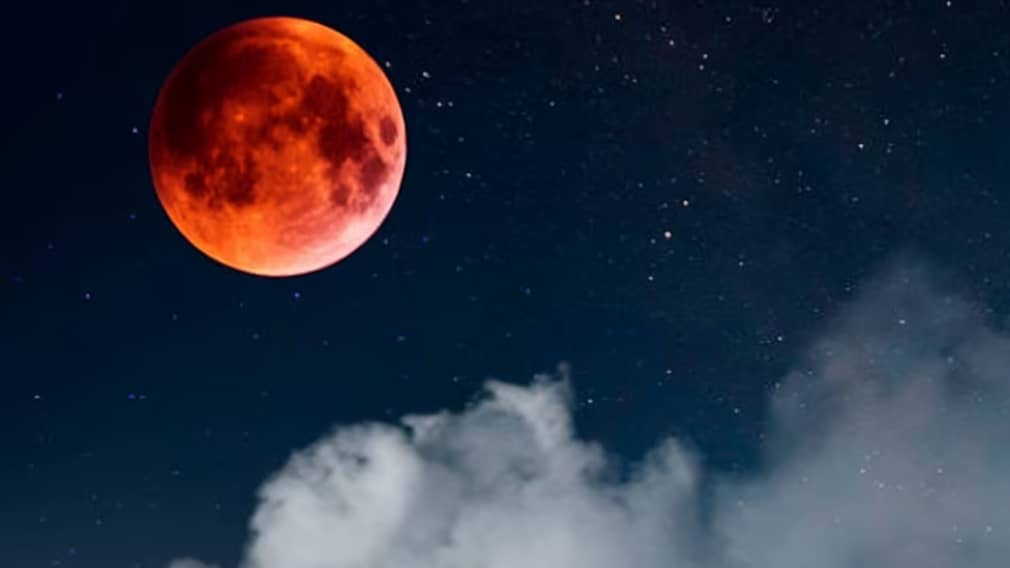
One of the most interesting features of a deep lunar eclipse is the possibility of a reddish or copper coloured Moon.
During a lunar eclipse, sunlight passing through Earth's atmosphere is scattered and refracted toward the Moon. Red and orange wavelengths can reach the lunar surface more effectively than shorter blue wavelengths.
As a result, the eclipsed portion of the Moon can take on a reddish or copper tone.
However, the exact colour and brightness will depend on atmospheric conditions, including dust, clouds and other particles in Earth's atmosphere.
Where Can the Eclipse Be Seen
The August 2026 partial lunar eclipse will have a broad visibility zone.
NASA states that the relevant partial eclipse phase will be visible across the Americas, western Europe and western Africa. Other astronomical sources similarly identify North America, South America, Europe and parts of Africa among the principal viewing regions.
In the Americas, many locations will have an opportunity to observe a substantial portion of the eclipse.
Parts of Europe and Africa will see the event at different stages depending on local sunrise, sunset and Moon position.
The viewing experience will therefore vary considerably between cities.
Will India See the August 2026 Lunar Eclipse
This is particularly important for Indian skywatchers.
The August 27 to 28, 2026 lunar eclipse will not be directly visible from India. During the relevant phases, the Moon will be below the horizon for observers across the country.
Therefore, major Indian cities such as Delhi, Mumbai, Chennai, Bengaluru, Hyderabad, Kolkata, Pune and Ahmedabad will not have a direct view of the eclipse.
This means there is no Indian city from which viewers can watch the main partial eclipse in the night sky.
Indian astronomy enthusiasts can instead follow online coverage or live streams provided by astronomy organisations and observatories.
Why the Eclipse Is Not Visible in India
Visibility of a lunar eclipse depends primarily on whether the Moon is above the horizon when the eclipse takes place.
Although lunar eclipses can potentially be seen from a much larger area than solar eclipses, observers still need to be on the nighttime side of Earth.
For the August 2026 event, India will be on the wrong side of the Earth during the principal eclipse phases. Consequently, the Moon will not be above the horizon when the deep partial eclipse occurs.
This is why reports listing Indian cities as viewing locations can be misleading unless they clearly distinguish between astronomical calculations and actual local visibility.
Can the Eclipse Be Watched Without Equipment
For locations where the eclipse is visible, no special protective equipment is required to look at a lunar eclipse.
Unlike a solar eclipse, viewing a lunar eclipse with the naked eye does not pose the same eye safety concerns.
Binoculars or a telescope can nevertheless provide a closer view of the Moon's changing appearance.
Photography enthusiasts can also attempt to capture the eclipse using cameras or smartphones, although a tripod and suitable exposure settings can significantly improve the results.
Why This Event Is Significant
The August 2026 eclipse is particularly notable because of its depth.
With more than 96 percent of the Moon's disk entering Earth's umbra, only a small section will remain outside the darkest part of Earth's shadow at maximum eclipse. NASA's calculation places the umbral coverage at 96.3 percent.
That makes the event visually different from an ordinary shallow partial eclipse.
The Moon could develop a striking reddish appearance, although the precise visual effect will vary according to atmospheric conditions.
The Difference Between a Partial and Total Lunar Eclipse
The distinction between partial and total lunar eclipses is based on how much of the Moon enters Earth's umbra.
In a total lunar eclipse, the entire lunar disk moves into the umbra.
In a partial lunar eclipse, only a portion of the Moon enters the umbra.
The August 2026 event falls into the second category. Even though approximately 96.3 percent of the Moon will be inside the umbra at maximum eclipse, a small part will remain outside it.
This small difference is enough for astronomers to classify the event as a partial lunar eclipse.
What Indian Skywatchers Should Know
For people in India, the most important point is that the August 2026 lunar eclipse cannot be observed directly from Indian locations.
There is therefore no need to travel between Indian cities in search of a viewing location. Changing from Chennai to Delhi, Mumbai or another major Indian city will not make the eclipse visible.
Those interested in the event can instead follow official astronomy broadcasts and online coverage.
For scientific accuracy, viewers should also distinguish between a genuine astronomical viewing opportunity and social media claims suggesting that the eclipse will be visible throughout India.
Final Takeaway
The August 27 to 28, 2026 lunar eclipse will be one of the year's notable astronomical events. At its peak, approximately 96.3 percent of the Moon's disk will enter Earth's umbral shadow, producing a deep partial eclipse that may give the Moon a reddish or copper appearance.
The event will be visible from large parts of North and South America, western Europe and western Africa, with visibility varying according to individual locations.
However, India will not be able to see the eclipse directly because the Moon will be below the horizon during the principal phases.
Therefore, Indian viewers who want to experience the event will need to rely on online livestreams and coverage from observatories or astronomy organisations.