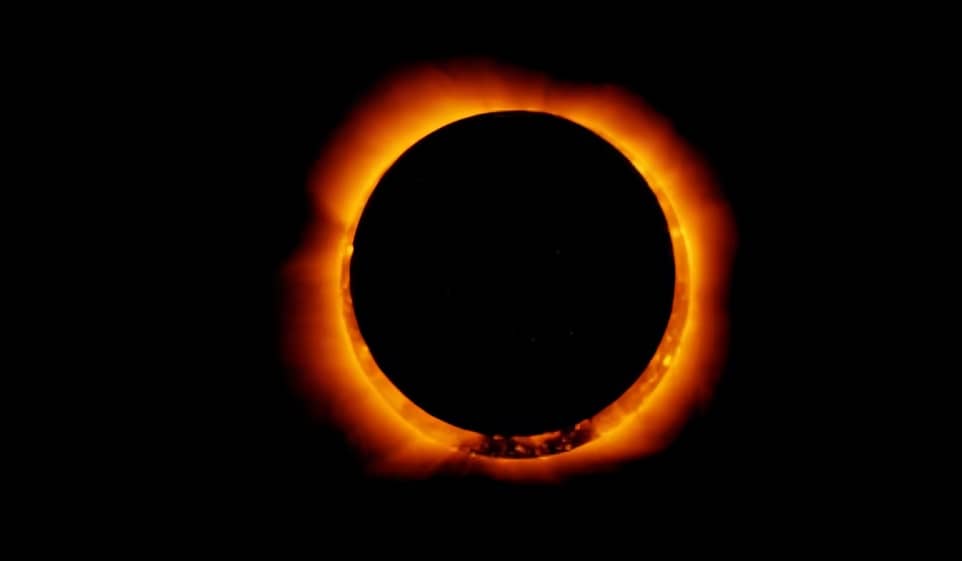
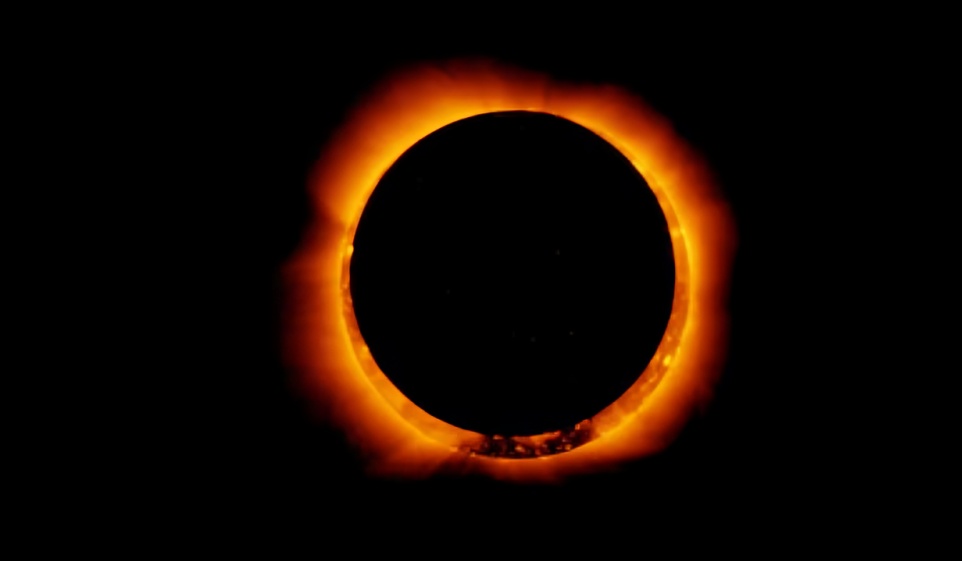
The annular Solar Eclipse of February 17 2026 is underway, presenting a striking ring of fire effect as the Moon passes between the Earth and the Sun but does not completely cover it. During an annular eclipse, the Moon appears slightly smaller than the Sun, leaving a bright ring visible at maximum coverage.
This astronomical event is visible primarily across the southern hemisphere. Observers in Chile, Zambia, Mauritius and Botswana are able to witness the phenomenon directly. The most prominent annular phase is expected over parts of Antarctica. Partial views are also reported in portions of southern Africa and South America.
The eclipse is not visible from India. As a result, customary observances such as the Sutak period traditionally followed during eclipses are not considered applicable within the country.
According to information shared by NASA and other astronomy agencies, the eclipse begins at 3:26 PM IST and ends at 7:57 PM IST. The peak annular phase, when the ring of fire is most clearly visible, takes place between 5:13 PM and 6:11 PM IST. Exact local timings vary depending on geographic location within the visibility path.
Astronomy experts emphasise that viewing the Sun without proper eye protection can result in permanent retinal damage. Only ISO 12312 2 certified solar eclipse glasses should be used for direct observation. Standard sunglasses do not provide adequate protection. Indirect viewing methods, such as using a pinhole projector, are considered safe alternatives. Cameras, telescopes or binoculars must also be fitted with appropriate solar filters before use.
For viewers outside the visibility zones, including those in India, live streams are available through official platforms operated by space agencies and observatories. These broadcasts provide real time visuals, scientific explanations and tracking updates.
Annular eclipses occur when the Moon is near its farthest point from Earth in its orbit, known as apogee. Because of this increased distance, the Moon does not completely block the Sun, unlike during a total solar eclipse. The next major solar eclipse events in 2026 include a total solar eclipse expected in August, which will be visible in parts of Europe including Russia, Greenland, Iceland and Spain.
Solar eclipses continue to generate global interest among scientists and skywatchers alike. They provide valuable opportunities for research into solar activity, atmospheric changes and celestial mechanics, while also serving as remarkable public science events.