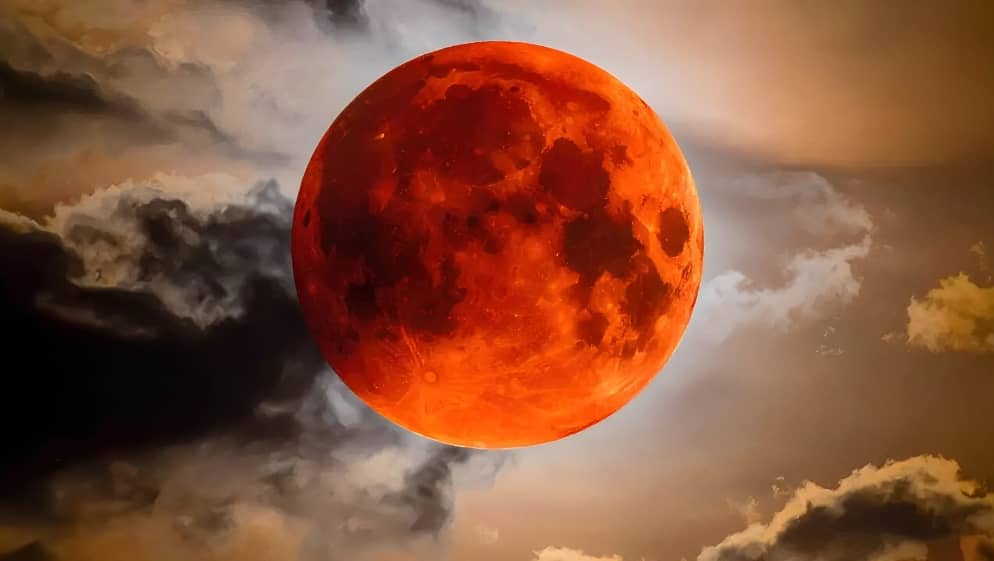
Astronomy enthusiasts and casual skywatchers alike are preparing for one of the most visually striking celestial events of 2026 – the Blood Moon. Scheduled for March 2, this total lunar eclipse is expected to last approximately 82 minutes, making it a rare opportunity to witness the Moon glowing red in the evening sky.
What Is a Blood Moon?
A Blood Moon occurs during a total lunar eclipse when the Earth comes directly between the Sun and the Moon. As Earth blocks direct sunlight, its atmosphere filters the light, bending red wavelengths toward the Moon. This gives the lunar surface a deep reddish hue, creating the dramatic “Blood Moon” effect. Unlike solar eclipses, lunar eclipses are safe to view without protective eyewear.
Best Time to Watch in 2026
Globally, the eclipse will begin at 17:32 IST (5:32 pm) and continue for roughly 82 minutes. In India, viewers can expect the phenomenon to start around 6:22 pm local time. The eclipse coincides with sunset, providing an ideal backdrop for sky photography. Experts suggest finding a location with minimal light pollution for the clearest and most vibrant view of the red Moon.
Ideal Locations for Viewing
The Blood Moon will be visible in parts of Asia, Australia, New Zealand, the Pacific Islands, and Antarctica. In India, it can be observed in most major cities including New Delhi, Mumbai, Bangalore, Kolkata, Chennai, Pune, Goa, and Lucknow. Observers in open spaces, away from tall buildings and city lights, are likely to enjoy the most striking views.
How to Watch the Blood Moon
Unlike solar eclipses, total lunar eclipses are completely safe to view with the naked eye. To enhance the experience, binoculars or telescopes can reveal more details of the lunar surface. Photography enthusiasts can capture stunning images using standard cameras or smartphone lenses. For the best results, set up the camera on a tripod to reduce shaking and use longer exposure settings to capture the rich red tones of the Moon.
Why It’s Special
Total lunar eclipses, while not extremely rare, do not occur every month, and the 2026 Blood Moon’s duration of 82 minutes makes it an unusually long event. It offers a perfect opportunity for astronomy enthusiasts, photographers, and families to witness and appreciate the dynamics of our solar system.
In conclusion, the Blood Moon on March 2, 2026, promises a spectacular celestial display visible across India and several parts of the globe. Whether observed casually or captured through a telescope or camera, this eclipse offers a rare chance to see the Moon bathed in red, a reminder of the fascinating interplay between the Sun, Earth, and Moon.