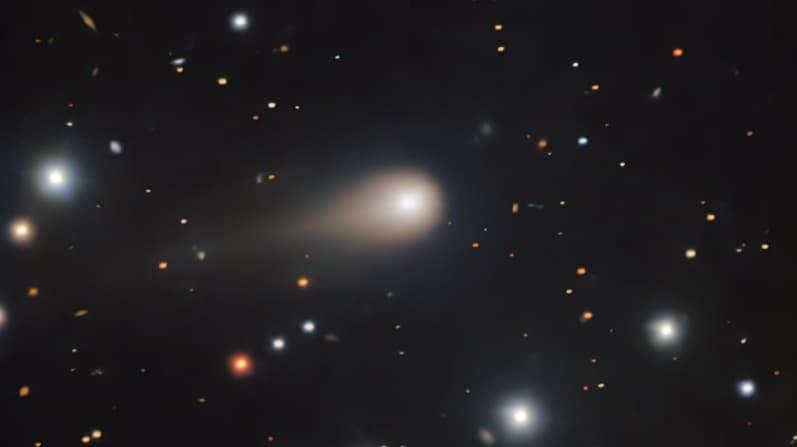
Astronomy enthusiasts across the world are preparing for a remarkable celestial event as the interstellar comet 3I ATLAS is set to make a rare appearance, with its passage being broadcast live through dedicated livestreams. This comet, which originates from outside our solar system, offers scientists and viewers an extraordinary opportunity to observe an object formed in a completely different star environment.
Comet 3I ATLAS was first detected by the ATLAS survey and has attracted attention due to its interstellar origin, making it only the third confirmed object of its kind to pass through our solar system. Unlike comets that form in regions such as the Kuiper Belt or the Oort Cloud, interstellar comets carry chemical and structural signatures that reflect the conditions of distant planetary systems. This makes every observation extremely valuable for researchers studying the formation of planets and the early evolution of star systems.
According to astronomers, the comet is currently moving through a trajectory that places it within an observable range for high powered telescopes. While the comet is not easily visible to the naked eye due to its distance and brightness levels, the use of advanced imaging equipment will allow observatories to broadcast a clear and steady view. Several major astrophysics groups have arranged livestreams that will begin later tonight, offering viewers around the world a chance to witness the comet passing through the night sky in real time.
The livestream will not only show the comet’s movement but may also include expert commentary from astronomers who will explain the comet’s unusual origins, composition, and the significance of interstellar objects in space science. Observers will be able to see the comet's faint tail, which is formed as solar radiation interacts with dust and gases released from its surface. Scientists note that studying the tail’s structure can reveal clues about the comet’s material composition.
Interstellar comets are incredibly rare, with only a handful ever being identified. The first known interstellar object, Oumuamua, created global excitement in 2017 when it passed through the solar system with an unusual shape and unexpected acceleration. The second, comet 2I Borisov, provided astronomers with detailed insights that suggested it resembled comets found within our own solar system but had subtle differences in its molecular composition. Comet 3I ATLAS is expected to add further valuable data to this growing field of research.
For viewers, the livestream offers a unique chance to witness a scientific moment that may not occur again for many years. While comets enter the inner solar system frequently, interstellar comets follow unpredictable paths and often take thousands or millions of years to travel across interstellar space before reaching the vicinity of Earth.
Sky watchers, students, and science enthusiasts are encouraged to tune in tonight as the event unfolds. Experts emphasize that the appearance of comet 3I ATLAS is not only a visual spectacle but also an important opportunity to learn more about the universe beyond our solar system.