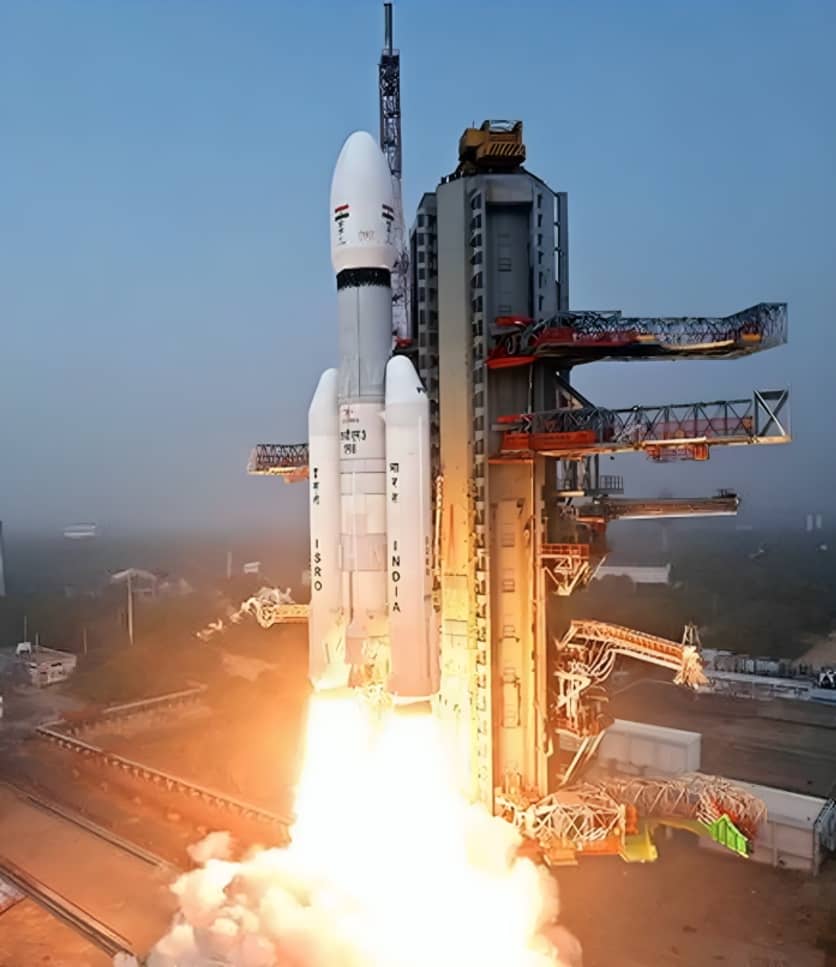

India’s space sector may be heading toward a major structural change, with reports suggesting that the Indian Space Research Organisation ISRO could gradually transfer the production and operational responsibilities of its heavy lift launch vehicle LVM3 to private companies. The rocket, often referred to as Bahubali due to its powerful lift capacity, has played a key role in major missions including Chandrayaan 3.
The proposed shift is seen as part of India’s broader strategy to expand private participation in the space industry. Over the past few years, the government has been encouraging non government players to enter satellite manufacturing, launch services, and space based technology development. The aim is to increase innovation, reduce costs, and improve global competitiveness.
The LVM3 rocket is currently one of India’s most powerful launch vehicles. It has been used for critical missions such as launching heavy communication satellites and interplanetary missions. Its successful deployment in the Chandrayaan 3 mission highlighted India’s growing capability in deep space exploration.
According to reports, discussions are underway regarding the gradual handover of manufacturing and operational responsibilities of LVM3 to private industry partners. However, ISRO is expected to continue playing a central role in design, mission planning, and oversight, particularly for high priority scientific missions.
One of the key areas of uncertainty is the human rated version of LVM3, which is being developed for the upcoming Gaganyaan human spaceflight mission. This version of the rocket is designed to carry astronauts into space, making it significantly more complex in terms of safety and reliability requirements. It remains unclear how much of this program will involve private sector participation at this stage.
Experts believe that involving private companies in rocket production could significantly boost India’s space economy. It may lead to faster production cycles, increased efficiency, and reduced dependency on government manufacturing facilities. Several private aerospace companies in India have already started developing capabilities in satellite systems and launch vehicle components.
The move also aligns with global trends where space agencies collaborate closely with private industry. In countries such as the United States, private companies have taken a leading role in launch services, satellite deployment, and even human spaceflight missions, working alongside national space agencies.
However, space technology experts emphasize that any transition of critical systems like LVM3 must be handled carefully due to the high reliability requirements of launch vehicles. Even minor technical failures can result in significant mission losses, making quality control and testing essential.
ISRO is expected to retain oversight and regulatory control even if production responsibilities are partially shifted to private companies. The organization has consistently maintained a strong track record in space missions, and any collaboration model is likely to prioritize mission safety and success.
The potential restructuring of LVM3 production marks an important step in India’s evolving space ecosystem. It reflects the country’s ambition to become a global leader in commercial space activities while continuing its scientific exploration missions.
If implemented, the move could open new opportunities for Indian aerospace startups and engineering firms, strengthening the country’s position in the global space industry. However, final decisions and implementation timelines are yet to be officially announced.