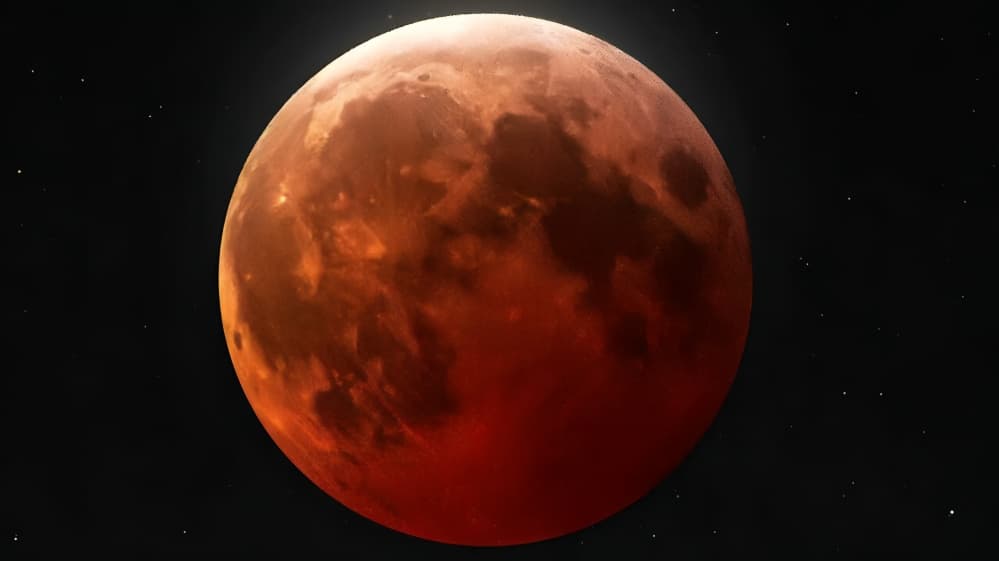
Astronomy enthusiasts worldwide are preparing to witness a rare celestial event as a total lunar eclipse, popularly known as a Blood Moon, lights up the night sky on March 3, 2026. During this eclipse, the Moon will turn a deep red for approximately 56 minutes during totality, providing an unforgettable sight for skywatchers across multiple continents. The phenomenon occurs when Earth passes directly between the Sun and the Moon, blocking direct sunlight and casting its shadow on the Moon’s surface.
The term Blood Moon refers to the reddish hue that the Moon takes on during the eclipse. This happens because sunlight passing through Earth’s atmosphere is scattered, with shorter blue wavelengths dispersing more than the longer red wavelengths. As a result, red light bends toward the Moon, giving it a copper or crimson glow similar to colors seen during sunrise and sunset. The total phase of the eclipse, known as totality, occurs when the Moon is fully immersed in Earth’s umbra, the darkest part of the shadow.
The March 3, 2026 lunar eclipse will be visible in large regions of the globe, including Asia, Australia, North America, and parts of South America. Observers in these regions will be able to watch the Moon gradually change color as it passes through the penumbral and umbral shadows. Some parts of Europe and Africa may not witness the full eclipse, depending on moonrise and local atmospheric conditions.
Unlike solar eclipses, lunar eclipses are completely safe to observe without protective eyewear. Enthusiasts can watch the event with the naked eye, although binoculars or telescopes will allow viewers to see lunar craters and surface details more clearly. For optimal viewing, it is recommended to choose areas with minimal light pollution and a clear horizon. Arriving early ensures observers can see Earth’s shadow slowly creep across the Moon, adding to the dramatic experience. Astronomy apps or observatory updates can provide accurate local timings for each stage of the eclipse.
Total lunar eclipses have captivated human imagination for centuries, holding cultural and scientific significance. The 2026 event coincides with Holi celebrations in India, offering a unique opportunity to combine festive enjoyment with skywatching. Educational institutions, astronomy clubs, and the public can take advantage of this rare alignment to learn more about lunar cycles, Earth-Sun-Moon interactions, and the physics behind the Blood Moon phenomenon.
In summary, the March 3 Blood Moon will be a spectacular and safe celestial display visible to millions of people worldwide. Whether for scientific observation, photography, or cultural enjoyment, the lunar eclipse of 2026 promises to be a memorable event in the night sky.