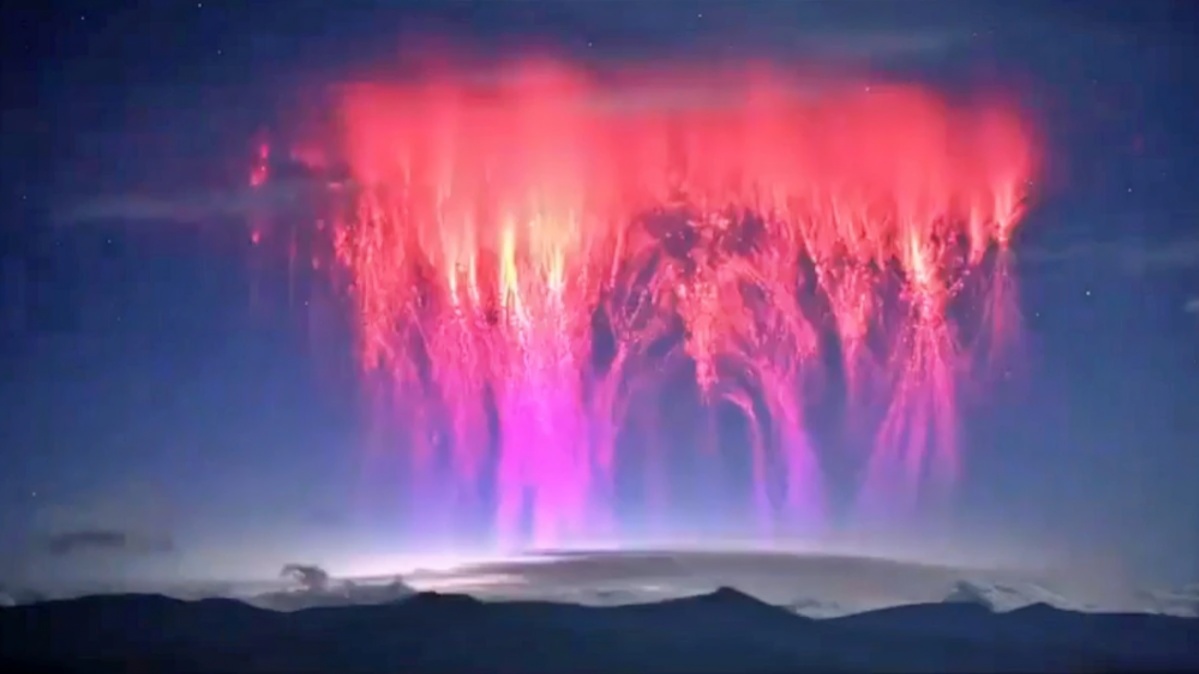
A rare atmospheric phenomenon observed above a thunderstorm in Tibet has generated widespread interest after videos showing towering red columns of light circulated online. The unusual display, captured during an intense thunderstorm, prompted curiosity among viewers and sparked discussions about the science behind the striking visual event.
According to atmospheric scientists, the red pillars of light are believed to be part of a class of upper atmospheric electrical phenomena associated with powerful thunderstorms. These events occur far above the clouds and are linked to intense lightning discharges that generate strong electrical fields in the atmosphere.
Researchers explain that when exceptionally powerful lightning strikes occur within a thunderstorm, they can produce electrical disturbances that extend upward into the mesosphere and lower ionosphere. These electrical fields can energize atmospheric gases, particularly nitrogen molecules, causing them to emit a reddish glow that becomes visible under suitable conditions.
The phenomenon is often categorized among transient luminous events, a group of short-lived optical emissions that occur above thunderstorms. Scientists have studied these events for decades, but they remain relatively difficult to observe because they occur at high altitudes and often last only a fraction of a second.
Advances in digital photography, high-speed cameras, and satellite monitoring have improved scientists' ability to document and analyze such phenomena. In recent years, more observations have been recorded around the world, contributing to a better understanding of atmospheric electricity and thunderstorm dynamics.
The Tibet observation gained attention because of the dramatic appearance of multiple red columns extending vertically into the sky. Experts note that the shape, color, and brightness of these events can vary depending on atmospheric conditions, lightning intensity, altitude, and viewing angle.
Atmospheric researchers emphasize that these red light displays are natural phenomena and are not considered dangerous to people on the ground. They occur at altitudes far above commercial aircraft flight paths and are generally visible only under specific weather and lighting conditions.
Thunderstorms are among the most powerful natural generators of electrical energy on Earth. A single lightning discharge can release enormous amounts of energy in a fraction of a second. In certain situations, this energy influences atmospheric layers well above the storm itself, producing optical effects that can be observed from great distances.
Scientists continue to study the relationship between thunderstorms and upper atmospheric phenomena because such research contributes to broader understanding of weather systems, atmospheric chemistry, and electrical processes in Earth's environment. These studies also provide insights into how energy is transferred between different layers of the atmosphere.
The growing availability of smartphones, digital cameras, and remote monitoring systems has increased the number of documented observations worldwide. Citizen scientists and amateur photographers often contribute valuable visual records that help researchers identify and analyze rare atmospheric events.
Experts note that public interest in unusual natural phenomena can encourage greater awareness of atmospheric science and meteorology. Events such as the recent Tibet observation demonstrate that Earth's atmosphere continues to produce remarkable and sometimes unexpected displays.
As scientists examine additional footage and data from the thunderstorm, the observation is expected to contribute to ongoing research into transient luminous events and the complex electrical interactions that occur above powerful storms. The incident serves as a reminder of the fascinating natural processes taking place high above Earth's surface.