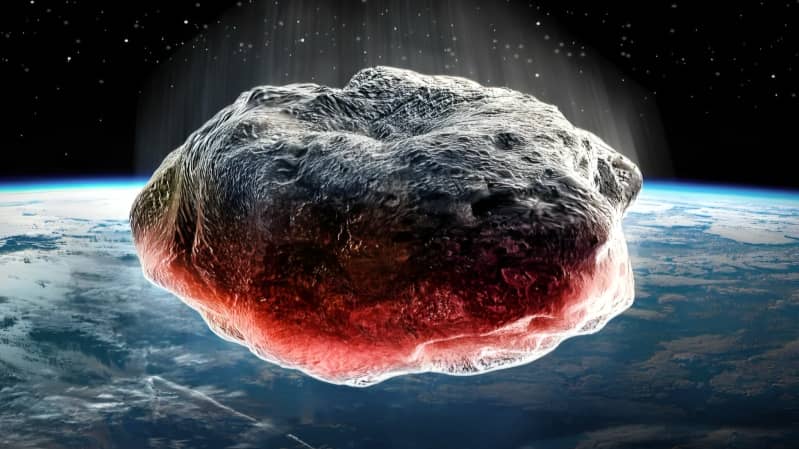
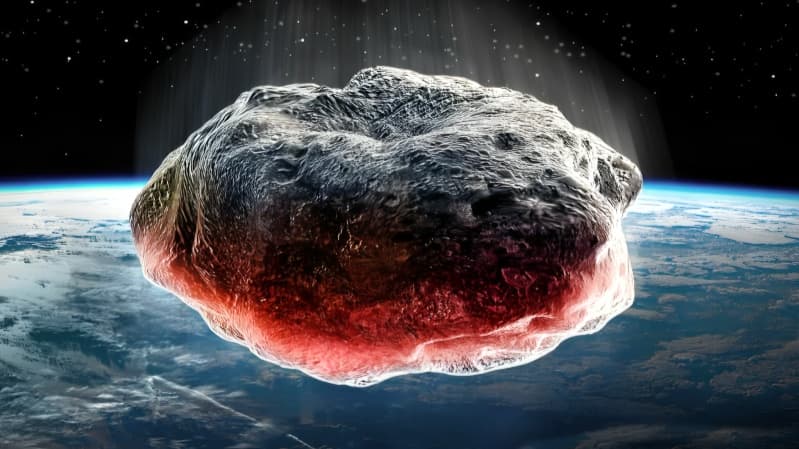
NASA has announced that two asteroids are scheduled to make close approaches to Earth tomorrow, drawing attention from scientists and space observers across the world. These space rocks are classified as near-Earth objects and are regularly tracked by NASA’s Center for Near-Earth Object Studies. According to officials, both asteroids will pass Earth at a safe distance and do not pose any collision risk.
Near-Earth objects are asteroids or comets whose orbits bring them close to the Earth’s orbit around the Sun. While thousands of such objects are tracked each year, only a small percentage are large enough to cause concern. NASA uses advanced telescopes and radar systems to continuously monitor their movement, speed, and trajectory. This constant observation helps scientists accurately predict future paths and identify any potential threats well in advance.
The two asteroids expected to pass by Earth tomorrow are believed to be of moderate size and will travel at extremely high speeds through space. However, experts have clearly stated that their trajectories place them far outside the danger zone. One of the asteroids is expected to pass within a few million kilometres of Earth, a distance that is considered close in astronomical terms but completely safe for the planet.
Scientists highlight that such close approaches are important opportunities for research. During these events, space agencies collect valuable data about the asteroid’s composition, rotation, and surface structure. This information helps improve understanding of how asteroids form and evolve over time. It also strengthens the global effort to develop strategies for planetary defence in the unlikely event of a future threat.
NASA has repeatedly reassured the public that asteroid monitoring has improved significantly over the last two decades. With the help of automated sky surveys, artificial intelligence, and international cooperation, most large near-Earth objects have already been identified and mapped. Smaller objects are also routinely discovered, but they usually burn up harmlessly in the atmosphere if they enter Earth’s vicinity.
Public interest in asteroid flybys has increased as awareness about planetary defence grows. While such events sometimes trigger concern on social media, experts urge people to rely only on verified scientific information. NASA maintains that all known near-Earth objects are being carefully observed and that early warning systems are in place to handle any unlikely emergency.
In recent years, space agencies have also tested asteroid deflection technologies through dedicated missions. These experiments aim to assess whether it is possible to alter the path of a potentially hazardous asteroid if needed. The success of such missions has boosted confidence in Earth’s ability to defend itself against future threats.
In conclusion, the back-to-back asteroid approaches expected tomorrow are part of a routine astronomical phenomenon that poses no danger to Earth. NASA continues to monitor the situation closely and has confirmed that both asteroids will pass safely. The event underscores the importance of continuous space monitoring and international cooperation in safeguarding the planet from cosmic hazards.