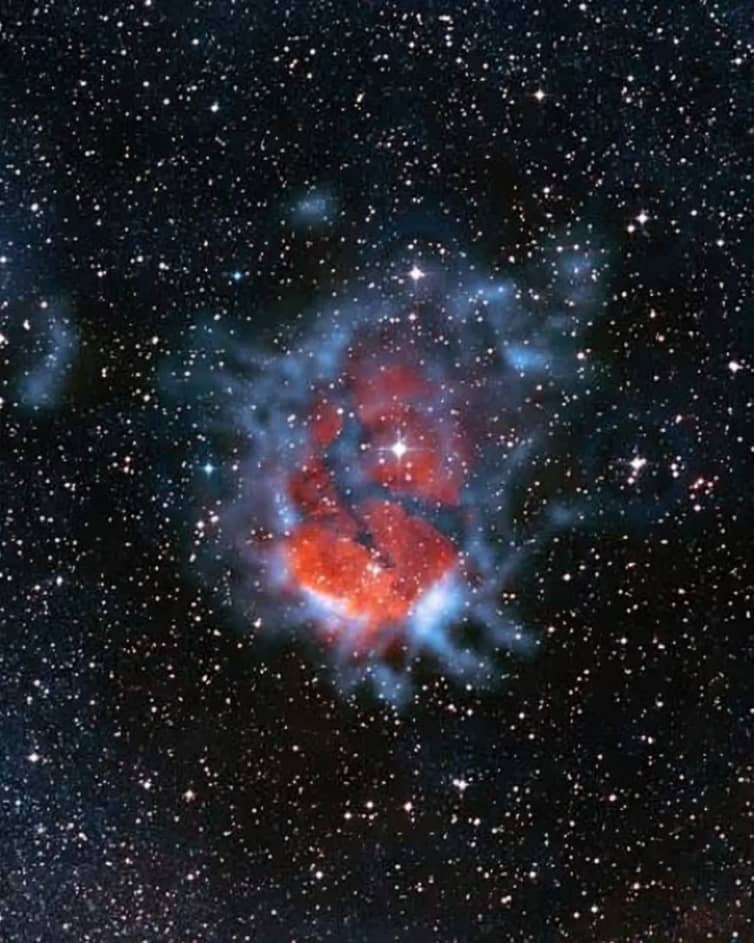
An unexpected astronomical observation in Chile has provided scientists with a new look at one of the important processes governing the life cycle of matter in the Milky Way. A telescope that was still under construction made the observation during a test run, allowing researchers to study material being released by a dying star.
The discovery is significant because astronomers have long understood that stars manufacture many of the elements found throughout the universe. However, observing how those elements are physically returned to the surrounding interstellar environment and subsequently mixed into the galaxy has been considerably more challenging.
The new observations offer a closer look at this stage of the cosmic recycling process. The study was published in the journal Nature.
An Unexpected Discovery
The telescope was not yet fully operational when researchers used it for observations in Chile. During the test phase, the instrument detected faint structures associated with material surrounding a dying star.
The observations revealed clumps of stellar material interacting with the surrounding interstellar medium. Researchers identified structures known as bow shocks, which can develop when material flowing away from a star encounters gas and dust in its surroundings.
The detection provides valuable information about how material released during the later stages of stellar evolution behaves after leaving its parent star.
How Stars Recycle Matter
Stars are important chemical factories in the universe. Nuclear reactions inside stellar cores create and transform elements over the course of their lifetimes.
When stars reach the later stages of their evolution, they can lose substantial amounts of material into space. This material contains elements that were produced or processed inside the star.
Once released, the material does not simply disappear. It becomes part of the interstellar environment and can eventually mix with gas and dust elsewhere in the galaxy.
Over extremely long periods, this material can contribute to clouds from which new generations of stars and planetary systems form. Scientists therefore describe the process as a form of cosmic recycling.
Why Carbon and Oxygen Matter
Carbon and oxygen are among the elements that play an important role in this process. They are also essential components of many molecules found in space and on Earth.
The discovery helps researchers study how material enriched by stellar evolution is transported away from a dying star and incorporated into the broader galactic environment.
This is particularly important for understanding how successive generations of stars inherit material from earlier generations.
The atoms that make up planets and living organisms have origins in earlier cosmic processes. Studying the movement of these elements therefore provides a broader understanding of how galaxies evolve chemically over time.
The Importance of Bow Shocks
One of the notable features identified in the observation is the presence of bow shocks around the stellar material.
A bow shock can form when gas expelled by a star moves through surrounding interstellar material. The interaction can compress and heat the gas, creating structures that can be detected by astronomical instruments.
The Nature study examines these structures around the Helix Nebula and provides information about the movement of stellar ejecta and their interaction with the surrounding interstellar medium.
The observations help astronomers understand what happens to stellar material after it leaves a star and before it becomes part of the wider galactic environment.
A Telescope That Was Still Being Built
The discovery is also notable because the telescope had not reached full operational status.
Instead of requiring a fully completed observatory, researchers were able to use the developing instrument for a test observation and obtain scientifically valuable data.
The result demonstrates how even early observations from new astronomical facilities can reveal unexpected phenomena.
The discovery also highlights the importance of improving astronomical instruments so that faint structures around distant stars can be detected and studied in greater detail.
What the Discovery Means for Future Research
The new findings do not change the basic understanding that stars recycle matter, but they provide a more detailed observational picture of how that recycling occurs.
Scientists can use observations like these to improve models of stellar evolution, gas movement and chemical enrichment within galaxies.
Understanding these processes is important because the Milky Way is not a static collection of stars. Gas and dust continually move through the galaxy, while stars are born, evolve and eventually return material to their surroundings.
The newly observed structures provide an opportunity to study one part of this continuing cycle.
A Cosmic Connection to Future Stars and Planets
The material released by dying stars can eventually become part of the raw material used by future stellar systems.
Over millions or billions of years, gas enriched by previous generations of stars can accumulate in regions where new stars form. Some of the resulting systems can also develop planets.
This means that the elements created inside ancient stars can ultimately become components of planets and, under suitable conditions, living organisms.
The latest observation therefore provides another piece of evidence for the interconnected nature of stellar evolution, galactic chemistry and the formation of planetary systems.
Conclusion
The accidental observation made by a telescope still under construction in Chile has given astronomers an unusually detailed look at stellar material being returned to the Milky Way.
By observing gas expelled from a dying star and the bow shocks created as that material interacts with its surroundings, researchers can better understand how matter moves through the galaxy.
The study published in Nature adds important observational evidence to the picture of cosmic recycling. It shows how material processed inside stars can eventually return to the galactic environment and contribute to the raw ingredients for future generations of stars and planetary systems