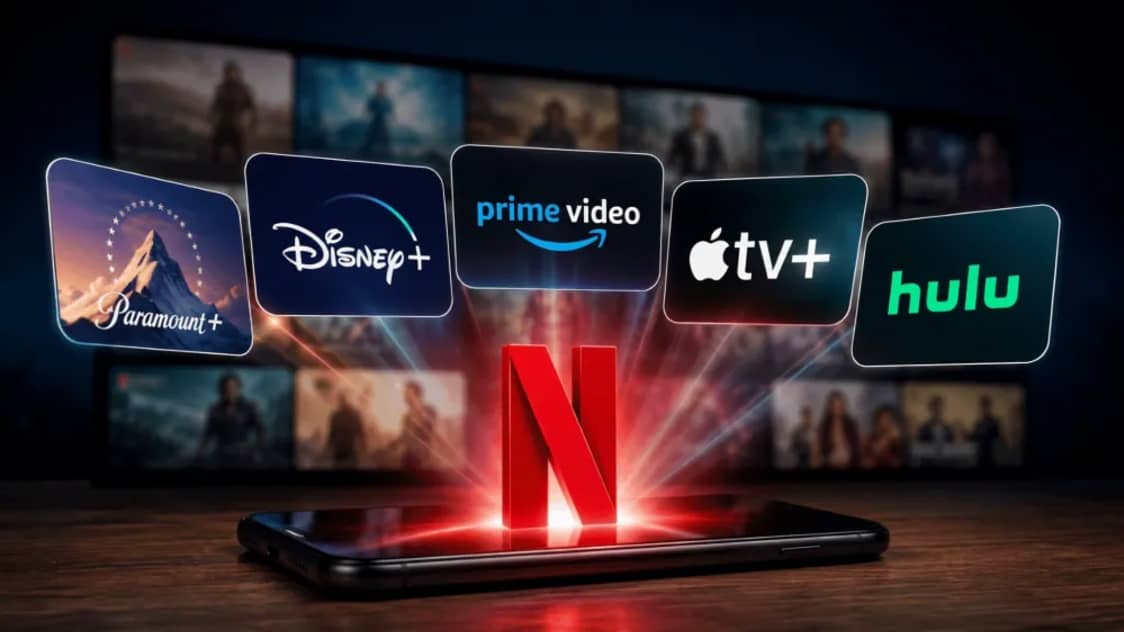
Netflix could be preparing for a major change in the way viewers access streaming content. The company is reportedly exploring the possibility of allowing rival services such as Peacock and Fox One to become available through its own application.
If implemented, the proposal could turn Netflix from a single streaming service into a broader entertainment hub where users can discover, manage or potentially subscribe to content from multiple platforms. However, discussions are still at an early stage, and there is no confirmed agreement with either Peacock or Fox One at present.
The reported discussions represent a notable shift in the streaming industry's competitive landscape. For years, major streaming platforms have largely operated as separate ecosystems. Customers typically need to download different applications, maintain separate subscriptions and switch between platforms to access their preferred movies, television programmes and live events.
A Netflix based aggregation model could change that experience. Instead of requiring viewers to move between multiple applications, Netflix could potentially provide a single interface through which users find content from several services.
Reports indicate that Netflix executives have discussed arrangements involving Peacock and Fox One. It remains unclear whether such an arrangement would involve Netflix selling subscriptions to those services, allowing their content to appear within the Netflix application or adopting a combination of both approaches.
The possibility is particularly interesting because Netflix has historically maintained a relatively closed approach to competing streaming services. The company has focused heavily on its own original productions and licensed catalogue, rather than functioning as a marketplace for rival subscriptions.
That strategy appears to be evolving. Netflix has already experimented with third party content integration in France through a partnership involving broadcaster TF1. The experiment has included live channels and streaming content within the Netflix environment, demonstrating that the company is willing to explore a more aggregated model.
The proposed integration of Peacock could be particularly significant because Peacock is operated by NBCUniversal and offers movies, television programmes, original productions and live sports. The service currently offers multiple subscription tiers and has continued expanding its content and sports offerings.
Fox One, meanwhile, provides access to FOX programming, sports, news and entertainment content. It is part of the growing number of streaming services competing for consumers who previously depended heavily on traditional cable and satellite television.
The addition of these services could give Netflix access to a broader range of content without requiring the company to produce or acquire every programme itself.
For consumers, the biggest potential advantage would be convenience. Viewers increasingly subscribe to several streaming platforms because popular programmes and sports events are spread across different services. A single application could make it easier to search for programmes and identify where they are available.
However, convenience would depend on the final structure of the proposed service. If Netflix simply provides links to other platforms, users may still need separate applications and accounts. If subscriptions can be purchased and managed directly through Netflix, the experience could become considerably more integrated.
Pricing would also be an important factor. A centralised streaming hub could potentially offer bundled subscriptions or simplified billing. At the same time, consumers would need to consider whether adding several services through one platform actually reduces their total monthly entertainment spending.
The streaming industry has already moved toward bundles as companies attempt to address subscription fatigue. Consumers face an increasingly large number of services, while subscription prices have risen across the sector.
Peacock, for example, recently increased prices for several of its plans. Its current offerings include an ad supported Select plan, a Premium plan and a Premium Plus option.
This environment could create an opportunity for Netflix to position itself as an aggregator. Rather than competing exclusively for individual subscriptions, the company could potentially become a central distribution platform for multiple services.
Other technology and entertainment platforms have already adopted similar strategies. Amazon Prime Video, for example, allows users to subscribe to additional streaming services through its Prime Video Channels system. This lets customers manage multiple subscriptions from one environment.
Apple and Roku have also developed aggregation models that allow viewers to discover content from different streaming providers through unified interfaces.
Netflix entering this space would therefore put the company into direct competition not only with other streaming platforms but also with technology companies that have positioned themselves as entertainment hubs.
There could also be benefits for streaming companies. A partnership with Netflix could provide rival services with access to a large existing audience. Instead of requiring consumers to discover a separate application independently, services such as Peacock or Fox One could potentially reach users through Netflix's established interface.
For Netflix, such partnerships could create new revenue opportunities through subscription commissions, advertising arrangements or other commercial agreements.
However, there are also challenges. Netflix would need to balance its own interests with those of competing services. Giving rival platforms prominent placement inside its application could potentially increase their visibility while also reducing the exclusive nature of the Netflix ecosystem.
Content discovery would be another important issue. Netflix would need to determine how third party programmes are presented alongside its own films and series. Ranking, recommendations and search results could become more complicated if the platform includes content from multiple providers.
There could also be differences between countries. Streaming rights vary significantly by market, and a programme available on Peacock in the United States may not be available through the same service in India or other countries.
This means any Netflix aggregation strategy would likely require different partnerships and content arrangements depending on the market.
For Indian viewers, the immediate impact may therefore be limited. Peacock and Fox One are primarily focused on the US market, and Netflix has not announced that these services will be integrated into its Indian application.
Nevertheless, the broader trend could influence how streaming platforms operate globally. If aggregation becomes successful in major markets, similar models could eventually emerge in other regions.
The development also comes as Netflix expands its approach to third party content. The company has increasingly shown interest in licensing content alongside its large portfolio of original productions.
This could allow Netflix to offer a wider entertainment catalogue while managing the cost and risk associated with producing every title itself.
The proposed partnerships with Peacock and Fox One should therefore be viewed as exploratory rather than a confirmed product launch. Reports indicate that no imminent deal has been finalised.
Netflix's experience with TF1 in France may provide an important indication of what the company wants to achieve. The French experiment demonstrates how live channels and third party programming can be incorporated into the Netflix environment. If the results remain positive, Netflix could potentially expand this model to additional partners and markets.
The possible move reflects a wider transformation in the streaming business. The first phase of streaming was dominated by companies building independent services and competing for exclusive content. The next phase could increasingly focus on aggregation, bundles and simplified access.
For viewers, the biggest question will be whether aggregation actually makes streaming simpler and more affordable. A single application could reduce the frustration of switching between services, but it could also encourage consumers to subscribe to even more platforms.
For Netflix, the strategy could create a new role in the entertainment industry. Instead of being only a destination for Netflix produced and licensed content, the company could become a gateway to a much wider streaming ecosystem.
At this stage, users should not expect Peacock or Fox One to suddenly appear inside Netflix. The reported discussions remain preliminary, and Netflix has not announced a confirmed launch date or final commercial structure.
Still, the possibility signals that the streaming industry is entering another period of change. As consumers face rising subscription costs and increasingly fragmented content, companies are looking for ways to make streaming more convenient while creating new revenue opportunities.
If Netflix eventually succeeds in bringing rival services into its application, it could significantly change how audiences search for, subscribe to and watch online entertainment.
Key Points
Netflix is reportedly exploring partnerships with Peacock and Fox One.
The proposed model could turn Netflix into a multi service streaming hub.
No final agreement has been announced yet.
Netflix has already tested third party integration through its TF1 partnership in France.
The development could increase competition with Amazon Prime Video, Apple and Roku's aggregation models