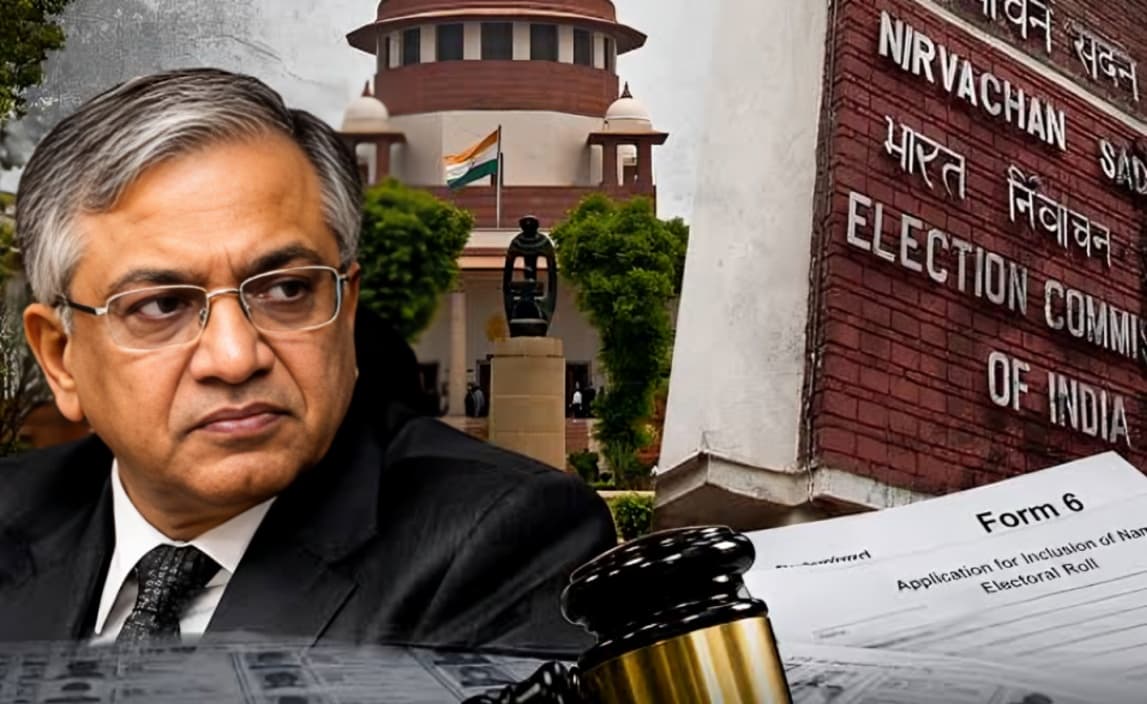

The Supreme Court has declined to grant interim relief to the All India Trinamool Congress in its challenge concerning the freezing of the party’s bank accounts by the Enforcement Directorate. The Supreme Court on August 11 refused to interfere with the interim arrangement put in place by the Calcutta High Court.
The case relates to bank accounts that were frozen in connection with an Enforcement Directorate investigation into alleged financial irregularities and money laundering. The TMC had approached the courts seeking relief and permission to operate the accounts.
The Supreme Court observed that the arrangement made by the Calcutta High Court was balanced and adequately protected the interests of the parties involved. The bench said it was not inclined to interfere with the High Court’s order at the present stage.
The court also took note of the fact that the main proceedings are still pending before the Calcutta High Court. Since the matter remains under consideration there, the Supreme Court considered it inappropriate to examine the merits of the allegations in detail at this stage.
The Enforcement Directorate had frozen three bank accounts associated with the Trinamool Congress as part of its investigation. Reports have put the total amount involved in the frozen accounts at around Rs 440 crore. The agency’s investigation concerns alleged financial irregularities and the suspected routing of funds through the accounts. These allegations remain part of the ongoing legal proceedings and have not been finally adjudicated by the court.
The TMC had sought access to the funds, particularly for meeting its regular organisational expenses. The issue of whether the party should be permitted to use money for day to day operations had also come before the courts during the proceedings.
The Calcutta High Court had earlier passed an interim arrangement concerning the operation of the frozen accounts. Under the arrangement, the interests of the parties were to be protected while the legal proceedings continued. The Supreme Court has now chosen not to disturb that arrangement.
The Supreme Court’s decision does not amount to a final determination of the underlying allegations against the party or any individual connected with the investigation. Instead, the court has limited its consideration to the interim relief sought by the TMC and the existing arrangement ordered by the High Court.
The bench also indicated that the parties could continue to raise their objections before the special officer appointed in connection with the matter. The parties retain the opportunity to place their arguments before the Calcutta High Court, where the main proceedings remain pending.
The dispute has political significance because the Trinamool Congress is a major political party in West Bengal. Restrictions on access to party funds can affect its organisational activities, particularly during periods of heightened political activity.
At the same time, the Enforcement Directorate’s action is part of an investigation under the Prevention of Money Laundering Act. The agency has been examining financial transactions and allegations connected with the case. The TMC has challenged the restrictions and sought judicial intervention.
The Supreme Court’s latest decision means that the interim framework created by the Calcutta High Court will continue for the time being. The party’s objections can be considered through the mechanisms already established by the High Court.
The court’s description of the High Court order as balanced is significant because it indicates that the judges did not find sufficient grounds to replace the existing interim arrangement with a different one. The bench also avoided making observations on the merits that could influence the pending proceedings before the High Court.
The case will therefore continue before the Calcutta High Court. The next stages are expected to focus on the objections raised by the parties, the circumstances surrounding the freezing of the accounts and the legal questions arising from the Enforcement Directorate’s investigation.
For the TMC, the immediate outcome is that it has not received the broader interim relief it sought from the Supreme Court. However, the party continues to have the opportunity to present its objections before the special officer and the High Court.
For the Enforcement Directorate, the Supreme Court’s refusal to interfere means that the existing interim restrictions remain in place while the investigation and related proceedings continue.
The development is therefore an interim legal outcome rather than a final judgment on the allegations involved in the investigation. The underlying proceedings remain pending, and any final determination on the substantive issues will have to come through the appropriate legal process.
The Supreme Court’s latest order highlights the importance of allowing the lower court proceedings to continue without premature interference. By maintaining the existing arrangement, the court has left the parties to pursue their respective claims before the Calcutta High Court while keeping the merits of the dispute open for consideration.