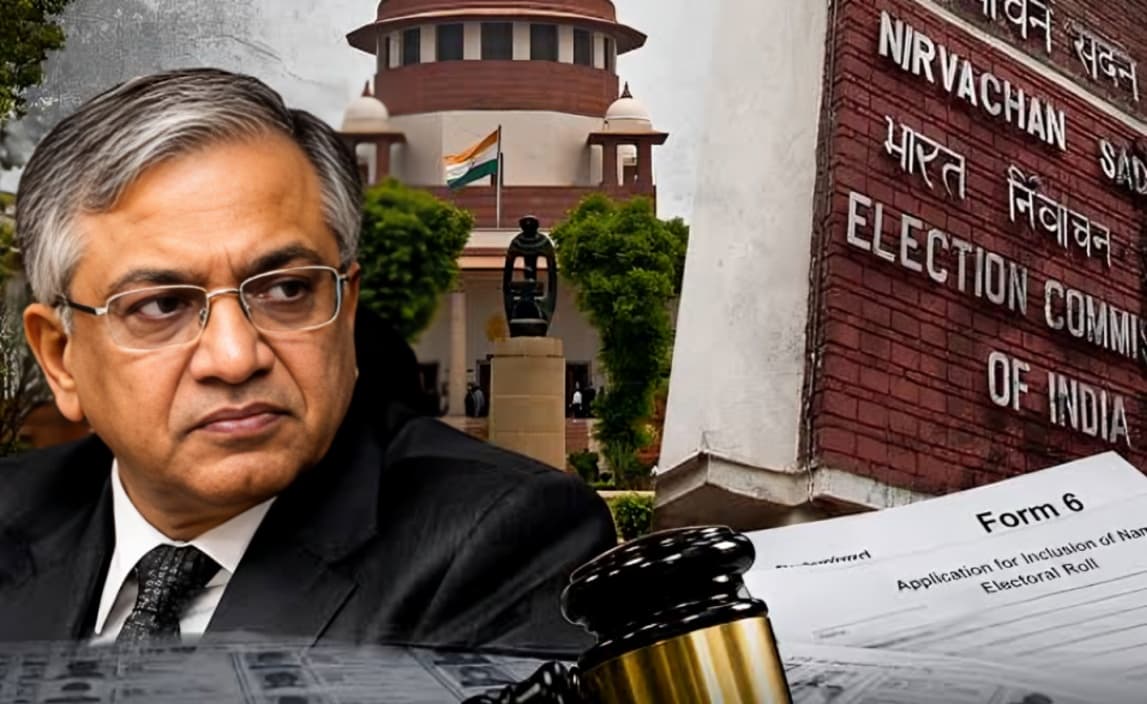

The Supreme Court has set aside an order passed by a tribunal in the insolvency proceedings involving Essel Infraprojects after observing that the judgment relied on legal precedents that did not exist. According to the Court, the cited authorities appeared to have been generated using Artificial Intelligence without proper verification, raising serious concerns about the accuracy of legal references used in judicial proceedings.
The case came before the Supreme Court during the examination of the tribunal's decision in an insolvency matter. While reviewing the judgment, the Court found that several judicial precedents cited in support of the tribunal's conclusions could not be traced in any official legal records or recognized law reports.
The Supreme Court observed that judicial decisions must be based only on authentic legal materials, verified precedents, and applicable statutory provisions. The use of fabricated or non existent case citations, regardless of how they were created, cannot form the basis of a legally sustainable judgment.
The Court noted that advances in Artificial Intelligence have made research tools more accessible to legal professionals and institutions. However, it cautioned that AI generated content may sometimes produce inaccurate or fictitious information, commonly referred to as AI hallucinations. Such material must always be independently verified before being used in legal arguments, judicial orders, or official documents.
During the proceedings, the Supreme Court emphasized that judges, lawyers, and tribunals have a responsibility to verify every legal authority cited before relying on it in judicial reasoning. Failure to do so could undermine the integrity of the justice delivery system and affect public confidence in judicial institutions.
As a result of its findings, the Supreme Court set aside the tribunal's order and directed that the matter be reconsidered in accordance with the law. The Court clarified that future proceedings should rely only on verified judicial precedents, statutory provisions, and legally admissible evidence.
Legal experts believe the ruling highlights the growing importance of responsible use of Artificial Intelligence within the legal profession. While AI based legal research tools can improve efficiency by assisting with document review and case searches, they cannot replace professional legal judgment or independent verification of legal authorities.
The judgment also serves as a reminder that technological tools should support legal research rather than become the sole basis for judicial reasoning. Courts continue to emphasize that every legal citation included in pleadings or judgments must be capable of verification through official legal databases or authoritative law reports.
The decision is expected to influence future judicial practices by encouraging greater caution in the use of Artificial Intelligence for legal research. Law firms, legal practitioners, and tribunals may adopt stricter verification procedures to ensure that AI generated outputs are carefully reviewed before being incorporated into court documents.
The Supreme Court's ruling reinforces the principle that judicial decisions must always be founded on authentic legal authorities, established precedents, and applicable statutory provisions. As Artificial Intelligence becomes more widely used across the legal sector, the judgment underscores the continuing importance of human oversight, legal expertise, and thorough verification in maintaining the integrity of the justice system.