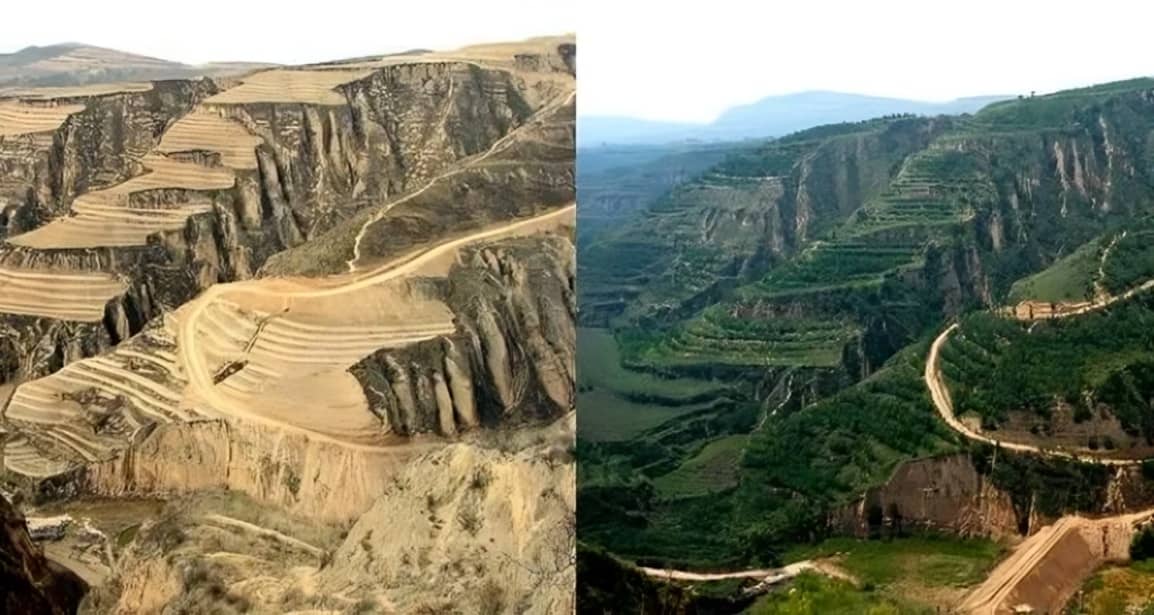
China’s large-scale environmental restoration efforts on the Loess Plateau have helped increase vegetation cover, but scientific research has identified a potential cost for the region’s groundwater resources. A study published in the Journal of Hydrology in December 2020 found that groundwater storage declined significantly and groundwater drought intensified between 2003 and 2015 as vegetation expanded across the region.
The findings highlight the challenges of restoring ecosystems in areas where water is already scarce. While planting trees and grasses can help protect soil and improve the landscape, increased vegetation can also raise water consumption. This creates a need to balance environmental recovery with the long-term availability of groundwater.
The Loess Plateau, located in north-central China, is known for its fragile environment, soil erosion and water limitations. Groundwater is an important resource for vegetation, agriculture and communities in the region. Changes in groundwater availability can therefore affect both the natural environment and people who depend on local water resources.
Restoration Programme Began in 1999
China began its large-scale Grain for Green restoration programme on the Loess Plateau in 1999. The initiative aimed to reduce soil erosion and restore degraded land by encouraging vegetation growth and converting some steep farmland into forest or grassland.
The programme was designed to address serious environmental problems. Vegetation can help stabilise soil, reduce the impact of rainfall on exposed land and limit soil erosion. Plant roots also help hold soil together, while plant cover can reduce the movement of sediment during heavy rainfall.
Over time, restoration activities contributed to increased vegetation cover across substantial parts of the plateau. However, ecological changes also affected the region’s water cycle. Plants absorb water through their roots and release it into the atmosphere through a process known as transpiration. As vegetation becomes denser and plant growth increases, total water use may rise.
In a region with limited rainfall and frequent drought conditions, this additional demand can place pressure on soil moisture and groundwater resources.
What Researchers Found Between 2003 and 2015
The researchers examined changes in groundwater drought on the Loess Plateau between 2003 and 2015. Their study, titled “Effects of vegetation restoration on groundwater drought in the Loess Plateau, China,” investigated how expanding vegetation was related to groundwater conditions.
The team estimated groundwater changes by separating groundwater-related variations from total terrestrial water storage data obtained through the Gravity Recovery and Climate Experiment satellite mission. The researchers also used soil moisture data from the Global Land Data Assimilation System to help distinguish groundwater changes from variations in soil water.
The findings showed that vegetation growth, measured using the Normalized Difference Vegetation Index, increased rapidly during the study period. At the same time, groundwater storage declined significantly, and groundwater drought intensified in both its geographical extent and severity.
The study also found a stronger statistical relationship between vegetation conditions and groundwater drought than between several meteorological factors and groundwater drought at annual, seasonal and monthly scales. This relationship was particularly notable near key vegetation restoration areas.
The researchers identified the rate of vegetation growth as a major factor influencing groundwater drought in the region. They also reported that vegetation-related groundwater consumption was greater in areas where the relationship between vegetation and groundwater drought was statistically significant.
These results indicate that vegetation restoration needs to be assessed not only by how much land becomes greener but also by how much water the restored ecosystems require.
Why More Vegetation Can Increase Water Demand
Vegetation plays an essential role in environmental recovery, but different plants use different amounts of water. Trees with extensive root systems may draw moisture from deeper soil layers, while grasses and shrubs can also consume significant quantities of water depending on their species, density and growing conditions.
As vegetation cover increases, more water may be returned to the atmosphere through evapotranspiration, which combines evaporation from land and water surfaces with transpiration from plants. Depending on rainfall, soil conditions and local climate, this can reduce the amount of water available for groundwater recharge.
Groundwater recharge occurs when water moves downward through the soil and replenishes underground water reserves. If vegetation uses more water and less water reaches deeper soil layers, groundwater replenishment may be limited.
The relationship is complex, however. Groundwater levels can also be influenced by rainfall, temperature, evaporation, land use, water extraction and other human activities. The study identifies vegetation growth as an important factor associated with groundwater drought, but its findings should not be interpreted as proof that vegetation restoration alone caused every observed groundwater decline.
Environmental Benefits and Water Management Challenges
Restoration programmes can provide substantial ecological benefits. On the Loess Plateau, increased vegetation has helped improve soil conservation and restore parts of a landscape that had experienced serious erosion. Broader research on the Grain for Green programme has also documented improvements in several ecosystem services, including carbon sequestration and soil conservation.
Nevertheless, these benefits must be considered alongside the availability of water. A restoration strategy that works well in a wetter region may not be suitable for a dry area where groundwater reserves are limited.
Scientists have therefore emphasised the importance of choosing appropriate plant species, considering local rainfall patterns and monitoring changes in soil moisture and groundwater storage. Restoration plans should account for the amount of water that different types of vegetation require, rather than focusing only on increasing green cover.
Natural regeneration may also be an option in some locations, depending on local conditions. The appropriate approach can vary according to soil characteristics, climate, land use and the existing ecosystem.
Lessons for Future Ecological Restoration
The Loess Plateau research provides an important lesson for countries undertaking large-scale tree planting, afforestation and land restoration projects. Increasing vegetation cover can improve environmental conditions, but success should not be measured by greenness alone.
Long-term monitoring of groundwater levels, soil moisture, rainfall and vegetation growth can help authorities identify areas where restoration may be placing excessive pressure on water resources. Satellite observations can provide valuable information across large regions, while local measurements can help verify changes on the ground.
The research also highlights the importance of adapting restoration plans to local water availability. Selecting suitable vegetation, protecting groundwater recharge areas and evaluating water demand before expanding plantations may help reduce the risk of unintended environmental consequences.
The central message is not that vegetation restoration should stop. Rather, ecological recovery and water conservation need to be planned together. In dry and drought-prone landscapes, restoration strategies are more likely to remain sustainable when they improve soil and vegetation conditions without exceeding the limits of available water resources.
China’s experience on the Loess Plateau demonstrates why environmental programmes require continued scientific assessment. The region’s increasing vegetation cover represents a significant ecological change, while the recorded decline in groundwater storage between 2003 and 2015 underlines the importance of managing water resources carefully.