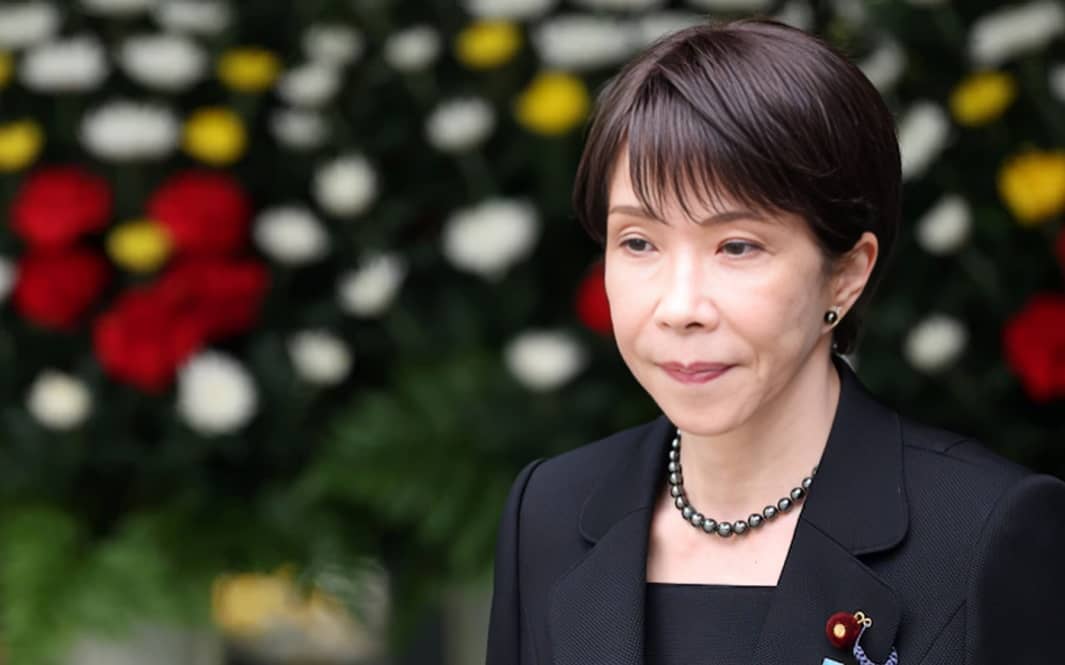
Japanese Prime Minister Sanae Takaichi has attracted international attention after sharing an unusual personal story about a cockroach that appeared inside her official residence in Tokyo.
In a social media post, Takaichi described how she encountered the insect while living at the official residence. The incident took an unexpected turn when she revealed that she felt a sense of loneliness after her staff removed the cockroach.
Takaichi said she had never encountered a cockroach while living in parliamentary accommodation. However, after moving into the official Prime Minister's residence, she eventually came across one inside the building.
The Prime Minister said she maintains the residence carefully. She described regularly cleaning the floor beneath the dining table, properly storing food waste in a covered bin and washing and sorting plastic containers.
Despite those precautions, a cockroach suddenly ran past her feet one day, leaving her shocked. According to her account, she screamed when she saw it.
Takaichi explained that she could not bring herself to kill the insect. She linked this unusual reaction to her childhood interest in Osamu Tezuka's Phoenix manga, a work that deals with themes of reincarnation and the continuity of life.
She said that these ideas had remained with her and influenced her attitude towards insects. Instead of killing the cockroach, she initially decided to leave it alone and hoped that it would eventually leave the residence on its own.
Her staff members, however, took a different view.
After learning about the cockroach, her secretaries reportedly considered the situation unhygienic and decided to take action. They arranged what Takaichi described as an operation to eliminate the insect.
Following the intervention, the cockroach was no longer seen inside the residence.
The Prime Minister's reaction after the incident was perhaps the most unexpected part of the story. Rather than simply celebrating the removal of the pest, Takaichi said she experienced mixed emotions.
She said she felt relieved that the cockroach was gone, but also felt a little lonely or sad.
Her comments quickly attracted attention because of the unusual combination of humour, personal reflection and the demanding life of a national leader.
The story has also drawn attention to the history of Japan's official Prime Ministerial residence. The building, known as the official residence or Kotei, is a historic structure that has been associated with Japan's political history and has long been surrounded by stories about its past.
The residence was built in 1929 and has witnessed major events in Japanese political history. It was associated with the assassination of Prime Minister Tsuyoshi Inukai during an attempted military coup in 1932. Another attempted coup took place in 1936, adding to the building's unusual reputation.
Because of this history, questions about whether the residence is haunted have occasionally attracted public attention. Takaichi addressed such questions in her social media post.
She said that she had not encountered any ghosts at the residence. Instead, the creature that caused her concern was a much more ordinary visitor, the cockroach.
Her comments have therefore provided a lighter and more personal perspective on life inside one of Japan's most important government buildings.
The incident also comes amid discussion about Takaichi's working habits and her increasing use of the official residence as a workplace.
Takaichi has explained that she moved into the official residence partly because of security and efficiency considerations. Since the residence is located next to the Prime Minister's Office, she can reach her workplace quickly when an emergency occurs.
She has also said that the residence has facilities that allow her to conduct meetings and other official duties. Staff meetings can be held there, while remote meetings with foreign leaders and other officials can also be conducted.
According to Takaichi, using the residence as a workplace can reduce the burden on government employees and security personnel. She has said that she tries to move between the Prime Minister's Office and the residence efficiently and limits unnecessary travel.
Her explanation has come amid reports and public discussion about her demanding working schedule and the amount of time she spends at the residence.
The cockroach story therefore provides an unusual glimpse into the personal side of a Prime Minister whose daily life is normally dominated by government responsibilities, security arrangements and political decisions.
Takaichi's reaction also reflects the personal influence that books and childhood experiences can have on an individual. In her account, her connection with the Phoenix manga helped shape her reluctance to kill insects.
The manga, created by Osamu Tezuka, explores themes including life, death and reincarnation. Takaichi said these ideas had remained meaningful to her even as an adult.
Her decision to leave the cockroach alone was therefore not simply about fear or hesitation. It was connected to her personal beliefs and memories.
Her staff members ultimately resolved the problem, after which the insect disappeared from the residence.
The Prime Minister's comment about feeling lonely after its removal has been the most widely discussed part of the story. It presented an unusual emotional response to an otherwise ordinary household incident.
The story has been widely reported because it contrasts sharply with the seriousness normally associated with the Japanese Prime Minister's official duties.
While the incident itself has no direct political implications, it has offered the public an informal look at Takaichi's personality and her life away from formal government meetings.
The episode has also generated interest because Takaichi has been using social media to communicate more directly with the public about her activities and experiences.
Her recent posts have included explanations about why she spends significant amounts of time working from the official residence. She has described the residence as both her home and a functional workplace.
The building allows her to handle documents, meet staff members and conduct official meetings without travelling away from the government complex.
For Takaichi, the arrangement is intended to improve efficiency and ensure that she can respond quickly when necessary.
The unusual cockroach episode has therefore become part of a broader picture of her daily life at the residence.
At the same time, the story should not be interpreted as evidence of any official problem at the Prime Minister's residence. It was presented by Takaichi as a personal anecdote rather than a government announcement.
The incident also illustrates how social media can turn an ordinary private experience involving a public figure into an international news story.
A senior political leader discussing a household pest, her decision not to kill it and her unexpected emotional reaction after its removal is naturally unusual. That combination has helped the story attract attention beyond Japan.
Takaichi's account ultimately ended with a mixture of relief and sadness. The cockroach was gone, but she said she felt a little lonely afterward.
The unusual episode has given the public a rare glimpse into the personal thoughts of Japan's Prime Minister and has become one of the more unexpected stories surrounding her official residence.