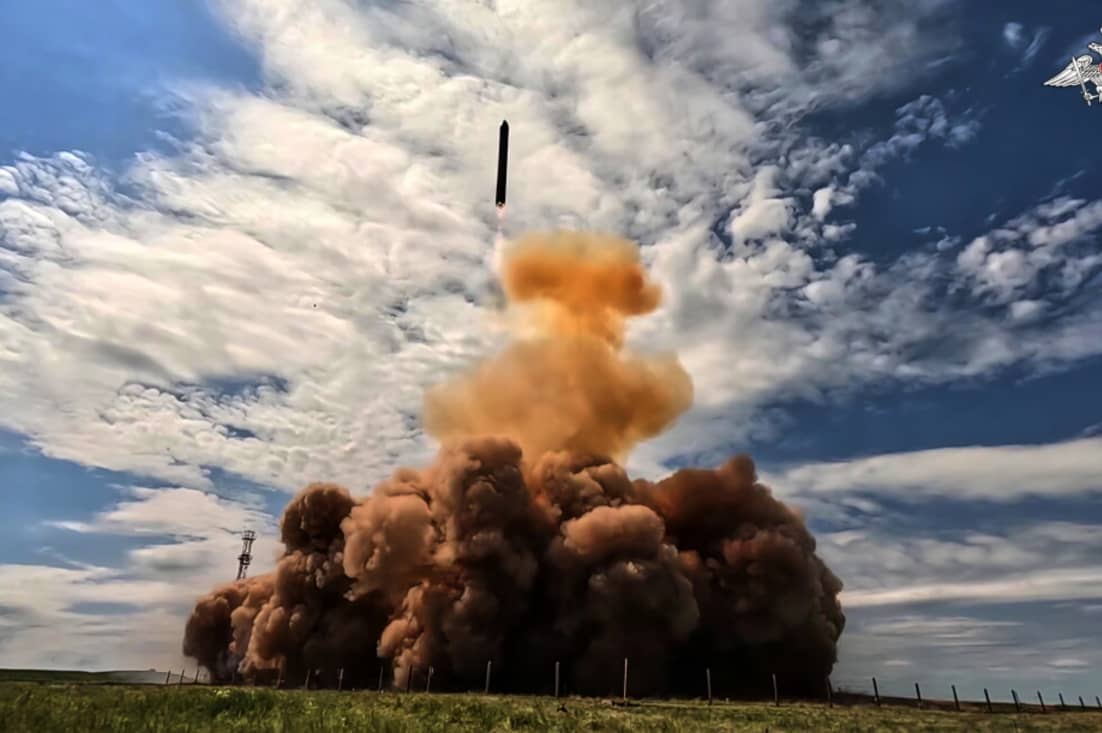
Russia has conducted a successful test launch of a mobile intercontinental ballistic missile from the Plesetsk Cosmodrome in the Arkhangelsk region, according to the Russian Defence Ministry.
The missile travelled more than 6,700 kilometres across Russia before reaching the designated target area at the Kura missile test range on the Kamchatka Peninsula in the Russian Far East. The Russian military released video footage showing the launch from a remote area.
According to the Defence Ministry, the main objective of the exercise was to verify the tactical, technical and flight characteristics of the missile system. Russian officials said that all assigned objectives of the launch were completed successfully.
The Defence Ministry did not publicly identify the exact missile model used in the latest launch. Reports have linked Russia’s mobile solid fuel ICBM systems with missiles such as the RS 24 Yars, but the specific weapon involved in this test has not been officially confirmed.
An intercontinental ballistic missile is designed to travel very long distances and can be equipped to carry nuclear warheads. Russia maintains one of the world's largest nuclear arsenals and regularly conducts missile tests as part of its strategic forces training and readiness activities.
The latest launch began at the Plesetsk Cosmodrome, a major Russian military and space launch facility located in the northern Arkhangelsk region. The missile was launched from a mobile launcher positioned in a remote area before travelling eastward toward the Kura test range.
The Kura range, located in Kamchatka, is one of Russia’s principal sites for testing ballistic missiles. Missiles launched from different Russian testing facilities have historically been directed toward the range because of its remote location and distance from major population centres.
The latest test covered a distance of more than 6,700 kilometres. The successful arrival of the missile at its designated target area was described by Russian authorities as confirmation that the system completed its assigned flight programme.
The timing of the launch has attracted international attention because it occurred shortly after CIA Director John Ratcliffe travelled to Moscow. Ratcliffe’s visit was confirmed by the Kremlin, which said he met with Russian intelligence officials. Kremlin spokesperson Dmitry Peskov said Russian President Vladimir Putin was briefed about the outcome of the discussions, although Putin did not personally meet Ratcliffe.
Ratcliffe’s visit was notable because it was the first publicly known visit to Moscow by a serving CIA director since former CIA Director William Burns travelled to Russia in 2021. The purpose of the latest visit was not fully disclosed, although US and Russian officials confirmed that intelligence level discussions took place.
US President Donald Trump described Ratcliffe’s Moscow trip as semi routine, while the Kremlin characterised continued intelligence contacts as useful despite the serious tensions between Russia and the United States.
The missile test has nevertheless generated speculation about its possible strategic message. Some reports have interpreted the timing as a demonstration of Russian military capability amid increasing tensions between Moscow and Western countries.
However, there is no official confirmation that the missile test was specifically intended as a warning to NATO. The Russian Defence Ministry’s stated explanation was that the launch was conducted to test the performance and flight characteristics of the missile system.
The distinction is important because strategic missile forces routinely conduct test launches and training exercises. Such launches can serve several purposes, including checking the reliability of equipment, training personnel, confirming flight performance and demonstrating the readiness of strategic forces.
The latest test also comes amid continuing tensions between Russia and Western countries over the war in Ukraine. Moscow and NATO members have repeatedly exchanged warnings and accusations over military support, weapons deliveries and the risk of escalation.
Recent reports have also suggested that US officials are concerned about Russia’s intentions toward NATO members. Some reports said Ratcliffe’s Moscow visit may have included a warning against any potential attack on NATO territory. However, the details of those discussions have not been officially disclosed.
The Russian government has rejected suggestions that it is preparing an attack on NATO and has repeatedly accused Western countries of escalating the conflict through military assistance to Ukraine.
The latest missile exercise therefore needs to be viewed within a wider strategic environment involving Russia, the United States, NATO and Ukraine.
The missile launched from Plesetsk was described by Russian authorities as a mobile, solid fuel intercontinental ballistic missile system. Mobile launchers are designed to provide greater flexibility because they can be moved between locations rather than remaining permanently stationed at a fixed launch site.
Russia has continued to modernise its strategic nuclear forces, including land based missiles, submarine launched ballistic missiles and strategic bombers. Missile tests are used to evaluate individual systems and maintain the operational readiness of the country's strategic forces.
The 6,700 kilometre flight demonstrates the long range capability of the missile system involved in the test. The distance between Plesetsk and Kura provides a realistic environment for testing an ICBM over a substantial portion of its potential flight path.
The Kura test range has been used for decades for Russian ballistic missile tests. Its location in the remote Kamchatka region allows authorities to conduct long range missile exercises with comparatively limited risks to populated areas.
The Defence Ministry’s video of the latest launch showed the missile rising from a wooded area after being fired from a mobile launcher. Russian officials said the missile followed its planned trajectory and successfully completed the assigned mission.
The launch also comes after reports of heightened military activity involving Russia and Western countries. Moscow has recently issued warnings over Western military assistance to Ukraine, while NATO members have continued strengthening their defensive preparations.
Despite the heightened rhetoric, the latest ICBM test should not automatically be interpreted as evidence that Russia intends to launch an attack against NATO. Strategic missile tests are a regular part of nuclear powers’ military readiness programmes.
At the same time, such tests can have a signalling effect because they demonstrate the capabilities and readiness of a country's strategic forces. This is particularly significant when conducted during periods of heightened geopolitical tension.
The international community is therefore closely watching Russia’s military activities, particularly developments involving nuclear capable systems. The United States and NATO have their own strategic deterrence capabilities and regularly conduct exercises and tests involving nuclear capable delivery systems.
For now, the confirmed information is that Russia conducted a successful long range ICBM test from the Plesetsk Cosmodrome, with the missile travelling more than 6,700 kilometres before reaching the Kura test range. The Russian Defence Ministry described the exercise as a test of the missile system’s tactical, technical and flight characteristics.
The timing of the test, shortly after the CIA director’s Moscow visit, has generated additional speculation. However, no official source has established that the launch was directly connected to Ratcliffe’s visit or was specifically intended as a warning to NATO.
The development is nevertheless significant because it demonstrates that Russia continues to test and maintain its strategic missile capabilities while relations with the United States and NATO remain under considerable strain.