

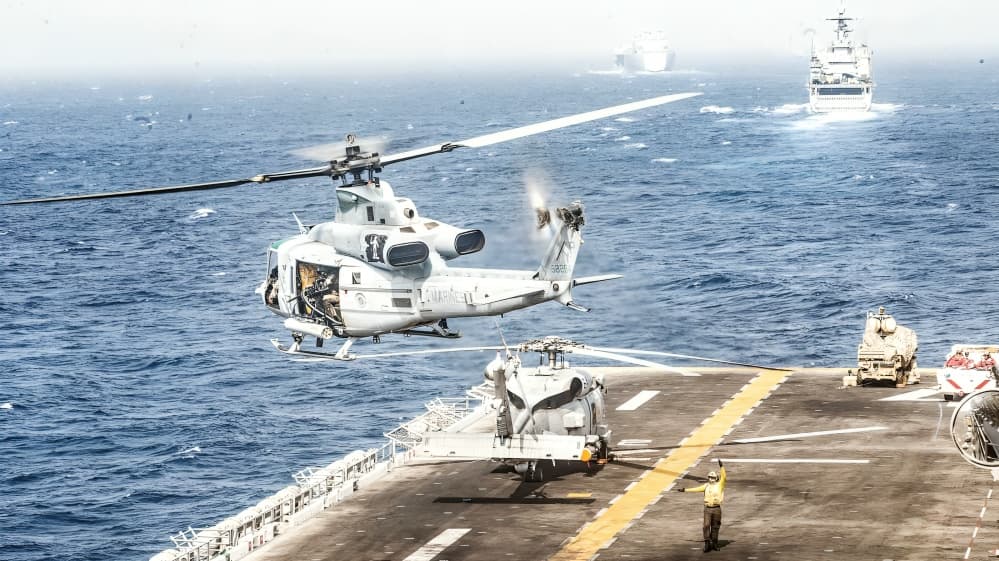
US President Donald Trump has sparked fresh international concern after a new audio recording surfaced in which he discussed a significant US military deployment toward Iran. The audio, recorded aboard Air Force One, captures Trump describing a “big flotilla,” an “armada,” and a “massive force” moving toward the Middle East. While he does not explicitly confirm a military strike, the remarks come amid reports of US naval and air assets being positioned near Iranian waters.
According to Reuters sources, the deployment includes warships and an aircraft carrier strike group, indicating a substantial show of force. Trump, in the audio, said he hopes that military action will not be required but did not rule out the possibility if circumstances escalate. Analysts note that the ambiguous language has fueled speculation about potential US-Iran military tensions, particularly in a region already fraught with geopolitical risks.
The announcement coincides with a period of heightened tension in the Middle East, following repeated warnings from both Washington and Tehran over regional security and strategic interests. US military officials emphasize that the movements are intended as a deterrent rather than a signal of imminent attack. Still, the scale of the deployment suggests that the Pentagon is prepared for a range of contingencies if the situation deteriorates.
Historically, statements from US presidents regarding Iran have had immediate implications for oil markets, regional security, and global diplomacy. Experts warn that even the perception of a potential conflict could trigger economic and political instability. Trump’s remarks, although not confirming a strike, have prompted discussions in international media and diplomatic circles about the risks of escalation and the potential for miscalculation.
The Iranian government has not yet officially responded to the audio, but previous statements have indicated a readiness to defend its territorial and strategic interests. Any confrontation between US forces and Iran carries the potential to affect shipping lanes in the Gulf, disrupt energy markets, and draw in other regional actors.
Analysts also point out that Trump’s comments, coupled with the visible military movement, may serve multiple purposes, including signaling resolve to domestic and international audiences while attempting to deter Iranian aggression. Observers note that such high-profile deployments are often used as leverage in diplomatic negotiations or as a show of strength during periods of political uncertainty.
For now, the situation remains fluid. US military officials are closely monitoring developments, while diplomats continue efforts to manage tensions through dialogue and international channels. Analysts caution that even without direct military engagement, the mere positioning of a large naval force in proximity to Iran increases the risk of misinterpretation or unintended escalation.
The unfolding developments highlight the delicate balance between deterrence and provocation in US-Iran relations and underscore the global implications of strategic military posturing in the Middle East.


