

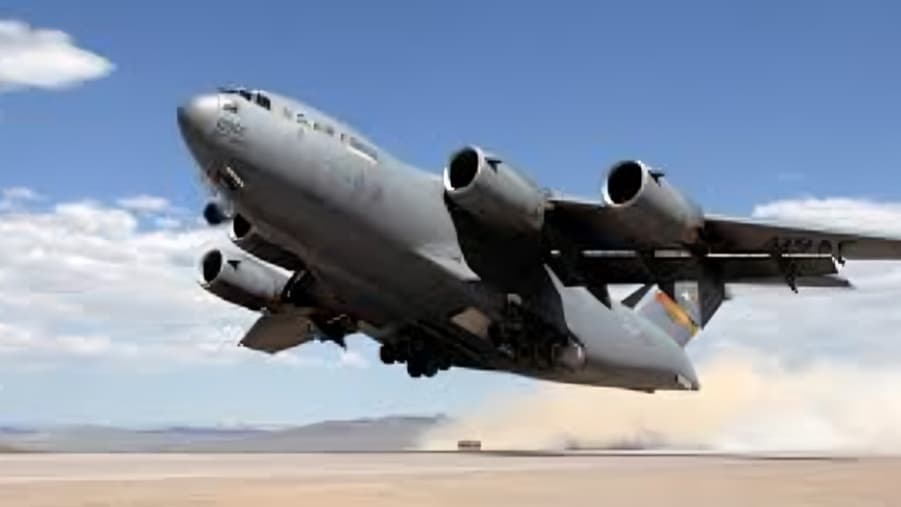
A United States Air Force C 17 Globemaster III transport aircraft declared a general in flight emergency while travelling between Abu Dhabi and Doha, according to publicly available flight tracking information. The aircraft was operating under the callsign MOOSE31 when it transmitted squawk 7700, the internationally recognised emergency transponder code used by pilots to indicate a serious situation requiring immediate attention.
Squawk 7700 is a four digit code entered into an aircraft’s transponder system to alert air traffic control to a general emergency. When this code is activated, it signals controllers that the aircraft may be facing mechanical problems, medical emergencies, or other critical issues. Upon receiving such a signal, air traffic authorities typically grant the aircraft priority handling and coordinate necessary assistance.
The aircraft involved in the incident was identified as a C 17 Globemaster III, a large military transport aircraft widely used by the United States Air Force for strategic airlift missions. The C 17 is capable of carrying troops, cargo, and humanitarian supplies across long distances and is often deployed for military logistics and emergency response operations.
The emergency declaration by the aircraft was visible on flight tracking platforms that monitor transponder signals transmitted by aircraft. These platforms collect and display publicly accessible data, including flight paths, altitude, speed, and emergency codes. The appearance of squawk 7700 on such systems quickly drew attention from aviation observers.
As of the time of reporting, the US Air Force has not released an official statement detailing the cause of the emergency. It is common for military authorities to withhold specific operational information for security and safety reasons. Without formal confirmation, the exact nature of the issue remains unclear.
Military aircraft movements between locations such as Abu Dhabi and Doha often involve logistical or operational assignments. The region hosts significant strategic and military infrastructure, and US Air Force aircraft regularly operate in coordination with allied forces. However, the declaration of an emergency does not necessarily indicate a catastrophic event. In many cases, such alerts are precautionary measures taken to ensure safety.
Aviation experts note that squawk 7700 can be triggered by a wide range of circumstances. These may include engine performance concerns, hydraulic system warnings, cabin pressurisation issues, or onboard medical situations. In all cases, the code ensures rapid communication between the flight crew and air traffic control authorities.
There were no immediate reports of injuries, forced landings, or visible disruptions linked to the flight at the time of writing. Further updates may be issued by official sources if additional information becomes available.
In conclusion, the US Air Force C 17 aircraft operating under callsign MOOSE31 transmitted squawk 7700 during its flight between Abu Dhabi and Doha, indicating a general emergency. While the precise cause has not been disclosed, the use of the emergency code ensured priority coordination with air traffic control.


