

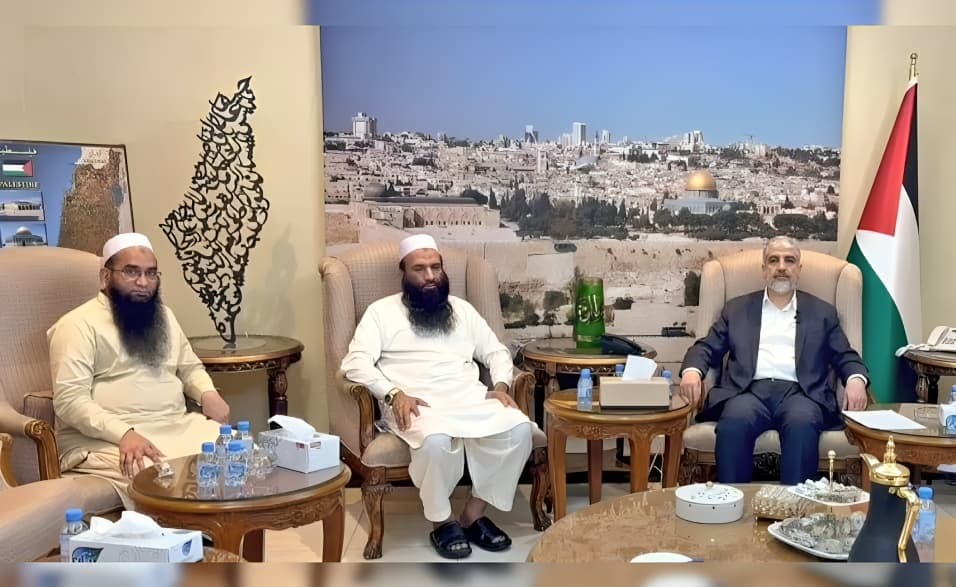
A video that surfaced recently has brought renewed focus on alleged links between Pakistan-based extremist networks and Middle Eastern militant groups. In the footage, Faisal Nadeem, a senior figure associated with the Pakistan Markazi Muslim League, is seen acknowledging a meeting with top Hamas leaders in Doha, Qatar, in 2024.
Pakistan Markazi Muslim League is widely viewed by security agencies as the political front of Lashkar-e-Taiba, a Pakistan-based organisation designated as a terrorist group by several countries, including the United States. In the video, which has been accessed by Indian media outlets, Nadeem states that he met Hamas leader Khaled Mashal and was accompanied by Saifullah Kasuri during the interaction.
The video does not specify the purpose of the meeting or the nature of discussions held. However, the acknowledgment itself has triggered concerns among security analysts due to the international status of both organisations. Hamas is designated as a terrorist organisation by the United States, Israel, and several other nations, while Lashkar-e-Taiba has been linked to multiple terror attacks, including the 2008 Mumbai attacks.
According to experts, any form of engagement or coordination between groups operating across different regions could complicate regional security dynamics. While the authenticity of the video has not yet been independently verified by authorities, officials say the claims warrant close monitoring and further investigation.
Doha has previously hosted political leaders from various Palestinian factions as part of diplomatic and mediation efforts in the region. However, meetings involving individuals linked to proscribed organisations often attract scrutiny from intelligence agencies due to the risk of operational coordination, funding transfers, or ideological alignment.
Security analysts note that such interactions, if confirmed, may signal attempts to build broader networks across South Asia and West Asia. These developments come at a time of heightened global vigilance over extremist movements and their cross-border connections.
Indian security officials have not issued an official statement on the video so far. However, past intelligence assessments have repeatedly warned about attempts by Pakistan-based groups to seek ideological or operational support beyond South Asia.
The emergence of the video also underscores the increasing role of digital evidence in tracking extremist activities. Open-source videos and online statements are now frequently used by analysts to identify patterns of engagement and movement among individuals associated with radical groups.
Authorities are expected to examine the claims carefully, verify the content, and assess whether the meeting violated international norms or sanctions. Any confirmed coordination between designated terrorist organisations could invite diplomatic responses and international action.
As global counter-terrorism efforts increasingly focus on dismantling transnational networks, such revelations, if substantiated, could add pressure on states to tighten oversight and enforcement against extremist linkages.


