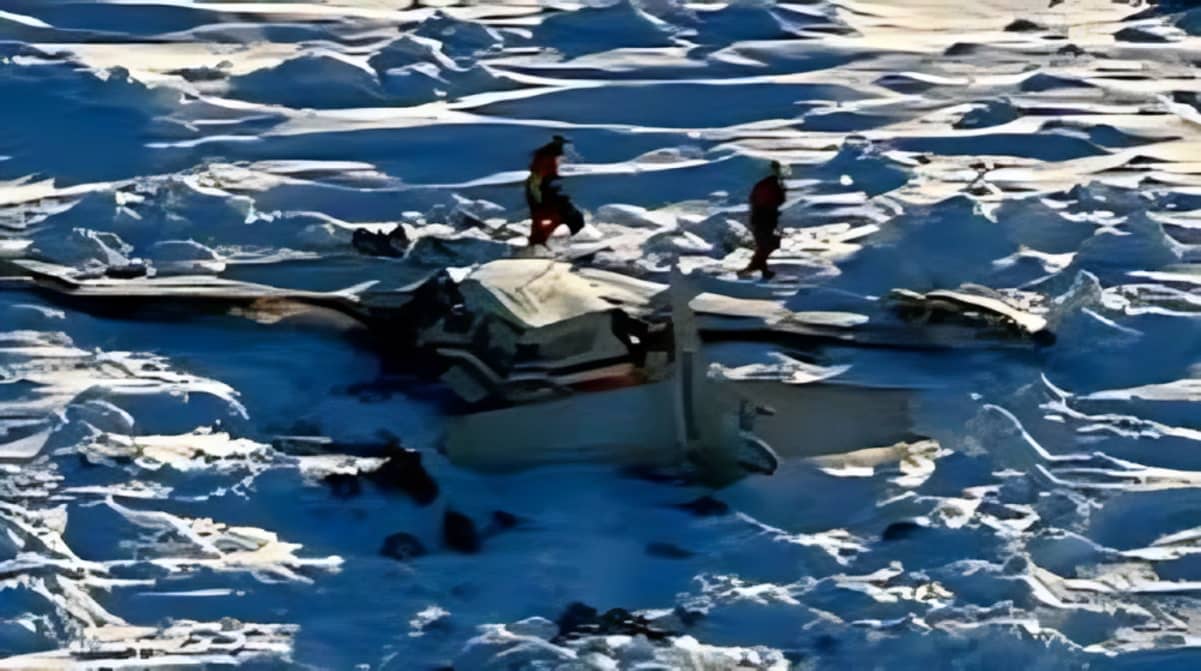
A charter aircraft carrying eight people crashed near a remote military radar site in western Alaska on Thursday, resulting in the deaths of all eight people on board. The US military’s Alaskan Command confirmed the fatalities following the crash.
The aircraft crashed at or near the Cape Newenham Long Range Radar Site Airport, a remote facility located approximately 450 miles or 725 kilometres west of Anchorage. The location is part of a network of radar installations that monitor aircraft activity in Alaska’s airspace and along the state’s borders.
According to the National Transportation Safety Board, the aircraft was carrying two pilots and six passengers. The plane had departed from Anchorage and was believed to have crashed during its approach to the Cape Newenham facility early Thursday afternoon.
The aircraft was described by the US military as a civilian contracted aircraft. The military did not immediately provide detailed information about the specific work being carried out by the people aboard the plane.
US Air Force Lieutenant General Robert Davis, commander of Alaskan Command, the Alaskan North American Aerospace Defense Command Region and the Eleventh Air Force, described the incident as a devastating loss. He said the priority was supporting the families, friends and colleagues of those who died.
The crash occurred in a particularly remote part of western Alaska, where access to the site can be challenging. The distance from major population centres and the area's rugged environment can make emergency response and recovery operations more difficult.
The Cape Newenham radar facility is managed by the Pacific Air Forces Regional Support Center. It forms part of a wider network of remote radar sites used to monitor aircraft operating in and around Alaska.
Alaska's radar network has an important role in monitoring the state's airspace because of its geographical position and proximity to international air routes and borders. The remote radar facilities provide surveillance capabilities in areas where conventional infrastructure is limited.
The accident has therefore drawn attention not only because of the loss of life but also because it occurred at a facility connected to the United States' airspace monitoring system.
According to the Federal Aviation Administration, the aircraft crashed west of Cape Newenham LRRS Airport shortly after midday. The aircraft was identified in reports as a Cessna 441 operated by Anchorage based charter company Security Aviation. It had been travelling from Anchorage to Cape Newenham.
The cause of the crash has not yet been established. Investigators are expected to examine the aircraft, flight path, weather conditions, maintenance records and other available evidence as part of the investigation.
The National Transportation Safety Board is leading the investigation into the accident, while the Federal Aviation Administration is also involved. Initial information released by authorities remains preliminary and could change as investigators collect additional evidence.
Authorities have not indicated that the crash was caused by any particular mechanical, weather or operational problem. Therefore, it would be premature to speculate about the cause until investigators release further findings.
The remote location is likely to make the investigation more challenging. Investigators must reach the crash site, document the wreckage and recover relevant evidence before determining what happened during the aircraft's final approach.
Search and recovery teams responded to the incident after authorities were notified of the crash. The US military praised the personnel involved in the response and recovery operation.
The identities of those killed were not immediately released in the initial reports. Authorities generally wait until families have been notified before publicly identifying victims.
The accident has also affected the US military community because the aircraft was supporting operations at a military related facility. Although the aircraft itself was civilian operated, the passengers were reportedly travelling in connection with work associated with the remote radar installation.
The incident highlights the risks involved in operating aircraft in remote parts of Alaska. The state covers a vast geographical area and contains numerous isolated communities and facilities that can only be reached efficiently by air for much of the year.
Remote aviation operations can involve long distances, challenging terrain and rapidly changing weather conditions. However, investigators have not yet identified weather or terrain as the cause of this particular crash.
The Cape Newenham facility is situated in an isolated region of western Alaska. Its location allows the United States to maintain radar coverage in an area where maintaining conventional infrastructure would be difficult.
The radar station is part of a broader network of long range radar sites across Alaska. These facilities contribute to monitoring aircraft activity and maintaining awareness of potential airborne activity near US territory.
The accident therefore occurred in an area that has strategic importance for US airspace monitoring.
The investigation will likely focus initially on the aircraft's final moments before the crash. Investigators may examine communications with air traffic controllers, flight tracking information, aircraft maintenance records and available cockpit or aircraft data.
The NTSB's Alaska region chief, Clint Johnson, confirmed that two pilots and six passengers were aboard. He initially described the information as preliminary while authorities were still responding to the incident.
As the investigation progresses, authorities are expected to release additional information about the aircraft, its occupants and the circumstances surrounding the accident.
The incident comes at a time when aviation safety in Alaska continues to receive attention because of the state's dependence on air transportation. Remote communities and industrial or government facilities frequently rely on smaller aircraft and charter services.
While the majority of such flights operate safely, accidents in remote areas can present particular challenges for emergency response.
The crash also demonstrates the importance of maintaining strong safety standards for charter operations. Investigators will examine whether the aircraft was properly maintained and whether the flight was conducted under appropriate operating conditions.
At this stage, there is no evidence in the available official information indicating that the crash was connected to any security incident at the radar site.
The US military has focused its public statements on the loss of life, support for the victims' families and the efforts of search and recovery personnel.
Lieutenant General Davis described those aboard as professionals carrying out work in a demanding environment. The statement also acknowledged the efforts of personnel who responded to the accident.
For the families of the victims, the investigation will be important in establishing what happened and why. Determining the cause of the crash can also help authorities identify whether any safety measures need to be strengthened.
The NTSB typically conducts detailed investigations into aviation accidents, examining the aircraft's mechanical condition, operational history, weather information and human factors. Its findings can eventually include safety recommendations designed to prevent similar accidents.
The FAA also maintains aviation safety oversight and provides information during accident investigations. The agency has stated that preliminary information relating to aviation accidents can change as more evidence becomes available.
The crash site itself will be carefully examined for evidence. Investigators will document the location and condition of aircraft components and attempt to reconstruct the aircraft's final flight path.
Information from air traffic control and other aviation systems can help investigators establish the aircraft's speed, altitude and position before the crash.
The aircraft had reportedly departed Anchorage and was travelling toward Cape Newenham. Investigators will examine the complete journey rather than focusing only on the final approach.
Weather conditions will also form part of the investigation. Alaska can experience rapidly changing weather, particularly in remote areas. However, no official agency has yet stated that weather played a role in this accident.
The identities of the eight victims and additional details about their professional roles are expected to become clearer once next-of-kin notifications are completed and authorities release further information.
The tragedy has prompted condolences from officials and members of the communities connected with the radar facility and aviation operations.
The loss of eight lives is significant for the small communities and organisations involved in the remote operation. The recovery effort will continue to focus on locating and documenting all relevant evidence while providing support to the families.
The incident also serves as a reminder of the importance of aviation safety in remote environments. Charter aircraft provide essential transportation to many parts of Alaska, including locations that lack regular commercial airline service.
Remote radar facilities are particularly dependent on reliable transportation because personnel and equipment must be moved to locations far from major cities.
The Cape Newenham facility is one of several radar installations distributed across Alaska. These sites support the monitoring of aircraft activity and contribute to the broader US airspace surveillance network.