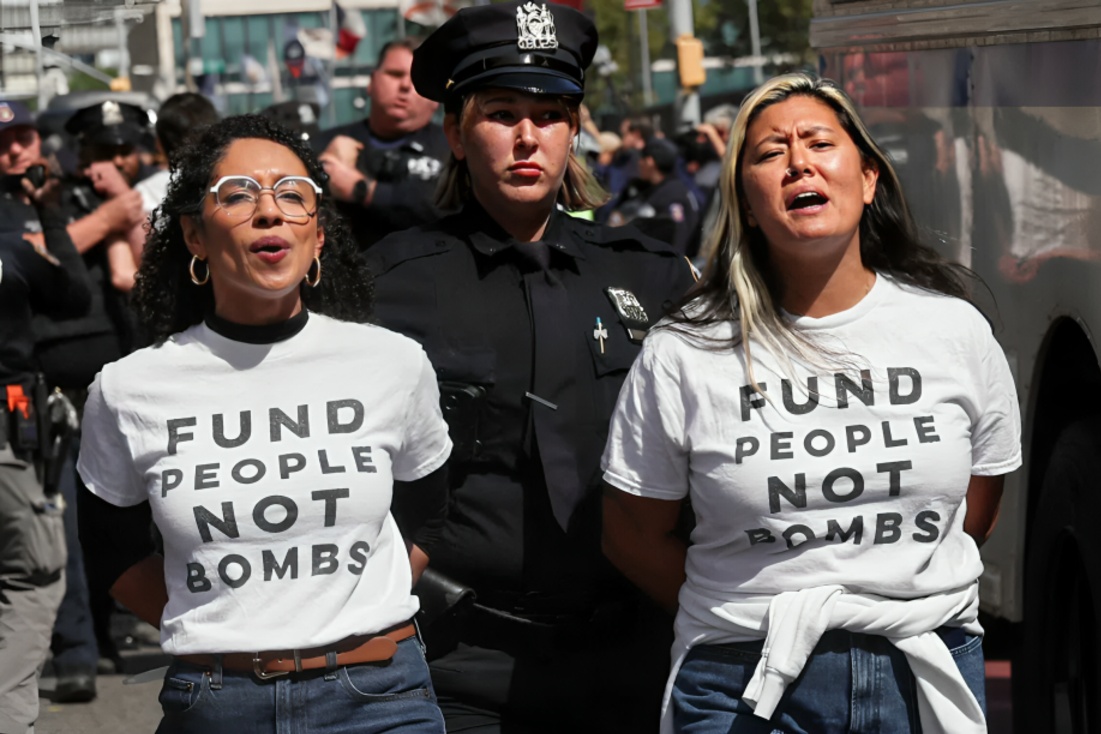
Protests took place in New York on September 24 as Israeli Prime Minister Benjamin Netanyahu travelled to the United Nations to address the General Assembly. Demonstrators gathered outside the UN headquarters to protest Israel’s military operations in Gaza and US support for Israel.
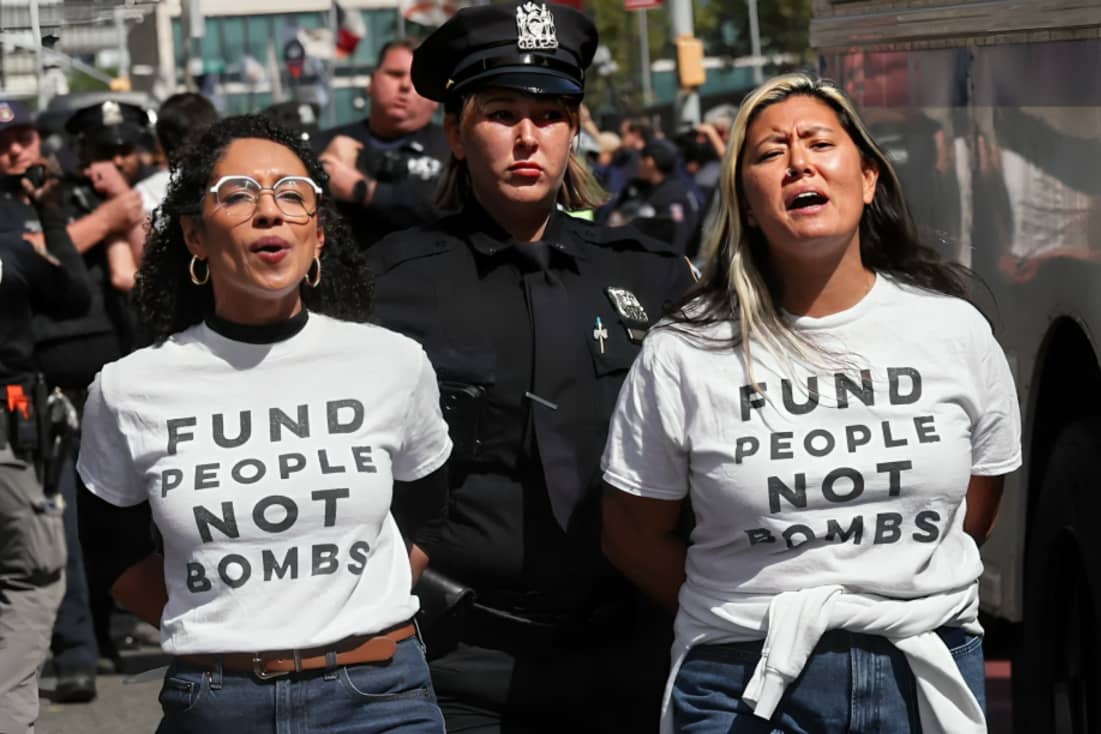
The demonstration was organised by Jewish Voice for Peace, a Jewish advocacy organisation that supports Palestinian rights. Around 200 people gathered near the United Nations, according to Reuters. Protesters wore matching white shirts carrying messages including calls to fund humanitarian needs rather than weapons and to support Palestinian freedom.
New York police moved to clear the demonstration after protesters blocked traffic near the United Nations. Police officers used loudspeakers to instruct the demonstrators to leave the roadway. While some protesters moved to the sidewalks, others remained seated in the street and continued their demonstration.
Reuters reported that at least 30 people were arrested during the protest. Among those taken into custody were Oscar winning actor Susan Sarandon, Emmy winning actor Hannah Einbinder, Democratic congressional candidate Darializa Avila Chevalier and New York City Council member Chi Ossé.
The arrests occurred shortly before Netanyahu delivered his address to the United Nations General Assembly. The protest was part of a wider series of demonstrations in New York connected to Netanyahu’s visit and Israel’s military campaign in Gaza.
Later reports gave a significantly higher number of arrests. Al Jazeera, citing Reuters and the Associated Press, reported that about 100 protesters were arrested. The Times of Israel reported that organizers said 104 demonstrators were arrested. Because different sources reported different totals, the exact final number of arrests should be treated separately from the initial Reuters figure of at least 30.
Susan Sarandon was one of the most prominent public figures detained during the demonstration. The Oscar winning actor has previously spoken publicly about the Gaza conflict and Palestinian rights. Hannah Einbinder, another actor who participated in the protest, has also publicly expressed support for Palestinians.
Political figures were also among the protesters. Darializa Avila Chevalier, a Democratic congressional candidate, was arrested, as was New York City Council member Chi Ossé, according to Reuters. Their participation brought additional political attention to the demonstration.
The protest took place while Netanyahu was preparing to deliver his speech to the 81st United Nations General Assembly. Inside the UN chamber, dozens of delegates also walked out as Netanyahu began speaking. The walkout was separate from the street demonstration in New York but reflected wider international criticism of Israel’s policies.
Netanyahu used his UN address to defend Israel’s military actions and its security position. He rejected accusations against Israel concerning its conduct in Gaza and argued that Israel had a right to defend itself against armed groups and regional threats.
The demonstrations outside the UN reflected a different perspective. Protesters criticised Israel’s military campaign and called on the United States to stop providing weapons to Israel. Organisers and participants said they wanted to draw attention to civilian suffering in Gaza and oppose what they described as US support for Israeli military operations.
According to Reuters, the protest caused traffic disruptions around the United Nations. Demonstrators who remained in the roadway were eventually removed by police officers and taken to police buses. The protesters continued chanting as arrests were made.
The demonstration was one of several protests held in New York around Netanyahu’s UN visit. Other groups also organised events in Manhattan, including gatherings supporting Palestinian rights. The protests involved people from different backgrounds, including Jewish, Palestinian, Iranian and Lebanese communities, as well as activists and public figures.
The presence of Jewish activists at the protest was particularly notable. Jewish Voice for Peace has been critical of Israeli government policies and has organised demonstrations in the United States calling for Palestinian rights and changes to US policy towards Israel.
The protests also highlighted the continuing debate within the United States over military assistance to Israel. The US has been Israel’s major military and diplomatic ally for decades, and the issue of American arms supplies has become a major point of disagreement among political groups and civil society organisations during the Gaza conflict.
At the same time, supporters of Israel argue that the country has the right to protect its citizens from attacks by Hamas and other armed groups. Israel has maintained that its military campaign is directed against Hamas and other militant organisations rather than Palestinian civilians.
The Gaza conflict has resulted in widespread international criticism, with governments, international organisations and rights groups expressing concern about civilian casualties and humanitarian conditions. Israel has rejected allegations that it is deliberately targeting civilians and has defended its military operations as necessary for national security.
Netanyahu’s visit to New York therefore took place against a highly polarised international and domestic political backdrop. His appearance at the United Nations attracted both diplomatic opposition inside the General Assembly and street demonstrations outside the building.
The arrests also drew attention because of the participation of well known actors and political figures. Images of Susan Sarandon and Hannah Einbinder being taken into custody circulated widely following the demonstration, adding to public interest in the protest.
Police said protesters were instructed to leave the roadway before arrests were made. The reported arrests were connected to the demonstration and traffic obstruction rather than simply attendance at the protest. This distinction is important when describing the events, as not every person who participated in the demonstration was necessarily arrested.
The differing arrest figures reported by news organisations also demonstrate why the final number should be presented carefully. Reuters initially reported at least 30 arrests, while later reports cited approximately 100 or 104 arrests based on additional information and statements from organisers.
The New York protests came at a time when Netanyahu was facing growing international criticism over Israel’s conduct in Gaza. His UN appearance provided an opportunity for the Israeli government to present its position directly to the international community, while protesters sought to use the same occasion to highlight Palestinian concerns.
The events outside the United Nations and the walkout inside the General Assembly demonstrated the continuing disagreement over the Gaza conflict. They also showed how Netanyahu’s international appearances have become occasions for both diplomatic debate and public demonstrations.
For readers, it is important to distinguish between the protesters’ political claims, the Israeli government’s position and independently reported facts. The exact number of arrests may also change as authorities release additional information.
As of September 25, reports confirm that multiple protesters, including actors and political figures, were taken into custody during the demonstration outside the United Nations. The protest formed part of wider demonstrations against Netanyahu and Israel’s Gaza policy during his visit to New York.