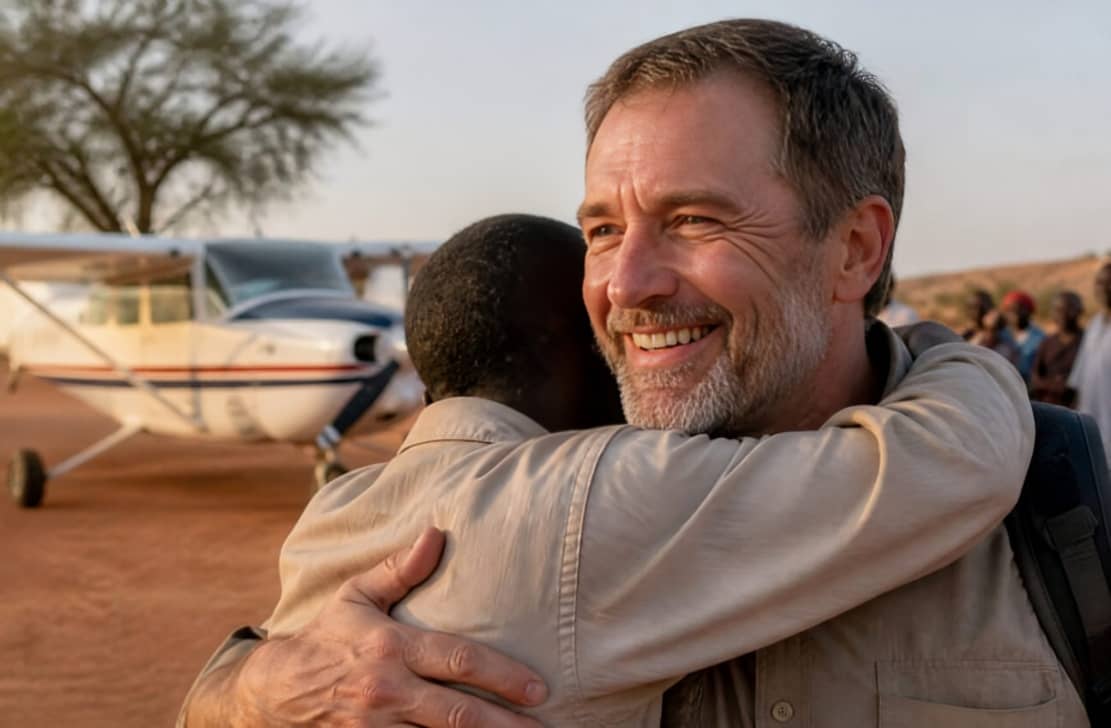
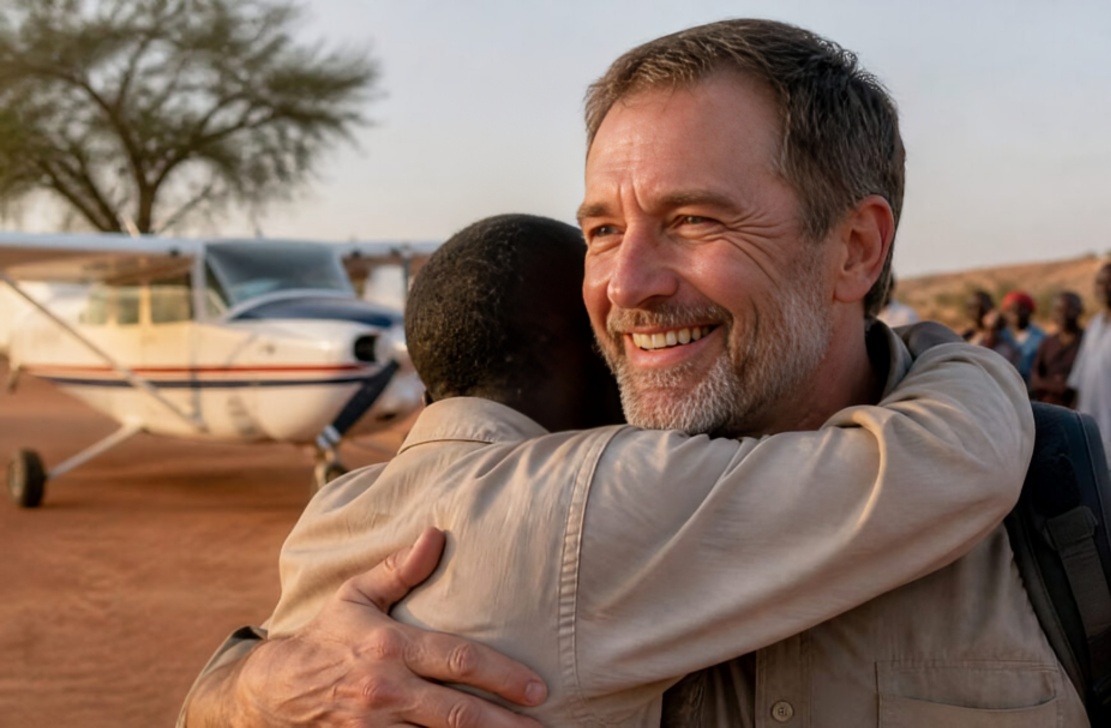
American missionary pilot Kevin Rideout has been released after spending more than nine months in captivity following his abduction in Niger in October 2025. His release has brought an end to a prolonged hostage ordeal and paved the way for his return to the United States.
Serving In Mission International, the evangelical organisation with which Rideout worked, confirmed his release and said he was in good health and under the care of US officials. The organisation also said he would be reunited with his wife, Krista, his children and his extended family.
Rideout was abducted on October 21, 2025, outside his home in Niamey, the capital of Niger. According to information released at the time, three armed men were involved in the kidnapping. He was reportedly taken away from the city after the abduction.
No armed group publicly claimed responsibility for the kidnapping. However, subsequent reports indicated that Rideout may have been transferred across the border into Mali, where several militant organisations operate.
The circumstances surrounding his release have not been fully disclosed. Different reports have pointed to possible involvement by authorities in eastern Libya, while other accounts have suggested that negotiations or a military operation may have played a role. US officials have not publicly provided a detailed account of how Rideout was freed.
Rideout's release was announced by his organisation on August 14, 2026. The announcement said he was in good health and receiving care from US officials.
US President Donald Trump subsequently confirmed that Rideout was back in US custody. Trump said the former hostage was preparing to fly home after being reunited with his wife.
Trump also described Rideout's release as the 110th captive American liberated since the beginning of his second presidential term. He said he expected to meet Rideout and his wife at the White House after their return to the United States.
The release represents a significant development for Rideout's family, who had spent months waiting for information about his safety and eventual return.
Rideout worked as a missionary pilot for Serving In Mission International, commonly known as SIM International. His work involved aviation services connected with the organisation's activities in Niger.
The kidnapping occurred against the backdrop of growing insecurity across the Sahel region of West Africa. Niger, Mali and Burkina Faso have experienced repeated attacks by armed groups linked to al Qaeda and the Islamic State.
Niger has faced particularly serious security challenges since a military coup in 2023. The change in government resulted in the withdrawal of several Western military partnerships and a significant change in the country's foreign and security relationships.
The security situation has remained volatile, with militant groups continuing to operate across large areas of the Sahel.
The US Embassy in Niamey issued a security warning following Rideout's abduction, stating that American citizens faced a heightened risk of kidnapping in Niger, including in the capital.
The kidnapping also demonstrated the difficulties involved in securing the release of foreign nationals in areas where multiple armed groups operate.
According to reports, Rideout may have been moved from Niger into Mali following his abduction. The exact chain of custody during his captivity remains unclear.
Reuters reported that authorities in eastern Libya may have played a role in securing his release. The report said sources provided conflicting accounts about whether the release involved a negotiated arrangement or a military operation.
Rideout himself reportedly expressed gratitude to Libyan forces after his release. In a video circulated by regional media, he said he was free and in good health and thanked those involved in securing his release and arranging his transfer to safety.
Despite those accounts, many details remain unclear. There has been no complete public explanation of the negotiations, the identity of the people who held Rideout or the precise circumstances that resulted in his release.
The US government had treated Rideout's case as a priority. His abduction occurred at a time when Washington was reassessing its security strategy in the Sahel following the withdrawal of US forces from Niger.
Niger had previously hosted US military personnel and facilities used for counterterrorism operations. Relations changed significantly after the 2023 military takeover.
The country subsequently moved closer to Russia and reduced its military cooperation with Western governments.
The wider security environment has also deteriorated in parts of the region. Armed groups associated with Islamic State and al Qaeda have expanded their operations and have increasingly targeted urban areas as well as remote regions.
Rideout's kidnapping in Niamey was therefore notable because it occurred in the capital rather than in an isolated rural area.
His release is likely to draw further attention to the security risks faced by foreign workers, aid personnel and missionaries operating in the Sahel.
For Rideout's family, however, the primary significance of the development is his safe return.
SIM International said the family was deeply grateful for the prayers and support offered during his captivity. The organisation also requested privacy as Rideout reconnects with his family after the long separation.
Rideout's captivity lasted from October 21, 2025, until his release in August 2026. That period of more than nine months represents a prolonged hostage situation and posed considerable uncertainty for his family and colleagues.
The organisation did not initially provide detailed information about his captivity because of the sensitivity of the situation.
This is common in hostage cases, where public disclosure of information can potentially affect negotiations or the safety of the captive.
The lack of information meant that Rideout's family and supporters had to wait for official confirmation before receiving details about his condition.
The eventual confirmation that he was in good health provided significant relief.
The case also highlights the continuing challenges facing the US government when American citizens are abducted in countries experiencing political instability and militant violence.
Hostage recovery operations can involve diplomatic negotiations, intelligence gathering, cooperation with foreign governments and, in some cases, specialised military or security operations.
In Rideout's case, the exact combination of efforts that resulted in his release has not been publicly established.
The reported involvement of eastern Libyan authorities has added a regional dimension to the case. Libya itself remains politically divided, with competing authorities and military forces exercising influence over different parts of the country.
The reported role of forces associated with eastern Libya demonstrates the complicated network of regional actors involved in security issues across North and West Africa.
Rideout's release also comes as governments across the Sahel continue to struggle with militant violence.
Niger, Mali and Burkina Faso have formed closer security ties with each other while reducing cooperation with several Western governments. At the same time, militant organisations have continued to exploit weak state control and difficult terrain.
For international organisations working in the region, the security environment has made operations increasingly difficult.
Missionary organisations and humanitarian groups often work in areas where government services are limited and local communities have significant needs. However, such organisations can also become targets for kidnapping because foreign nationals may be viewed as valuable hostages.
Rideout's case demonstrates the risks associated with such work.
Despite the dangers, SIM International has continued to operate through its network of staff and volunteers. The organisation's statement following Rideout's release focused on gratitude for his safe return and the support received during the ordeal.
The release also provides an opportunity for renewed attention to the safety of foreign nationals in Niger and neighbouring countries.
US citizens travelling or working in Niger continue to face significant security risks, including the possibility of kidnapping.
The US government has previously warned citizens against travelling to Niger because of terrorism, kidnapping, crime and other security concerns.
The broader security situation remains uncertain, particularly as militant groups continue to operate across national borders.
For Rideout, the immediate priority is his return home and reunification with his family.
Trump's announcement that he expects to meet Rideout and his wife at the White House suggests that the case will also receive political attention in Washington.
The president's description of Rideout as the 110th captive American liberated during his second term places the release within the administration's broader focus on recovering Americans held overseas.
However, the circumstances of Rideout's release remain subject to further clarification.
While several reports have described possible involvement by Libyan forces and militant groups operating in Mali, no definitive public account has yet explained exactly how the captivity ended.
Authorities may eventually provide additional information about the operation or negotiations once security considerations allow.
For now, the most significant confirmed development is that Rideout has been released and is in US custody.
His organisation has confirmed that he is in good health, while the US president has said he is preparing to return home.
The case has also highlighted the continuing instability across the Sahel and the dangers faced by foreign nationals working in the region.
After more than nine months apart, Rideout's return is expected to allow him to reunite fully with his wife, children and extended family.
Overall, Kevin Rideout's release marks the end of a long captivity that began with his abduction in Niamey in October 2025. The American missionary pilot is now in US care and preparing to return home, while questions about his captors, the negotiations and the precise circumstances of his release remain unanswered