

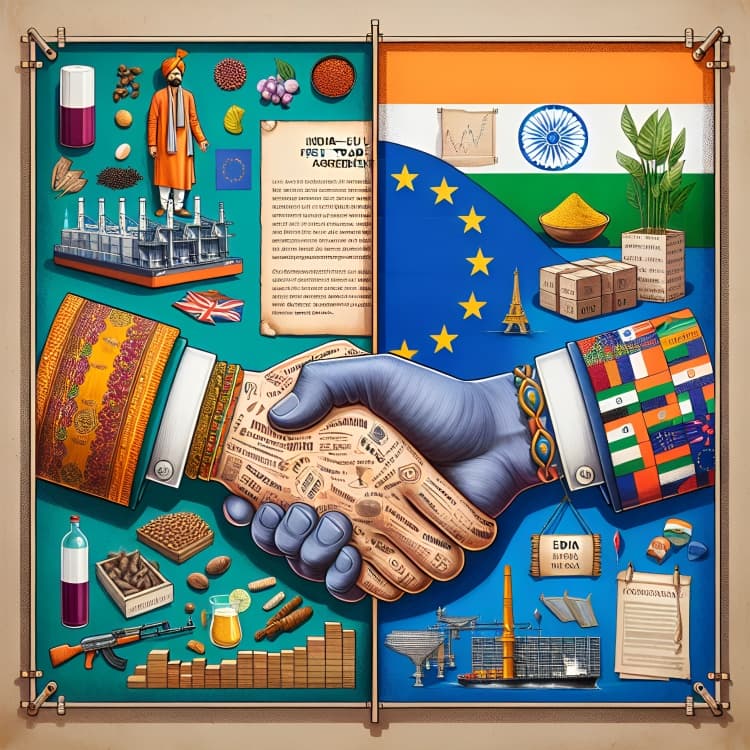
The European Union has underscored concerns over global trade uncertainty, economic coercion, and security risks in the context of its newly announced Free Trade Agreement with India. Speaking shortly after the deal was unveiled, EU High Representative for Foreign Affairs and Security Policy Kaja Kallas addressed the broader geopolitical realities influencing the agreement, without explicitly naming any country.
Speaking at an event hosted by the Ananta Centre, Kallas noted that the global multilateral order is facing pressure from powerful nations seeking to reshape international rules. She remarked that certain superpowers tend to overestimate their own strength while underestimating the importance of cooperation with others. Although she avoided direct references, her comments were widely interpreted as pointing to ongoing trade tensions and strategic challenges involving China.
Tariffs emerged as a central theme in her remarks. Kallas said tariff uncertainty has become a defining feature of international relations, creating confusion and instability for governments and businesses alike. She stressed that tariff-related disputes should be addressed through respectful and balanced dialogue, rather than unilateral actions. According to her, a fair approach requires that rights and obligations apply equally to all parties involved.
She also referred to instances of economic coercion, including pressure linked to China, noting that such practices undermine trust and stability in global trade. Kallas contrasted this with the European Union’s approach, describing the EU as a predictable partner that values consistency, transparency, and long-term confidence building.
Climate change was another area where she drew distinctions between global actors. Kallas suggested that while some powerful countries tend to disregard climate concerns when it suits their interests, the EU remains committed to its climate objectives and integrates sustainability into its economic and trade policies.
A key takeaway from her address was the emphasis on economic security. Kallas highlighted the importance of identifying reliable partners in an increasingly uncertain global environment. She stated that the EU is actively pursuing diversification strategies to avoid overdependence on any single country or supply chain. This approach, she explained, is central to safeguarding economic resilience and strategic autonomy.
The India-EU Free Trade Agreement fits into this broader strategy. The deal aims to strengthen trade, investment, and cooperation between the two sides while reducing vulnerability to external shocks. By deepening ties with India, the EU seeks to build a partnership based on shared democratic values, mutual trust, and long-term stability.
Analysts note that Kallas’s remarks reflect a growing alignment between India and the EU on issues of trade diversification, economic resilience, and rules-based global order. While geopolitical tensions continue to shape international relations, both sides appear keen to position their partnership as a counterbalance to uncertainty driven by global power competition.
The India-EU FTA is expected to evolve further in the coming years, with cooperation extending beyond trade into areas such as technology, climate action, and security. Kallas’s comments underline that the agreement is not merely commercial, but also strategic in nature.


