
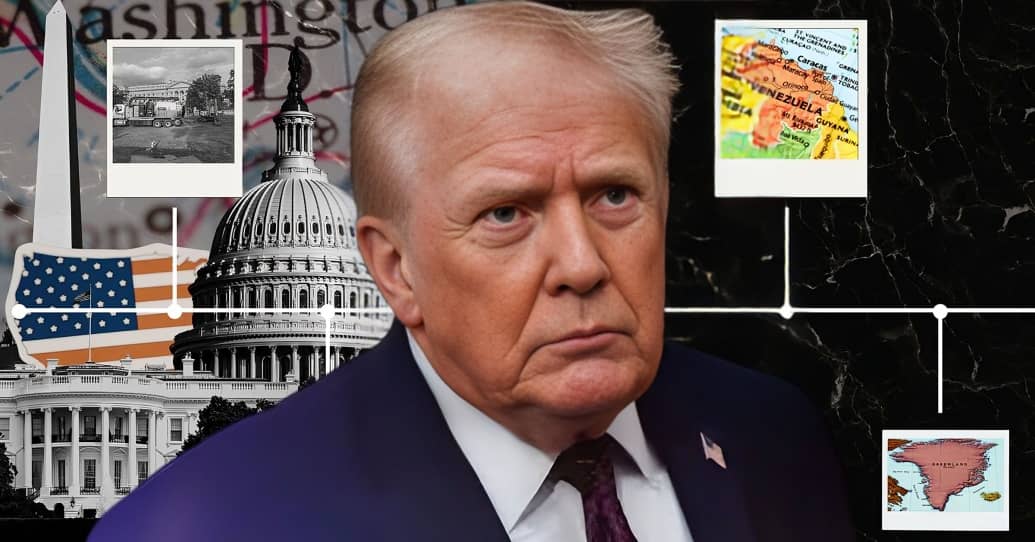
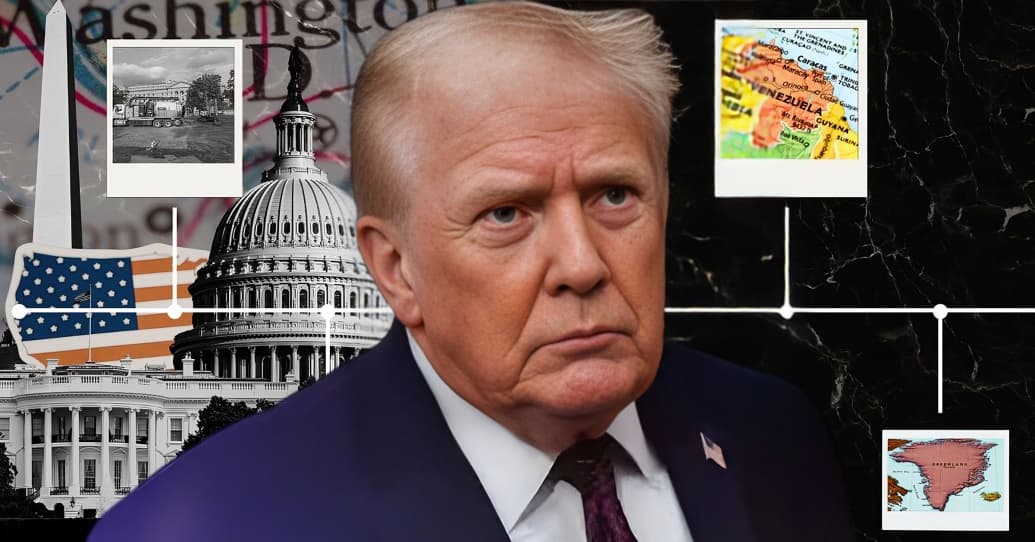
US President Donald Trump has stirred international controversy by sharing a set of heavily altered images on his social media platform, Truth Social, depicting Greenland and other regions as part of the United States. One of the posts shows Trump alongside Vice President JD Vance and Secretary of State Marco Rubio planting a US flag in Greenland next to a sign that reads “GREENLAND – US TERRITORY EST. 2026.” Another image places Trump in the Oval Office with senior European leaders and a map behind him that shows Greenland, Canada, and Venezuela under the US flag, a depiction widely understood as symbolic rather than official.
Trump has repeatedly stated that Greenland, an autonomous territory under Danish sovereignty, is strategically important for US national and global security. In his social media post accompanying the images, he claimed that Greenland must remain within American influence and suggested there can be “no going back” on this position. He also mentioned a recent telephone conversation with NATO Secretary General Mark Rutte about the island’s future.
The timing and tone of these posts have drawn sharp reactions globally. The controversial imagery was shared just before the World Economic Forum in Davos, where Trump’s push regarding Greenland has been a key point of diplomatic friction. European leaders depicted in the altered Oval Office image include French President Emmanuel Macron, UK Prime Minister Keir Starmer, Italian Prime Minister Giorgia Meloni, and President of the European Commission Ursula von der Leyen. The use of such imagery appears intended to challenge or mock these allies amid ongoing disagreements, particularly over Trump’s demands related to Greenland.
The reactions from affected nations have been firm. Greenland’s political leaders have strongly reiterated that the territory is not for sale and remains committed to Denmark and its existing international ties. Denmark itself has emphasized that its sovereign control over Greenland is non-negotiable. The notion of territorial acquisition, even symbolically, has been met with concern from European capitals, highlighting the sensitivity of Arctic geopolitics.
Trump’s statements are not isolated. Over the past year, he has tied his Greenland stance to broader national security arguments, suggesting that foreign powers like Russia or China might seek influence there if the US does not assert its interests. These arguments point to Greenland’s strategic position in the Arctic and its natural resources. However, critics argue that the rhetoric and imagery cross conventional diplomatic boundaries and risk eroding trust among long-standing allies.
While the images shared by Trump are AI-generated or heavily manipulated and do not reflect official US policy changes, their dissemination has intensified global discourse about US intentions and the future of international alliances. They also underscore the evolving nature of geopolitical communication in the digital era, where symbolic content can rapidly amplify diplomatic tensions.
In summary, President Trump’s social media posts depicting Greenland and other regions as US territories have triggered diplomatic pushback and renewed debate over Arctic sovereignty, allied cooperation, and the role of symbolic imagery in international relations. The reactions from European leaders and Greenland officials suggest the issue will remain a topic of discussion at diplomatic forums in the coming weeks.


