Ranabaali Movie Review: Vijay Deverakonda’s Period Action Drama Has a Powerful Premise but Uneven Execution
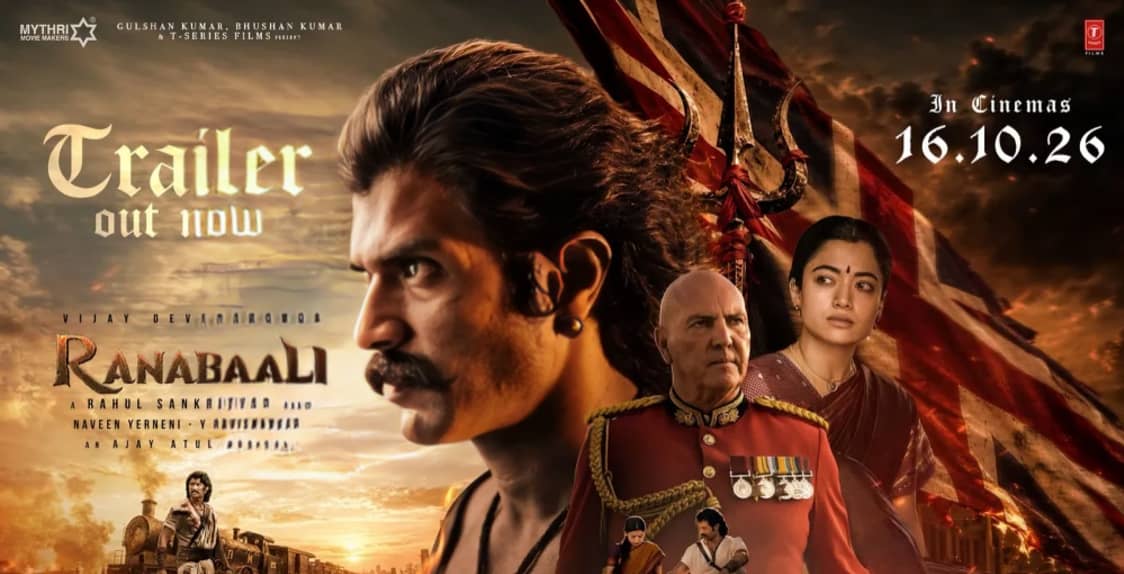
Vijay Deverakonda returns to the big screen with Ranabaali, a Telugu period action drama directed by Rahul Sankrityan. Set against the backdrop of the devastating Madras Famine of 1876–1878, the film follows a warrior who challenges British colonial authority to protect his people and their land. The story combines historical suffering, resistance, romance and large-scale action.
Rashmika Mandanna plays Jayamma, Ranabaali’s wife, while Hollywood actor Arnold Vosloo appears as Sir Theodore Hector, a British commissioner who represents the colonial administration. The film was released in theatres on October 16, 2026.
Early reviews have been mixed. Critics have recognised the ambition of the historical setting, the performances of the lead actors and the scale of the production. However, concerns about the screenplay, slow narration, repetitive sequences and excessive violence have affected the film’s overall impact.
Story: A warrior rises against British rule
The film centres on Singanamala Bobbili Ranabaali, played by Vijay Deverakonda. Presented as a respected and fearless figure, Ranabaali lives in a region facing severe hardship under British colonial rule. As the effects of famine and exploitation become increasingly devastating, he decides to resist the powerful administration and defend his people.
The story draws inspiration from the Madras Famine of 1876–1878, one of the most devastating famines in colonial Indian history. The crisis affected large parts of southern India and caused widespread suffering and loss of life. By placing its central character within this historical setting, the film attempts to connect an individual’s rebellion with the struggles of ordinary people.
Ranabaali’s principal adversary is Sir Theodore Hector, portrayed by Arnold Vosloo. Their conflict forms the backbone of the action drama, with the warrior’s determination to protect his community bringing him into direct confrontation with the colonial authorities.
Although the historical backdrop gives the film a strong foundation, the execution does not always match the importance of its subject. Reviews have pointed to repetitive storytelling and a lack of emotional depth in some sections, limiting the impact of a narrative that could have explored colonial oppression and human suffering more effectively.
The film should also be understood as historical fiction rather than a complete documentary account of the famine. Its central characters and dramatic confrontations serve the narrative, while the historical setting provides context for the story of resistance.
Vijay Deverakonda’s performance
Vijay Deverakonda takes on a larger-than-life role as Ranabaali. The character requires him to portray a warrior whose physical strength, determination and anger are central to his opposition to British rule.
His screen presence and commitment to the role have been recognised in several early reviews. The character also offers the actor an opportunity to move into a period-action setting, with elaborate confrontations and dramatic speeches replacing the contemporary settings of many of his earlier films.
However, the effectiveness of a larger-than-life hero depends on more than action sequences. The audience also needs to understand the character’s motivations, emotional conflicts and relationships. Some reviews have argued that Ranabaali relies too heavily on aggression and spectacle, leaving insufficient room for deeper character development.
The result is a performance that has moments of intensity but is not always supported by equally strong writing. The film’s central idea remains compelling, although its storytelling could have created a stronger emotional connection between the warrior and the people he is fighting to protect.
Rashmika Mandanna and the relationship with Jayamma
One of the more engaging aspects of Ranabaali is the relationship between Ranabaali and Jayamma, played by Rashmika Mandanna. Their romance provides a personal dimension to a story otherwise dominated by political conflict, suffering and violence.
Jayamma is not simply a character who appears alongside the hero. Her support for Ranabaali and her response to his flaws help establish an emotional foundation for their relationship. Their scenes offer moments of warmth and intimacy that contrast with the film’s harsher sequences.
The chemistry between Deverakonda and Mandanna has been highlighted as one of the film’s strengths. Their interactions help maintain audience interest, particularly when the broader narrative becomes slow or repetitive.
The relationship also gives the story an opportunity to explore what resistance means for people beyond the battlefield. A warrior’s decisions affect his family and community, and the emotional consequences of those decisions could have been a stronger focus throughout the film.
Despite these strengths, the film’s action-heavy approach sometimes overshadows its quieter moments. A more balanced screenplay could have given Jayamma greater space within the larger conflict and strengthened the emotional stakes of the story.
Historical setting and the portrayal of colonial oppression
The Madras Famine of 1876–1878 provides Ranabaali with a serious historical foundation. The famine affected extensive areas of southern India during British rule and was associated with widespread hunger, displacement and mortality. The period remains an important subject in discussions about colonial administration, relief policies and the vulnerability of rural communities.
The film uses this background to portray the suffering of ordinary people and the emergence of resistance against an oppressive authority. Its central message concerns the need to protect a community when those in power fail to safeguard its welfare.
This approach gives the film a clear emotional and political direction. However, historical dramas must balance dramatic storytelling with credible characterisation and a convincing representation of the period.
Some reviews have found that Ranabaali conveys the seriousness of its subject but does not always develop its themes with sufficient subtlety. The focus on bloody confrontations and stylised violence can overshadow the famine itself and the experiences of the people affected by it.
A greater emphasis on the daily realities of famine, the decisions facing local communities and the human cost of colonial policies could have added depth to the film’s central conflict.
Action, music and technical aspects
Ranabaali is designed as a large-scale period action drama, with production design and battle sequences intended to establish the atmosphere of nineteenth-century southern India. Its visual scale and selected action moments have received appreciation from reviewers.
However, the film’s pacing has emerged as a recurring concern. Some critics have found the narration slow in places, while others have pointed to repetitive scenes that reduce the impact of later developments. The second half, in particular, has received criticism for failing to maintain the engagement established earlier.
The background score has also drawn mixed responses. Music and sound design can strengthen a historical action film by adding tension to confrontations and emotional weight to personal scenes. When the score becomes too prominent, however, it can distract from the performances and dialogue.
The film’s emphasis on violence is another point of disagreement. While intense action may suit a story about colonial resistance, repeated graphic confrontations can become exhausting if they are not balanced by meaningful narrative progression.
These concerns suggest that tighter editing and a more consistent focus on the characters could have improved the overall experience.
Final verdict
Ranabaali attempts to combine a painful chapter of Indian history with the story of a warrior who stands against British colonial rule. Vijay Deverakonda’s screen presence, his chemistry with Rashmika Mandanna and the film’s ambitious period setting provide its strongest elements.
Nevertheless, the film has received criticism for its uneven pacing, repetitive storytelling and reliance on violence. Its historical premise offers considerable potential, but the narrative does not always translate that potential into a consistently engaging experience.
For viewers interested in period action dramas, colonial-era stories and large-scale confrontations, Ranabaali may offer moments of interest. Those looking for a carefully layered historical drama with sustained emotional depth may find its execution less satisfying.
Overall, Ranabaali is an ambitious attempt to bring a story of resistance and survival to the screen, but its strong central idea is only partly realised in the finished film.