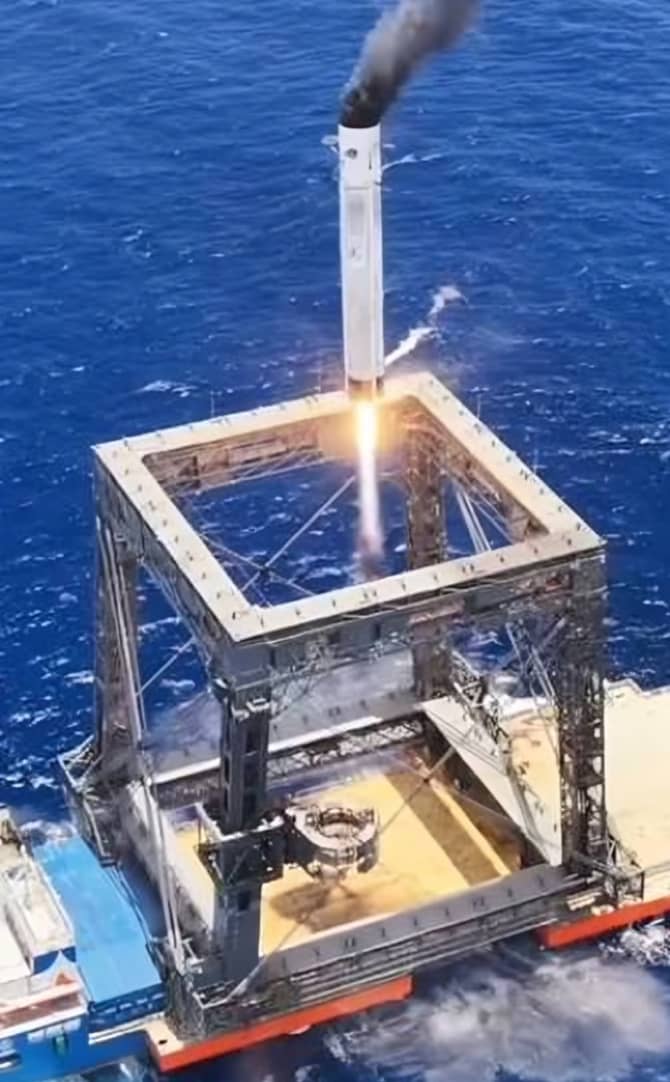

China has achieved a significant milestone in its space program by successfully recovering the reusable booster of its Long March 10B rocket following its maiden flight. The accomplishment represents an important step in the country's efforts to develop reusable launch systems and strengthen its position in the rapidly evolving global space industry.
According to official reports, the Long March 10B rocket was launched successfully, and its first-stage booster separated from the main vehicle as planned. Shortly after separation, the booster performed a controlled descent and landed safely on a designated recovery platform. The successful recovery demonstrates China's growing capability in reusable rocket technology, which is considered one of the most important developments in modern space exploration.
Reusable rocket technology has transformed the global space industry by significantly reducing the cost of launching satellites, scientific missions, and future human spaceflight. Instead of being discarded after a single mission, reusable boosters can be refurbished and flown multiple times, lowering operational expenses and increasing the frequency of launches.
For many years, the United States has led this field through companies such as SpaceX and Blue Origin. SpaceX has routinely recovered and reused Falcon 9 rocket boosters for commercial, government, and scientific missions, while Blue Origin has also demonstrated reusable launch capabilities through its New Shepard rocket. China's latest success indicates that it is making substantial progress toward developing similar capabilities for its own space program.
The Long March rocket family has served as the backbone of China's space missions for decades. These launch vehicles have been used to deploy satellites, transport cargo to China's space station, and support lunar and planetary exploration missions. The addition of reusable technology is expected to enhance the efficiency and sustainability of future launches.
Chinese space authorities have been investing heavily in advanced launch systems as part of the country's long-term space strategy. The development of reusable rockets aligns with China's broader goals of expanding satellite deployment, supporting human spaceflight, conducting lunar exploration, and preparing for future missions to Mars and other deep-space destinations.
Experts believe that reusable launch systems will become increasingly important as global demand for satellite launches continues to grow. Lower launch costs could encourage more commercial space companies, research organizations, and governments to undertake space missions that were previously considered too expensive.
The successful booster recovery also highlights the growing competition among major space powers. Alongside the United States, countries including China are investing in technologies designed to improve launch efficiency, increase mission reliability, and support long-term exploration beyond Earth's orbit.
Industry analysts note that although China's achievement represents a major technological step, the country will need to demonstrate consistent booster recovery, refurbishment, and repeated reuse before matching the operational experience of established reusable rocket operators. Reusability involves not only successful landings but also the ability to prepare recovered boosters for multiple future missions safely and economically.
China's space program has expanded rapidly over the past decade through achievements including the construction of the Tiangong Space Station, successful lunar sample-return missions, Mars exploration, and the continued development of heavy-lift launch vehicles. The successful recovery of the Long March 10B booster further strengthens China's ambitions to become one of the world's leading space powers.
The achievement is expected to support future commercial launches, scientific research missions, and international cooperation while contributing to the advancement of reusable launch technology across the global space sector.