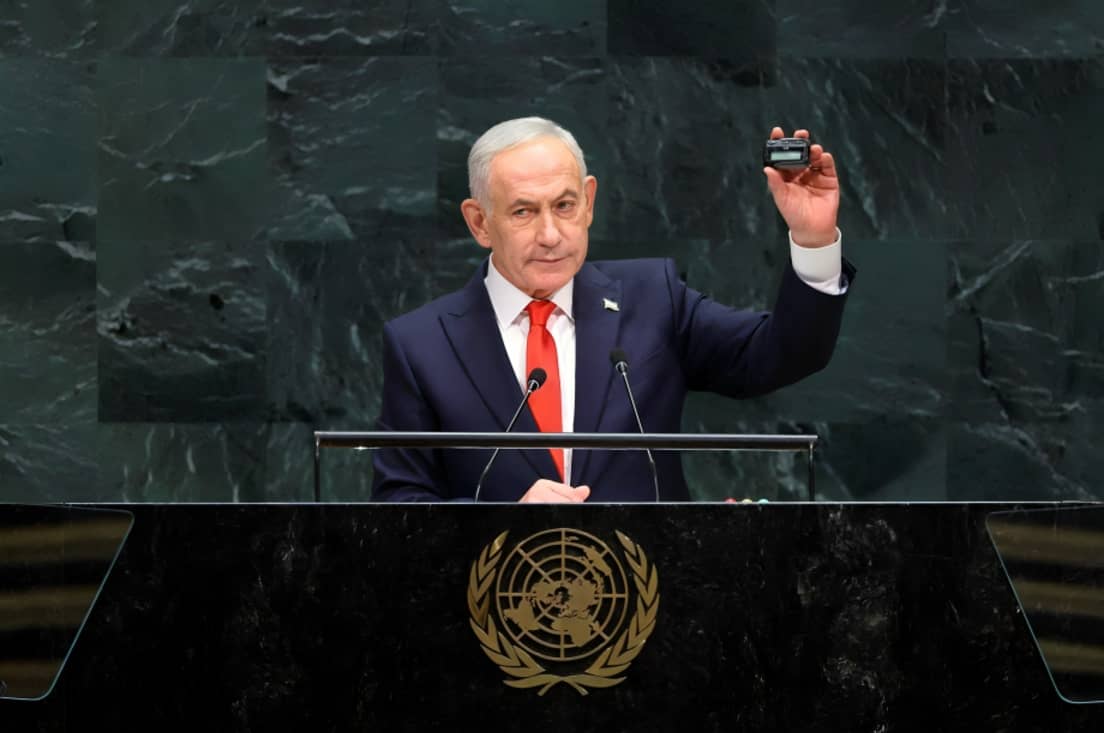

Israeli Prime Minister Benjamin Netanyahu faced a large diplomatic walkout and street protests during his address to the United Nations General Assembly in New York on September 24. The speech came amid continuing international disagreement over Israel’s military operations in Gaza, its actions in the wider Middle East and the future of the Israeli Palestinian conflict.
As Netanyahu entered the General Assembly chamber, dozens of delegations left their seats. The walkout resulted in large sections of the chamber becoming empty as he began speaking. Reports said the action was linked to opposition to the Israeli government’s policies and its conduct during the Gaza conflict.
Netanyahu responded strongly to the walkout. He criticised the departing delegates and said Israel would continue defending itself. He also rejected allegations that Israel had committed genocide in Gaza, saying that Israel’s military actions were intended to protect the country.
The Israeli prime minister used much of his speech to defend his government’s approach to security. He described Israel as facing threats from several directions and argued that the country’s military operations were necessary to prevent attacks against its population.
Iran was another major focus of Netanyahu’s address. He said that political change would eventually occur in Iran and addressed the Iranian people directly. He argued that the Iranian government would ultimately face pressure from its own population. The comments came after Israeli and US military operations against Iranian targets earlier in 2026.
Netanyahu also defended the decision to carry out military action against Iran. He described the decision to attack Iranian targets as one of the easiest decisions he had made as prime minister. His remarks reflected Israel’s stated concerns over Iran’s nuclear programme and regional military activities.
A notable moment during the speech came when Netanyahu displayed a pager to the General Assembly. The device was presented as a reference to the pager attacks in Lebanon in September 2024, when thousands of communication devices used by members of Hezbollah were remotely detonated. The attacks killed and injured people across Lebanon and were widely attributed to Israel, although Israel did not immediately publicly acknowledge responsibility at the time.
Netanyahu used the pager as part of his argument about Israel’s military capabilities and its campaign against armed groups supported by Iran. Hezbollah is a Lebanese armed and political organisation that has close ties with Iran and has fought several conflicts with Israel.
The Israeli leader also referred to Israel’s relationship with the United States. He praised US support and argued that cooperation between the two countries was important for Israel’s security. Netanyahu has repeatedly described the US as Israel’s most important international ally.
The UN speech took place against a backdrop of growing criticism of Israel’s military campaign in Gaza. Palestinian representatives and several governments have accused Israel of serious violations of international law. Israel rejects allegations of genocide and war crimes and says its military operations are directed against Hamas and other armed groups.
Outside the United Nations headquarters, hundreds of demonstrators gathered to protest Netanyahu’s visit and Israel’s policies. Demonstrators included Palestinian supporters, human rights activists and Jewish groups critical of the Israeli government. Some protesters called for an end to US arms supplies to Israel and demanded a ceasefire and greater protection for Palestinian civilians.
Police detained protesters during demonstrations near the UN. Reports said protesters blocked traffic in some areas and chanted slogans calling for an end to military support for Israel. The demonstrations were separate from the diplomatic walkout inside the General Assembly.
The protests reflected the wider international debate over the Gaza war and the role of the United States in supporting Israel. Supporters of Israel have argued that the country has a right to defend itself against armed attacks, while critics have raised concerns about civilian casualties, humanitarian conditions and the scale of Israel’s military campaign.
Netanyahu also addressed criticism from New York Mayor Zohran Mamdani. The Israeli prime minister criticised Mamdani for his public opposition to Israel’s government and its military operations. Mamdani has previously criticised Netanyahu and has spoken in support of Palestinian rights.
The speech also included Netanyahu’s response to international criticism over Israeli settlements and violence involving Israeli settlers in the West Bank. Critics have accused the Israeli government of failing to do enough to prevent settler attacks against Palestinians. Netanyahu has rejected broader accusations against Israel and has emphasised the country’s security concerns.
The issue of Israeli settlements remains one of the most contentious aspects of the Israeli Palestinian conflict. Much of the international community considers Israeli settlements in the occupied West Bank and East Jerusalem to be contrary to international law, while Israel disputes aspects of that legal interpretation and maintains claims based on historical and security considerations.
The UN address also came at a politically important time for Netanyahu. Israel is preparing for parliamentary elections, and the prime minister has continued to face domestic political debates over the Gaza conflict, security policy and relations with the United States.
The walkout during the UN speech highlighted the gap between Israel and several governments over the Gaza war and regional security. At the same time, Netanyahu used the international platform to present Israel’s position and defend its military actions.
The Iranian portion of the speech demonstrated the wider regional dimension of the conflict. Israel considers Iran a major security threat because of its nuclear programme, missile capabilities and support for armed groups in the region. Iran has consistently rejected Israeli accusations and has maintained that its nuclear programme is intended for peaceful purposes.
The United States has also remained deeply involved in the regional conflict. Washington has provided military and diplomatic support to Israel while also participating in efforts to address the broader conflict and humanitarian situation.
Netanyahu’s appearance at the United Nations therefore became a focal point for several overlapping disputes involving Gaza, Iran, Israel’s relations with the United States, settlements and the wider Middle East security situation.
The mass walkout and protests demonstrated the depth of opposition to Netanyahu among some governments and civil society groups. However, the speech also gave the Israeli prime minister an international platform to explain his government’s position and defend Israel’s security policy.
The developments at the United Nations do not by themselves indicate any immediate change in the underlying conflicts. The Gaza war, disputes over Palestinian statehood, tensions between Israel and Iran and disagreements over settlements remain unresolved.
For readers, it is important to distinguish between statements made by Netanyahu, claims made by Palestinian representatives and protesters, and independently established facts. Israel rejects allegations of genocide and war crimes, while Palestinian representatives and critics continue to accuse Israel of serious violations. International legal proceedings and diplomatic discussions concerning these issues remain ongoing.